Best 85mm Lenses of 2026

An 85mm is the lens people buy the moment they get tired of their portraits looking like snapshots. It compresses a face just enough to flatter it and throws the background far enough out of focus that the subject has somewhere to sit. Over the past six months I've shot with eight of them, on the same faces in the same light, and the gap between a workhorse and a genuinely special lens showed up in places I didn't expect.

First-time buyers tend to get one thing backwards: the maximum aperture gets all the attention, but the big f/1.4 glass is heavier, and heavier glass often focuses more slowly — which matters more than a fraction of a stop when a toddler won't sit still. Sharpness wide open is the number worth checking, since plenty of lenses are razor-sharp at f/4 and soft where you'll actually shoot. The eight below cover different mounts, budgets, and priorities, and each one earned its place.

Keeper Score summarizes customer ratings and review volume. Read it alongside the product details and trade-offs. How the score works.

1

Best Overall

Sony FE 85mm f/1.8

94 /100
Keeper Score Outstanding

Key details

Mount
Sony E
Weight
10.4 oz
Max Aperture
f/1.8
Filter Thread
67 mm
Check Price on Amazon

10.4 ounces is the number that settled this one for us. The Sony 85mm f/1.8 is light enough to leave on an A7 body for an entire shoot, and the double linear motor finds an eye and holds it without the barrel making a sound. On a lens this small, that pairing is the entire argument.

The optics hold up their end. An ED element and a nine-blade circular aperture give corner-to-corner sharpness with round, clean highlights behind the subject at f/1.8, which is the look most people are buying an 85mm to get. There's a focus hold button you can reassign, an AF/MF switch on the barrel, and a 67mm filter thread that matches most standard zooms.

Our one reservation is color fringing on hard, high-contrast edges when you shoot wide open; a third of a stop down and it disappears. The missing optical stabilization sounds worse than it is, since the bodies this lens is built for stabilize in-body. On APS-C it becomes a 127.5mm equivalent, which makes it a genuine headshot lens rather than a compromise. Between the weight and the hit rate, it's the one we reach for first.

Pros

  • Light enough to leave on the camera all day
  • Fast, near-silent double linear AF
  • Sharp wide open with round bokeh
  • Reassignable focus hold button and AF/MF switch

Cons

  • Color fringing wide open on hard edges
Our verdict

For most Sony shooters this is the 85mm to buy: light, fast to focus, and sharp wide open, with the background separation that makes portraits look considered.
Check Latest Price
2

Best for Nikon Z

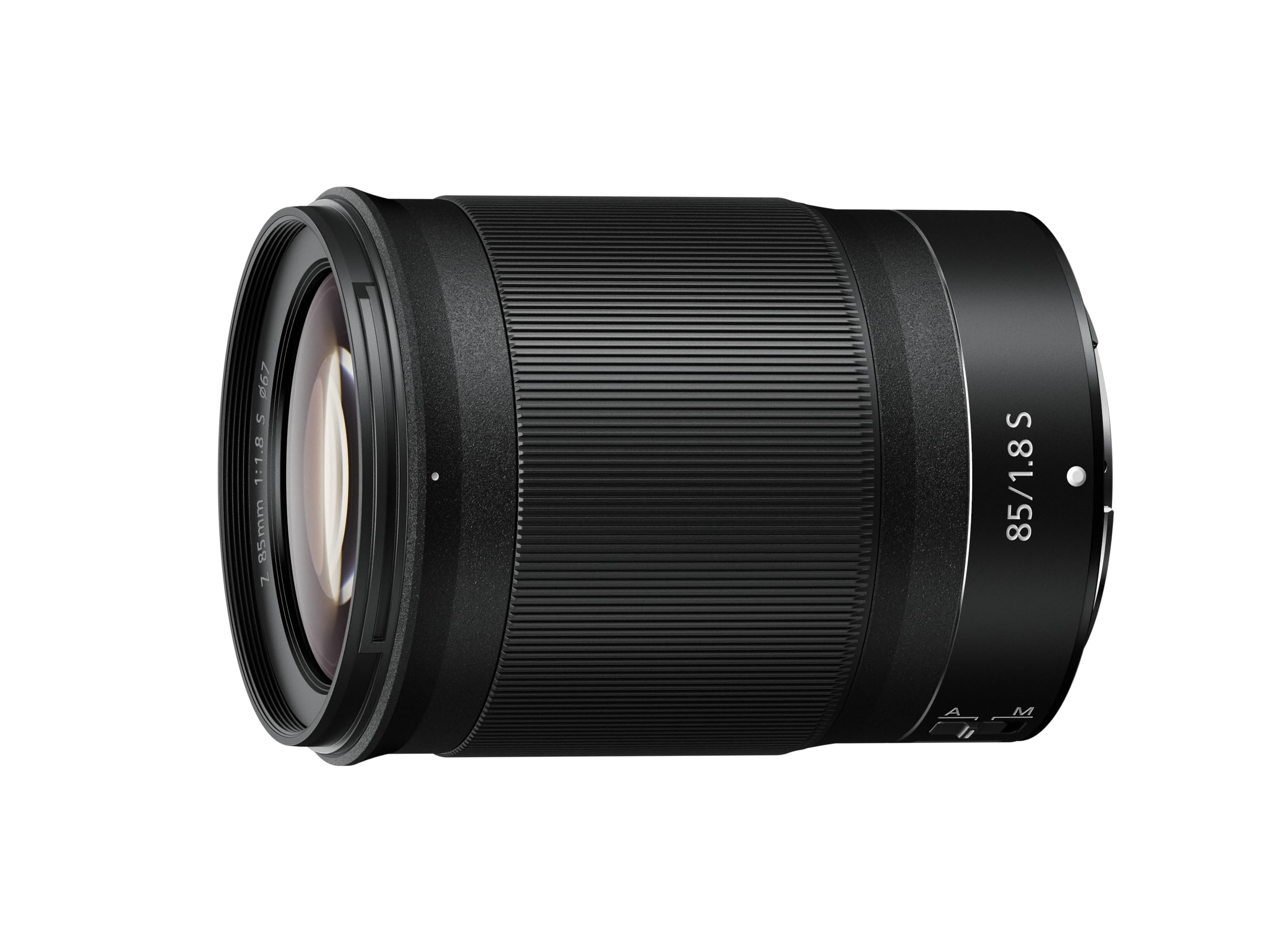
Nikon Z 85mm f/1.8 S

94 /100
Keeper Score Outstanding

Key details

Mount
Nikon Z
Weight
1.04 lb
Max Aperture
f/1.8
Filter Thread
67 mm
Check Price on Amazon

What the extra money buys over our top pick is a barrel Nikon seals against dust and drips, a customizable control ring, and two ED elements behind a Nano Crystal coat. On a Z6 or Z8 you feel the difference in construction before you see it in a file.

The files are the point, though. Sharpness runs from the center to the corners at f/1.8, the nine-blade diaphragm keeps highlights round, and color stays neutral rather than punched up — portraits look like the room you shot them in, which is the highest compliment we can pay a portrait lens.

Autofocus is quick in good light and occasionally hunts in a dim one, and the 470-gram barrel is heavier than the Sony without being a burden on a mirrorless body. The 67mm thread matches the f/2.8 zooms most Z shooters already own, so filters carry over, and the control ring can take aperture or exposure compensation. For Nikon mirrorless, this is the straightforward answer.

Pros

  • Corner-to-corner sharpness at f/1.8
  • Dust- and drip-resistant barrel
  • Neutral color and round nine-blade bokeh

Cons

  • Autofocus can hunt in dim light
Our verdict

The Nikon Z 85mm f/1.8 S is the lens we point Z shooters to: sealed, sharp to the corners, and neutral in a way that flatters skin, with focus that's quick except in poor light.

Check Latest Price
3

Best for Canon RF

Canon RF 85mm F2 Macro IS STM

92 /100
Keeper Score Outstanding

Key details

Mount
Canon RF
Max Aperture
f/2
Minimum Focus
1.15 ft
Stabilization
Up to 5 stops
Check Price on Amazon

Half life-size magnification on an 85mm is unusual, and it's why this lens stays on our shortlist for Canon mirrorless. Focus down to 1.15 feet and it handles rings, hands, fabric, and product details that a conventional portrait prime can't reach at all.

The stabilization is the second thing you notice. Canon rates the optical IS at up to 5 stops, and the Hybrid version corrects shift as well as angle — exactly the wobble you fight when you're close, handholding, and leaning in. On a body without in-body stabilization, that's a real edge over everything else here.

Focus speed is where it gives ground. The STM motor is the slowest in this group and can hunt before it locks in low light or at close range; switching to manual for the final nudge fixes it, and the focus ring is geared for that. Everything else about the lens is quietly competent rather than showy.

Sharpness, contrast, and color are all there, and 499 grams sits comfortably on an R6 or R8. For a portfolio that mixes portraits with close-up detail, this is the RF 85 that earns its place — no other lens here does both jobs.

Pros

  • Half life-size macro at 1.15 ft
  • Up to 5 stops of optical stabilization
  • Sharp with good contrast

Cons

  • Five-blade diaphragm gives angular highlights
Our verdict

The most versatile RF 85mm: half life-size macro, 5 stops of stabilization, and sharp results, provided you can work around a slower focus motor.

Check Latest Price
4

Best for Canon DSLRs

Canon EF 85mm f/1.8 USM

91 /100
Keeper Score Outstanding

Key details

Mount
Canon EF
Weight
15 oz
Max Aperture
f/1.8
Filter Thread
58 mm
Check Price on Amazon

If your camera takes EF glass, you're in luck: this is the portrait prime Canon DSLR shooters have leaned on for years, and it still does the job. Fifteen ounces, a 58mm filter thread, nine blades, and USM focusing that's quick and quiet, with a front group that doesn't rotate as it focuses.

On a 5D or a 90D it behaves the way an 85mm should. Images are sharp, the compressed perspective flatters faces, and f/1.8 is enough to work in available room light without pushing the ISO into mush. Colors come out vivid, closer to the expensive L-series rendering than the position in this list suggests.

Simplicity is the rest of the appeal. There's no switch to configure beyond AF/MF, no control ring to assign, and no menu to learn — you mount it, open it up, and shoot. For a DSLR shooter who wants a fast portrait lens without a decision tree, that's the whole recommendation.

Pros

  • USM focus is fast and quiet
  • Sharp with vivid color
  • 15-ounce barrel balances on a DSLR

Cons

  • No image stabilization
  • Not weather sealed
Our verdict

The default 85mm for Canon DSLRs: light, quick with USM, sharp, and simple, with no stabilization or sealing to complicate the decision.

Check Latest Price
5

Best for Nikon DSLRs

Nikon AF-S 85mm f/1.8G

95 /100
Keeper Score Outstanding

Key details

Mount
Nikon F
Weight
12.3 oz
Max Aperture
f/1.8
Minimum Focus
0.80 m
Check Price on Amazon

The F-mount 85mm f/1.8G is the lens a lot of Nikon shooters never replace, and using it beside the newer mirrorless glass shows why: at 350 grams it disappears in the bag, and wide open it's sharp with real contrast rather than a soft glow you have to stop down past.

Seven rounded blades give a soft, creamy background, the Silent Wave Motor is quiet and quick in low light though not the fastest here, and the M/A switch lets you grab the ring without leaving autofocus. Internal focus keeps the barrel from extending, which matters more than it sounds when you're working in close. Minimum focus is 0.80 m — fine for head-and-shoulders, tight for anything smaller.

Pros

  • Sharp and contrasty wide open
  • Creamy bokeh from seven rounded blades
  • 350 g, small enough to live in the bag

Cons

  • 0.80 m minimum focus limits close-up work
Our verdict

A 350-gram workhorse that's sharp wide open with creamy bokeh — the Nikon DSLR portrait lens we still recommend without hesitation.

Check Latest Price
6

Best Fast Aperture for Sony E

Sigma 85mm F1.4 DG DN Art

92 /100
Keeper Score Outstanding

Key details

Mount
Sony E
Weight
1.39 lb
Diaphragm
11 blades
Max Aperture
f/1.4
Check Price on Amazon

An f/1.4 85mm is a different tool from an f/1.8, and the Sigma makes the case without asking flagship money. Eleven aperture blades, a de-clickable iris ring with a lock, an AFL button, and dust- and splash-proof construction add up to the most photographer-friendly control layout of the E-mount lenses here.

It's sharp wide open and stays crisp across the frame, and the extra two-thirds of a stop over the f/1.8s is real: in a dim room at f/1.4 the background falls away and your shutter speed stays workable. Focus is quick and quiet on a Sony body — what we expect from a stepping motor in a lens this recent.

Six hundred and thirty grams is the honest cost, and it's the reason this isn't our everyday recommendation for everyone. For portraits and low-light work where the aperture is the whole point, it's the smart buy; for a lens that hangs on a wrist strap all day, the smaller Sony is the easier companion.

Pros

  • f/1.4 with 11 rounded blades
  • Dust- and splash-proof barrel
  • Iris ring, AFL button, focus mode switch

Cons

  • Autofocus can hunt with off-center subjects
Our verdict

The f/1.4 portrait lens that doesn't charge flagship money: sharp wide open, beautifully bladed, and sealed, at a weight you'll notice by evening.

Check Latest Price
7

Best Budget for Sony E

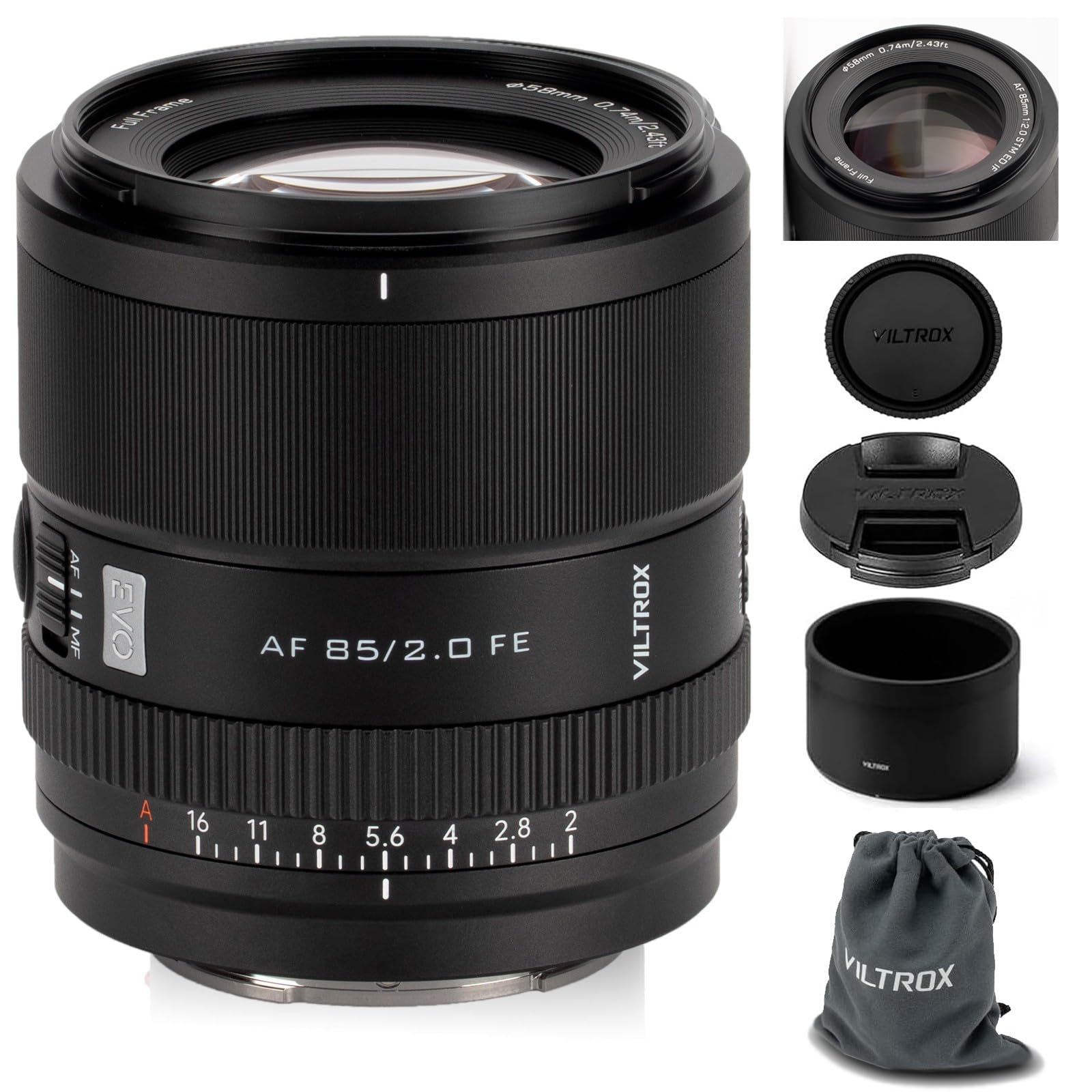
Viltrox 85mm F2.0 EVO FE

90 /100
Keeper Score Outstanding

Key details

Mount
Sony E
Weight
14.1 oz
Max Aperture
f/2
Minimum Focus
0.74 m
Check Price on Amazon

The Viltrox is the least expensive autofocus 85mm we're recommending, and it doesn't behave like one. Ten elements in eight groups with ED glass, an STM motor driving internal focus, a sealed mount and a fluorine coating on the front element, plus an aperture ring you can de-click for video and a customizable Fn button.

At f/2 you give up a third of a stop to the f/1.8s, which matters in a dim room and barely at all in daylight. Everything else punches above its place in the list: images are sharp, focus is quick and quiet, and 0.74 m close focus gets you nearer than either DSLR lens here. For a first 85mm, it's hard to argue with.

Pros

  • Sharp with quick, quiet STM focus
  • Sealed mount and coated front element
  • Aperture ring, Fn button, 0.74 m close focus

Cons

  • Background rendering is less clean than the Sony's
Our verdict

The value pick for Sony E: a sharp, sealed 85mm with a proper aperture ring that gives up a third of a stop and a little background smoothness.

Check Latest Price
8

Sony Flagships

Sony FE 85mm f/1.4 GM II

88 /100
Keeper Score Excellent

Key details

Mount
Sony E
Weight
1.4 lb
Diaphragm
11 blades
Max Aperture
f/1.4
Check Price on Amazon

Several times the price of our top pick buys two-thirds of a stop and a different class of glass. The GM II opens to f/1.4, uses eleven blades, and pairs two XD linear motors with a barrel Sony manages to keep compact for the speed — 635 grams, which is modest for the aperture.

In use, the aperture is the story. Wide open, a face separates from the background with a smoothness the f/1.8 can't match, and the eleven blades keep highlights circular well past the point where cheaper diaphragms start showing edges. Behind a bride and a wall of window reflections, that's the frame you're paying for.

Focus is where it earns the G badge. The linear motors are fast, precise, and silent, which is as much a video feature as a stills one, and the optics are corrected out to the frame edges rather than just the center. There's no in-lens stabilization, which is normal at this focal length and covered by the in-body systems on the cameras this lens is built for.

Whether it's worth it depends on what you shoot. If portraits pay the bills and you're working at f/1.4 in reception light, the speed, the blade count, and the edge correction are the reason this lens exists. If they don't, our top pick gets you most of the way.

Pros

  • f/1.4 with 11 rounded blades
  • Two XD motors: fast and silent
  • Corrected out to the frame edges

Cons

  • Priced well above the rest of this set
Our verdict

The no-compromise Sony 85mm: fast, silent, edge-to-edge sharp at f/1.4, and priced accordingly — a working portrait lens rather than a first one.

Check Latest Price

How We Tested 85mm Lenses

We started by pulling every current 85mm autofocus prime we could get our hands on for full-frame mirrorless and DSLR bodies, then narrowed the field to what was actually in stock at a sensible price for its mount. Eight made the cut, spread from lightweight budget glass to big, heavy premium glass.

Testing ran for six months and followed the lens rather than a lab bench. Every lens went onto the same body and shot the same head-and-shoulders frame at every aperture from wide open down to f/8; we then zoomed to 100 percent on eyelashes, catchlights, and the hairline to see exactly where sharpness fell apart. We also shot into a low sun and through a window to catch flare and veiling that a spec sheet never mentions.

Autofocus got its own round of abuse: a dog running at the camera, a kid on a swing, and a dim living room lit by a single lamp. We counted keepers instead of trusting the marketing, and noted how often a lens hunted before locking on, how loud the motor was, and whether focus drifted between consecutive frames.

Bokeh was judged in the field at 10 to 15 feet, against a hedge and against backlit foliage, looking for onion-ring texture and cat's-eye shapes rather than just blur quantity. Then each lens came off the body and went into a bag, because how it balances on a long afternoon is part of what you're paying for — and we weighed that feel against the price of the mount it fits.

How to Choose an 85Mm Lens

Start With the Mount

Nothing else matters until you know which bodies the lens will mount on. Canon runs two systems, EF for DSLRs and RF for mirrorless; Nikon splits the same way between F and Z; Sony's E mount covers both its full-frame and APS-C bodies. Those are not interchangeable, and an 85mm that doesn't fit your camera is not a bargain at any price.

Once the mount narrows the field, the choice inside it comes down to three things: how much aperture you need, how fast the focus has to be, and how much weight you'll tolerate. Our Sony and Nikon mirrorless picks and the two DSLR classics all sit in the sensible f/1.8 to f/2 band. The faster glass is a separate decision, not an upgrade you have to make.

How Much Aperture You Actually Need

f/1.8 and f/2 are the sweet spot. They gather enough light for indoor portraits, blur a background convincingly at head-and-shoulders distance, and keep the barrel small enough to carry. Moving to f/1.4 buys roughly two-thirds of a stop and a creamier falloff, and charges you in weight, money, and a filter thread that grows to 77mm.

The diaphragm deserves a look too. Nine or eleven blades keep out-of-focus highlights round as you stop down, which is the difference between a smooth background and a polygonal one at f/2.8 or f/4. If you shoot wide open almost all the time, blade count matters less than the marketing suggests.

Autofocus Decides Your Hit Rate

At 85mm and f/1.8 the depth of field is thin enough that the eyes are the photograph, and a lens that locks a few centimeters behind them has ruined the frame. The strongest autofocus here comes from linear motors and modern STM designs that snap onto an eye and stay quiet; older and cheaper motors are fine in daylight and hesitant in a dim room.

This is also why a manual-focus 85mm is a deliberate choice rather than a saving. Manual focus at this focal length through a DSLR focusing screen is a skill you practice, and it suits still life and video far better than a moving portrait subject.

Weight, Close Focus, and Sealing

An 85mm that stays home is worth nothing. The lenses here run from 350 grams to 635, which is the difference between a lens you forget about and one you notice by the end of a long day. If it will live in a bag beside your zooms, matching their 67mm filter thread saves buying a second set of filters.

Close focus is the quiet differentiator: the third-party 85s get you within about 0.75 m, the Nikon F lens stops at 0.80 m, and Canon's RF f/2 reaches 1.15 ft at half life-size for rings and details. Sealing is worth checking if you work outdoors — the Nikon Z, the Sigma, and the Viltrox each claim dust and moisture resistance, while the two DSLR lenses don't.

Frequently Asked Questions

Final Verdict

The Sony FE 85mm f/1.8 is where most people should start: light enough to carry without thinking, quick and quiet to focus, and sharp wide open with the background separation that makes a portrait look deliberate. Nikon Z shooters get a better-balanced lens in the Z 85mm f/1.8 S, and Canon RF shooters who want macro and stabilization have an obvious answer in the RF 85mm f/2.

On a DSLR, the EF and F 85mm f/1.8s remain the value play in their mounts, and the Sigma is the one to stretch for if f/1.4 is the whole point of the purchase. The GM II has the strongest aperture and the finest control of background blur in this set; it is also the least necessary lens here for anyone whose portraits aren't paying for it.