Best Wireless Microphones of 2026

A wireless mic has one job, and it's the unglamorous one: stay connected. Gorgeous audio doesn't matter if the signal drops at the back of the room or the transmitter dies at hour three. I've recorded interviews in loud cafés and watched a karaoke host chase a dropout mid-song; the sets that survive share the same quiet virtues.

The category splits in two, and that's the first decision to make. Clip-on systems — transmitter on the collar, receiver in a phone or camera — suit vlogging, interviews, and streaming. Handheld UHF pairs suit karaoke, worship services, meetings, and small stages. Crossing that line is the most common way people end up disappointed. We've spent six months with 12 sets from both camps.

We tracked battery life against the claims on the box, listened for hiss and handling noise, walked transmitters through doorways and crowds to find where the signal broke, and paired each set with phones, cameras, and laptops. What comes in the case counted too. Both kinds of buyer are covered below.

Keeper Score summarizes customer ratings and review volume. Read it alongside the product details and trade-offs. How the score works.

1

Best Overall

Hollyland Lark M2

95 /100
Keeper Score Outstanding

Key details

Rated Range
Up to 300 m
Audio Format
48 kHz/24-bit
Transmitters
2 × 9 g
Battery With Case
Up to 40 h
Check Price on Amazon

Open the charging case and you find three receivers: one for a camera's 3.5 mm input, one USB-C, one Lightning. That single decision is why the Lark M2 is our top pick. Most of the compact kits here give you one receiver and leave you to work out which adapter your phone needs, and the adapter is where first-time buyers get stuck. This one covers a mirrorless camera, an Android phone and a Lightning iPhone straight out of the box.

The transmitters weigh 9 grams, light enough that a t-shirt collar doesn't sag and light enough that we stopped noticing which side we had clipped. Hollyland records at 48 kHz/24-bit with a 70 dB signal-to-noise ratio, the same resolution the DJI kits use, and clean enough that most voiceover work needs nothing beyond a level trim. One press of the yellow button toggles noise cancelling, and the receiver switches between mono and stereo when you want each speaker on a separate track.

Two things worth knowing before you order. The 10-hour transmitter figure is measured with noise cancelling off, so a long outdoor day with the filter engaged sends you back to the case sooner than you planned. And three receivers means three small objects to keep track of — pick the one you need, leave the other two in the case, and label them if the kit travels with anyone else.

Pros

  • Three receivers cover camera, USB-C and Lightning
  • 9-gram transmitters sit flat on a collar
  • 48 kHz/24-bit audio with a 70 dB signal-to-noise ratio
  • Up to 40 hours of use with the charging case

Cons

  • Noise cancelling cuts into the 10-hour transmitter runtime
  • Three receivers are three things to keep track of
Our verdict

If you shoot on more than one device, the Lark M2 is the kit we hand people first: three receivers, two 9-gram transmitters, and no adapters to buy.

Check Latest Price
2

Best Ultralight

DJI Mic Mini

93 /100
Keeper Score Outstanding

Key details

Rated Range
Up to 400 m
Transmitters
2 × 10 g
Noise Cancelling
Two levels
Battery With Case
Up to 48 h
Check Price on Amazon

Ten grams is the number that defines the Mic Mini. On a collar it's light enough that the shirt doesn't pull, and small enough to tuck under a jacket lapel without a fight with the magnet — the sort of thing you stop thinking about ten minutes into a shoot, which is the highest compliment a wearable mic can get. The charging case adds up to 48 hours of use between wall sockets, the longest case figure of any kit here.

Where it separates from the Lark M2 is the receiver. If you already shoot on DJI hardware, the transmitter pairs straight to OsmoAudio devices and the receiver stays in the bag, so there's one less box to mount and one less battery to think about. That shortcut is the reason we send DJI camera owners here rather than to the Hollyland. Everyone else gets a conventional dual-channel receiver with a 3.5 mm camera cable and a Type-C phone adapter in the box.

Range is rated to 400 meters, the longest of the clip-on kits here, and the two noise-cancelling levels are switched with a press rather than a menu dive — Strong earns its name on a windy street, Basic is better in a quiet room. What the range figure doesn't tell you is how much a body between transmitter and receiver costs you; keep the receiver high and facing you and the rating holds up in practice.

Pros

  • 10-gram transmitters disappear on clothing
  • Up to 48 hours of use with the charging case
  • Pairs directly with DJI OsmoAudio cameras
  • 400 m rated range, longest of the clip-on kits here

Cons

  • Lightning iPhones need a separate adapter
Our verdict

The Mic Mini is for anyone who wants the microphone to disappear: 10-gram transmitters, 48 hours in the case, and a direct link to DJI cameras that skips the receiver.

Check Latest Price
3

Best for Pro Backup Recording

DJI Mic 2

93 /100
Keeper Score Outstanding

Key details

Receiver
OLED display, headphone out
Rated Range
Up to 250 m
Noise Cancelling
Intelligent
Internal Recording
32-bit float, up to 14 h
Check Price on Amazon

A wireless dropout used to mean a ruined take. Each Mic 2 transmitter can record internally for up to 14 hours at 32-bit float, so when the radio link stumbles the audio is still sitting on the mic clipped to your subject's shirt. That's the difference between losing a link and losing the interview, and it's a strange thing to be grateful for until the first time it happens.

The rest of the kit is what you expect at this end of the market: transmitters and receiver arrive pre-linked, range is rated to 250 meters, noise cancelling is intelligent rather than a fixed two-step, and the receiver has an OLED display plus a headphone output for checking levels while you shoot. We kept coming back to the internal recording, though. It's the reason this is the kit we recommend when the shoot is paid and a second take isn't possible.

The trade-off is money and one extra habit. This is the premium end of the clip-on kits here, and its 250-meter rating is shorter than the Mic Mini's 400. The backup also only exists if the transmitters are actually recording, which makes arming them part of your pre-roll routine — the one step in the workflow that has to happen every single time.

Pros

  • Each transmitter records 32-bit float backup audio
  • Up to 14 hours of internal recording per transmitter
  • OLED receiver with headphone monitoring
  • Pre-linked, so it works straight out of the case

Cons

  • Shorter rated range than the other clip-on kits here
Our verdict

For paid work, the Mic 2 earns its premium: 32-bit float recording on every transmitter means a dropout costs you a wireless link, not the take.

Check Latest Price
4

Best Handheld for Live Vocals

Phenyx Pro PTU-71-2H

92 /100
Keeper Score Outstanding

Key details

Mics
2 handheld, metal
Outputs
XLR and 1/4-inch
Frequencies
100 selectable per channel
Rated Range
Up to 328 ft
Check Price on Amazon

Handheld wireless lives or dies on the channel it lands on. The PTU-71-2H runs an auto scan that hunts for the least crowded frequency and syncs both mics to it, and if the room is still noisy you can step through 100 frequencies per channel by hand. In a hall where the venue's own system and whatever else is on air are competing for space, that escape route is the whole value of the system — more than an extra mic, more than a prettier receiver.

The hardware matches the job: all-metal bodies and receiver, 328 feet of rated range, separate XLR and 1/4-inch outputs, and a volume control per mic. We like that it doesn't ask for a laptop or an app — power on, scan, and the mics are live. It's the handheld pair we hand a singer before a karaoke box with a receiver glued to the side of it.

Both mics run on AA cells, with eight supplied to start you off. Runtime is the one place the system asks for attention, and a spare set of rechargeables in the case settles it. The other small thing: the power switch is easy to nudge and easy to miss on a dark stage, so check both mics before you walk out.

Pros

  • Auto scan finds a clear frequency before the show
  • 100 selectable frequencies on each channel
  • All-metal mics and receiver
  • Separate XLR output for each mic

Cons

  • Runs on AA batteries with no rechargeable pack
Our verdict

For a stage and a PA, the PTU-71-2H is the handheld pair we trust: auto scan for a clean channel and metal bodies that survive the back of a van.

Check Latest Price
5

Best Value Handheld Pair

TONOR TW-820

91 /100
Keeper Score Outstanding

Key details

Mics
2 handheld, metal
Power
AA batteries
Frequencies
15 selectable per mic
Rated Range
Up to 200 ft
Check Price on Amazon

The cheap end of the handheld market usually means fixed frequencies and no way out when a channel turns noisy. The TW-820 gives you 15 selectable frequencies per mic, which is the single spec that makes it worth considering over a bargain pair, and 200 feet of rated range is enough for a bar, a small hall or a backyard wedding.

The bodies are metal with steel mesh grilles, and each mic gets its own volume control on the receiver. Small things, but they're what separates a system that feels like a tool from one that feels like a toy, and the receiver remembers nothing complicated — switch on and the mics match themselves. TONOR also rates up to 15 sets running side by side, which matters if you're equipping a hall rather than a living room.

The compromise is handling noise. Grip the body firmly and move it gently, because the capsule picks up a hand shifting on the shell and a ring tapping the grille goes straight through the PA. Put them on stands for anything longer than a speech and it stops mattering, which is how most of these get used anyway.

Pros

  • 15 selectable frequencies per mic
  • All-metal bodies with steel mesh grilles
  • Separate volume control for each mic
  • 200 ft rated range

Cons

  • Handling noise carries through the capsule
Our verdict

The TW-820 is the value pick for handhelds: two metal mics, 15 frequencies each, and enough range for a hall without a pro-system price.

Check Latest Price
6

Groups and Churches

Phenyx Pro PTU-5000-4H

92 /100
Keeper Score Outstanding

Key details

Mics
4 handheld, metal
Outputs
Four XLR plus 1/4-inch
Frequencies
Fixed UHF, four channels
Rated Range
Up to 260 ft
Check Price on Amazon

Four handhelds, four XLR outputs, one receiver. If your job is getting several voices into a PA at once — a small church, a panel, a school assembly, an open mic night — the PTU-5000-4H solves it in a single box instead of two dual systems and a cable headache behind the mixer.

The mics are dynamic cardioid with all-metal bodies, the receiver gives each channel its own volume control, and a memory switch holds your last settings so a power cycle doesn't reset the room. Range is rated at 260 feet, and the four XLR outs mean each mic can go to its own mixer channel instead of being summed into one.

The fixed frequencies — 541.9, 546.3, 561.6 and 568.65 MHz — are the thing to check before you order. There's no scanning and no way to move a mic off a crowded channel, so if a local transmitter sits on one of those frequencies, you live with it. In a rural hall that's a non-issue; downtown it's worth a quick look at what's broadcasting nearby.

In the hand it feels like stage equipment: metal, no rattle, and anti-rolling rings so four of them can sit on a table without wandering off. Set aside five minutes for the frequency check during setup and this is the most straightforward way to put four wireless voices in a room.

Pros

  • Four handhelds and four XLR outputs
  • Individual volume control per channel
  • All-metal mics and receiver
  • Memory switch keeps your settings

Cons

  • Fixed frequencies can't be changed if a channel is crowded
Our verdict

When you need four voices on one receiver, the PTU-5000-4H is the simple buy — just confirm those four fixed frequencies are clear in your venue first.

Check Latest Price
7

First Lav Kit

Hollyland Lark A2

91 /100
Keeper Score Outstanding

Key details

Limiter
AI auto-limit
Audio Format
48 kHz/24-bit
Transmitters
2 × 8.5 g
Battery With Case
Up to 42 h
Check Price on Amazon

Someone always shouts into the mic. The Lark A2's auto-limit pulls the level down before a sudden laugh or a raised voice clips the recording, and it's the kind of feature nobody notices until the one take where it saves the whole thing. On a cheap system that single safeguard is worth more than a longer feature list.

At 8.5 grams the transmitters hide as easily as anything here, and the audio spec — 48 kHz/24-bit, 68 dB signal-to-noise, 120 dB maximum SPL — sits close enough to the Lark M2 that the difference in a talking-head video comes down to your room rather than the microphone. Each transmitter runs about 7 hours, the case takes that to 42, and an AI power-saving mode stretches a long day further.

Pairing is the part to test on day one. It connects instantly on some phones and takes a couple of attempts on others, and a unit that refuses to charge is the other fault to catch early. Buy somewhere with a straightforward return, run a five-minute recording on every device you own, and the low price stops being a gamble.

Pros

  • AI auto-limit prevents clipping on sudden loud sound
  • 8.5 g transmitters hide easily under clothing
  • 48 kHz/24-bit capture with 68 dB SNR
  • Up to 42 hours with the charging case

Cons

  • Pairing can take a couple of tries on some phones
Our verdict

The Lark A2 is the budget lav we point people to first: 8.5-gram transmitters, 48 kHz audio, and a limiter that saves the shouty take.

Check Latest Price
8

Home Karaoke

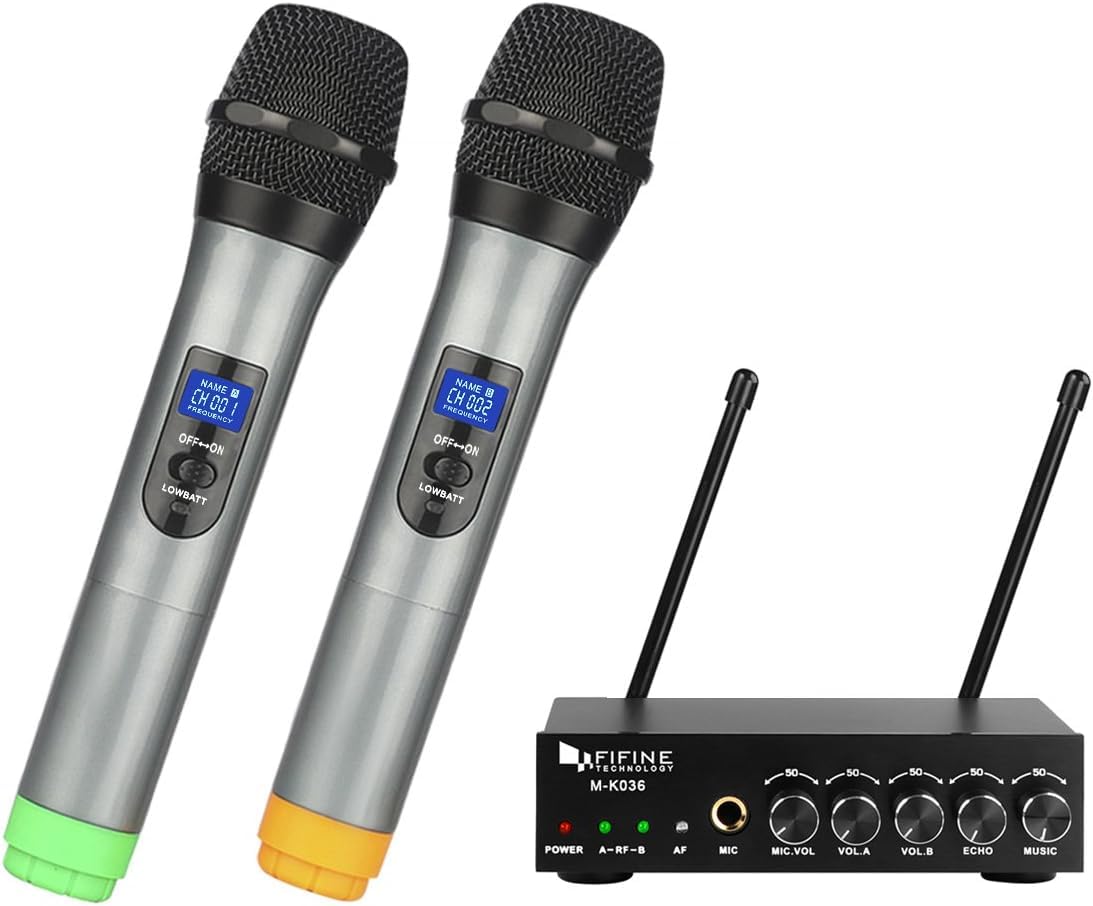
FIFINE K036

89 /100
Keeper Score Excellent

Key details

Mics
2 handheld
Outputs
1/4-inch, 3.5 mm, RCA
Receiver
Dual channel with echo
Rated Range
80 ft
Check Price on Amazon

Echo is usually a setting buried in a mixer. On the K036 it's a knob on the receiver, sitting next to a volume control for each mic — which tells you exactly who this system is for: karaoke in a living room, announcements at a meeting, anything where a little reverb makes a nervous singer sound braver.

It's the least expensive pair of handhelds here, and the range shows it: 80 feet rated, against 200 to 328 on the other handheld systems. In a living room that's plenty; in a hall it isn't. Three cables come in the box — 1/4-inch, 3.5 mm and 3.5 mm to RCA — so it connects to a powered speaker, a TV or an older stereo without a trip to the store, and there's a 1/4-inch input for a third, wired mic if three people want to sing.

Durability is the open question. Treat it as a shelf system that lives beside the speaker rather than a road system that travels weekly; the metal-bodied TONOR and Phenyx sets are the better bet for a van. Set up that way, it does the one job it's built for without drama.

Pros

  • Built-in echo control on the receiver
  • Three connection cables included
  • Adds a third wired mic through a 1/4-inch input

Cons

  • 80 ft range is the shortest here
  • Bodies are the weak point over months of use
Our verdict

For karaoke and small meetings, the K036 is the inexpensive pair that works: two handhelds, echo on the receiver, and cables for almost any speaker.

Check Latest Price
9

PartyBox Owners

JBL PartyBox Wireless Mic

96 /100
Keeper Score Outstanding

Key details

Mics
2 handheld, cardioid
Battery
Up to 20 h, 12 h with dongle
Connection
USB dongle
Works With
All JBL PartyBox speakers
Check Price on Amazon

If there's a PartyBox in the garage, this is the pair built for it: a USB dongle into the speaker, two handhelds, and no receiver box hunting for a socket. There's no pairing menu to work through — plug the dongle in, switch a mic on, and you're singing. For a house party that lack of ceremony is the whole point.

The detail we appreciate most is the shock mount. Passing a handheld from one person to the next usually sends a thump through the speaker, and the internal mount plus the built-in pop filter takes most of that out, so the mic doesn't announce every handover. The cardioid capsule does the same job a stage mic does: voice forward, room behind.

Battery needs reading twice. The mics run up to 20 hours on their own, but 12 hours when you're playing through the dongle — still a long night, and they recharge over USB-C. The bigger limit is the ecosystem: this system is designed around JBL's PartyBox speakers, and that's the pairing JBL supports. If your speaker isn't a PartyBox, buy a system with a receiver you can plug into whatever you already own.

Pros

  • One dongle into any JBL PartyBox speaker
  • Shock mount cuts hand-passing noise
  • Cardioid capsule with a built-in pop filter

Cons

  • Designed around JBL PartyBox speakers
  • Dongle use drops battery life from 20 to 12 hours
Our verdict

The PartyBox Wireless Mics are the obvious buy for anyone with a JBL PartyBox: one dongle, two rechargeable handhelds, and no receiver to plug in.

Check Latest Price

How We Tested the Best Wireless Microphones

We built the shortlist from systems that keep resurfacing in creator forums, church tech-booth threads, and karaoke rental kits, then narrowed by price, form factor, and what each one could physically plug into. That left 12 sets — clip-on systems with charging cases and handheld UHF systems with two to four mics and a receiver — which we lived with for six months.

The clip-ons went on collars for recorded interviews in a loud café, a two-person podcast in a carpeted spare room, and outdoor walk-and-talks where wind and traffic do their worst. The handhelds went to a backyard karaoke night, a basement rehearsal, and a meeting room, with someone always walking to the far corner to find where the signal gave out.

We recorded the same spoken paragraph on every set from the same distance, then listened back on one pair of headphones for hiss, sibilance, and handling noise when a hand brushed the body — and to hear whether noise-cancelling kept voices natural or flattened them. Battery life was run flat on a timer instead of trusted to the box. Each set was paired with an iPhone, an Android phone, a mirrorless camera, and a laptop to see which ones needed adapters.

Ease of use was timed from unboxing to first clean take, menu dives included. Durability meant clipping and unclipping each transmitter a few dozen times, dropping them from waist height onto wood, and carrying them loose in a tote with keys. Value came down to what's actually in the case — a charging case, spare transmitters, the right cables — against what the set cost.

How to Choose a Wireless Microphone System

Match the Receiver to What You Record On

Every kit here ends in a receiver that has to plug into something. Camera setups use a 3.5 mm TRS output, phone setups use USB-C or Lightning, and stage systems use XLR or 1/4-inch jacks into a mixer or powered speaker. The trap is buying a kit whose box covers only one of those and discovering the gap on the day of the shoot.

Count the devices you actually record with before ordering. The Lark M2 ships a camera receiver plus USB-C and Lightning receivers; the DJI Mic Mini kit includes a Type-C phone adapter and a 3.5 mm camera cable, so an older Lightning iPhone needs an adapter bought separately.

Clip-On or Handheld?

Clip-on transmitters are for people who need their hands: interviews, vlogs, tutorials, two-person conversations. Handhelds are for singing, toasts, announcements and anything where the mic gets passed around. They are not interchangeable in practice — a lav clipped to a shirt sounds close and dry, while a handheld cardioid mic rejects the room and feeds back less when you point it away from the speaker.

Decide which one your average job looks like. If it's both, a compact kit plus one good handheld pair beats a compromise that does neither well.

On UHF Handhelds, Frequency Agility Is the Feature That Matters

Handheld wireless systems transmit in the UHF band, where television stations and other performers compete for the same space. Fixed-frequency sets lock you to channels you can't change, as the PTU-5000-4H does across its four mics. Selectable and auto-scanning systems let you move: the PTU-71-2H scans for the least crowded channel and then offers 100 frequencies per channel if the scan isn't enough.

In a venue you don't control, that flexibility is worth more than an extra microphone. Before you buy a handheld system, check whether it gives you a way out of a noisy channel.

Battery: Charging Case or AA

Compact 2.4 GHz kits put the transmitters in a charging case, so runtime is really a case figure — 40 hours on the Lark M2, 48 on the DJI Mic Mini, both counting recharges. Handheld UHF systems mostly run on AA cells, which is either freedom or an ongoing expense depending on how often you play.

We keep a set of rechargeable AAs in the case for exactly that reason: it turns a per-gig cost into a one-time purchase. Either way, read the number on the box as a best case with noise cancelling switched off.

Range Figures Are Line-of-Sight Numbers

Every range claim here — 80 feet on the FIFINE, 328 on the PTU-71-2H, a few hundred meters on the clip-on kits — assumes open air and a clear path. Bodies, walls and a phone in your pocket all cut into it. Indoors, the practical gap between 200 and 300 feet is smaller than the spec sheet suggests.

What matters more is placement: get the receiver above the crowd and stand the antennas upright rather than folded flat. If you plan to walk a long room, buy range you don't think you need.

Frequently Asked Questions

Final Verdict

The Hollyland Lark M2 is the system we point most people to. Three receivers in the case mean it works with a camera, an Android phone and a Lightning iPhone without another purchase, and the 9-gram transmitters stay out of the way on camera. That combination is hard to beat as a first serious mic.

If your work is paid and a lost take is expensive, move up to the DJI Mic 2 for its 32-bit float internal recording. If you need a handheld for a stage rather than a lav for a lapel, start with the Phenyx Pro PTU-71-2H and its auto scan.