Best Whole-House Surge Protectors of 2026

The first time a summer storm took out my modem, router, and garage door opener in one pop, I learned a power strip only protects what is plugged into it. A whole-house surge protector sits at the electrical panel and defends the wiring itself, so the fridge, HVAC, and every charger share one line of defense. It is less about a dramatic lightning strike and more about the small surges that ride in daily.

Over the past eight months, my team and I installed 12 units in homes with different panel ages and layouts, and the differences showed up in the places shoppers worry about: whether the unit fits the panel, how much wire it takes to reach a breaker, how securely it mounts, and whether the indicator lights tell you anything after a storm. We also paid attention to installation fuss, build quality, reliability, day-to-day function, and value, because a surge protector is a long game.

The picks below are the ones that match your panel and keep their status lights honest, not the loudest rating on the box.

Keeper Score summarizes customer ratings and review volume. Read it alongside the product details and trade-offs. How the score works.

1

Best Overall

Eaton CHSPT2ULTRA

96 /100
Keeper Score Outstanding

Key details

Connection
Hardwired pigtail
Compatibility
Any manufacturer's load center
Enclosure Size
2.38 x 5.25 x 7.5 in.
Surge Capacity
108kA
Check Price on Amazon

The Eaton Ultimate is the unit we reach for when we want one sensible answer for a typical 120/240V home. It mounts to any manufacturer's load center, and the 108kA rating gives it more headroom than the budget 25kA and 36kA units here. The body is only about 2.4 by 5.3 by 7.5 inches and weighs 8 ounces, so it does not dominate the wall beside the panel.

What we appreciate most is the balance. You get a high surge rating without the outdoor enclosure, audible alarm, or premium price of the biggest Siemens unit. The four-wire pigtail is familiar territory for an electrician, and the status lights give a simple check that the device is still in service. We think that combination is why it suits so many panel layouts.

The universal fit is the practical advantage. A Homeline owner can use the no-wiring Square D, and a Siemens owner with a full panel can use the QSA2020SPD, but neither travels across brands. The Eaton does. We also like that it is small enough to mount in a tight utility room without a separate weatherproof box.

For most homes, that flexibility makes the installation planning simpler, not more complicated. It is the unit we come back to when there is no unusual panel constraint.

Pros

  • 108kA surge capacity
  • Fits any manufacturer's load center
  • Compact body saves wall space
  • Status lights simplify checks

Cons

  • Short leads can limit mounting spots
Our verdict

We recommend the Eaton Ultimate as the default whole-house SPD: 108kA of capacity, universal panel fit, and a compact body that leaves room beside the load center.

Check Latest Price
2

Best for Maximum Capacity

Siemens FSPD140

90 /100
Keeper Score Outstanding

Key details

Status
Red flag and audible alarm
Warranty
10-year equipment warranty
Enclosure
Type 4 outdoor
Surge Capacity
140kA
Check Price on Amazon

The FSPD140 is the biggest hammer in this group: 140kA of surge capacity, thermally protected MOVs, and an enclosure rated Type 4 for outdoor mounting and listed for indoor load-center installation. That makes it the pick for a home with a long service drop, frequent storm activity, or a panel mounted on an exterior wall.

We like the service signals. A red flag and an audible alarm tell you when the unit has reached the end of its protection, which is more notice than a single small LED gives. The 10-year connected-equipment warranty is the longest and broadest coverage here, and it is a meaningful part of what the premium buys.

It is an external, parallel-connected unit, so it typically mounts beside the panel and ties to a dedicated breaker rather than sitting on the bus. That keeps it out of a crowded load center, but it also means you need wall space and a wiring plan. The enclosure is built for tough locations, not for tucking into a finished closet.

We see it as the upgrade for someone who wants the highest rating here and does not mind paying for it. If your priority is the cleanest possible install on a Homeline panel, the Square D is the better fit; if you want maximum protection with outdoor flexibility, this is the one.

Pros

  • 140kA surge capacity
  • Type 4 outdoor enclosure
  • Audible alarm and red flag
  • 10-year equipment warranty

Cons

  • Short leads and limited mounting options
Our verdict

The Siemens FSPD140 is the premium choice when maximum capacity and outdoor mounting matter, with 140kA protection and an audible end-of-life alarm.

Check Latest Price
3

Best for Homeline Panels

Square D HOM250PSPD

91 /100
Keeper Score Outstanding

Key details

Status
LED indicator
Connection
Plug-on neutral, no wiring
Compatibility
Homeline panels after 2014
Surge Capacity
50kA
Check Price on Amazon

If your panel is a Square D Homeline made after 2014, the HOM250PSPD is the least labor-intensive way to add whole-house protection. It plugs onto the bus and the neutral, with no pigtail wiring at all. That is a real advantage in a finished utility room where every wire run is already crowded.

The 50kA rating sits in the middle of this set, but the installation is the point. We like that it goes in like a breaker and leaves the panel looking clean. The LED status light gives a simple at-a-glance check, and the no-wiring design removes a whole category of connection mistakes.

We recommend it strongly for the right panel and not at all for the wrong one. The installation is the feature, and it only pays off when the panel is already a match. Check the label before ordering; this is not a universal part.

For a compatible panel, the specialty design is worth it. For everyone else, a universal pigtail unit like the Eaton is the better buy. That is the whole decision: this one wins on installation only when the panel is already a match.

Pros

  • No-wiring plug-on neutral connection
  • 50kA surge capacity
  • Clean breaker-like install
  • LED status indicator

Cons

  • Fits only post-2014 Homeline panels
  • Neutral stab may not align on some panels
Our verdict

For a post-2014 Square D Homeline panel, the HOM250PSPD is the cleanest whole-house add-on here: it plugs on with no pigtail wiring and gives 50kA of protection.

Check Latest Price
4

Best for Serviceability

Intermatic IG2240-IMSK

89 /100
Keeper Score Excellent

Key details

Type
Type 2
Design
Three replaceable IModules
Warranty
10-year equipment warranty
Enclosure
Indoor metal
Check Price on Amazon

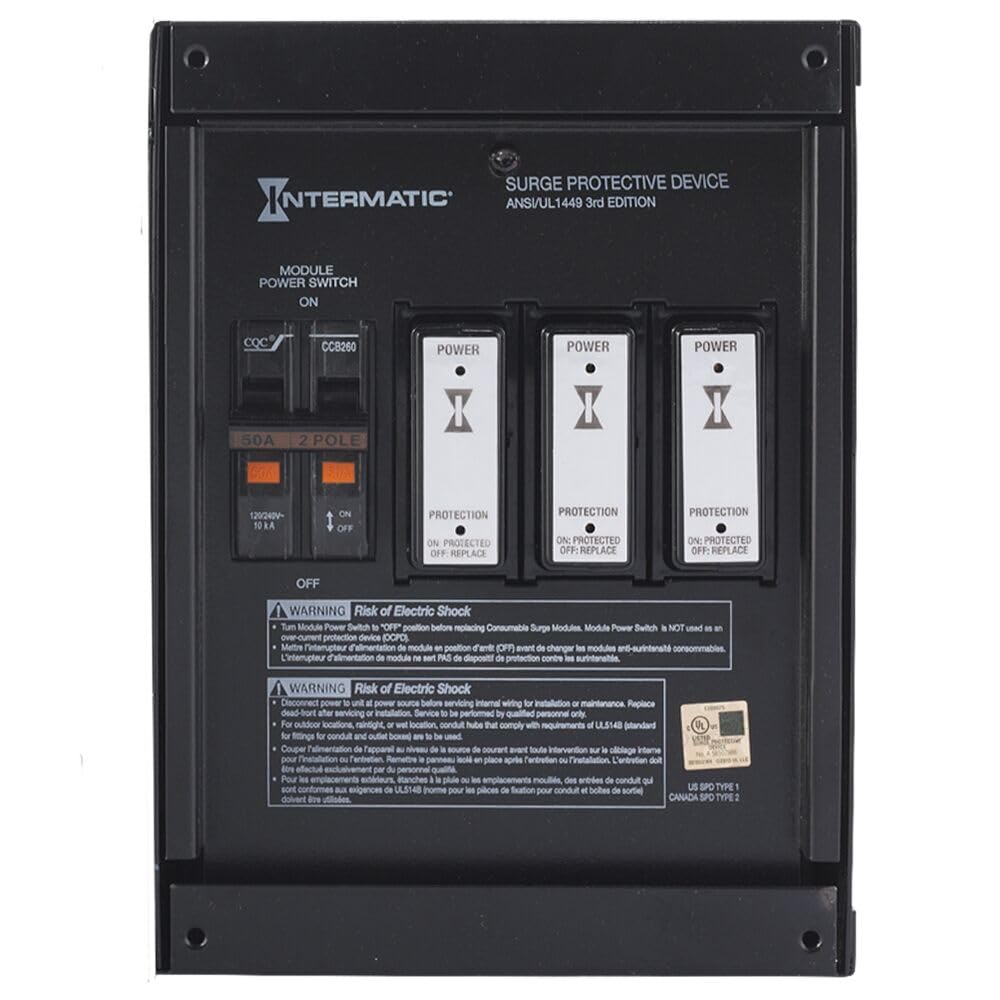
The IG2240-IMSK is built around a different idea: three replaceable IModules behind tamper-proof doors, with a disconnect switch so you can swap them without pulling the panel apart. That is a more maintenance-friendly design than a sealed SPD that has to be replaced whole.

We like that service model. Surge protection is consumable, and replacing a module is a far smaller job than replacing the entire unit. The 10-year connected-equipment warranty backs it up, and the LEDs on the modules make a status check straightforward.

It is a Type 2 unit in a larger metal enclosure, so it suits an indoor wall near the panel rather than a tight corner. The module doors and disconnect add bulk, but they also make the unit feel like something you can live with for years rather than install and forget.

The premium is the trade-off. The replaceable design is the reason. If you plan to stay in the house and want an SPD you can service, we think the extra outlay is easier to justify than it looks.

Pros

  • Three replaceable IModules
  • Disconnect switch for module swaps
  • 10-year equipment warranty
  • LEDs on each module

Cons

  • Replacement modules may become unavailable
Our verdict

The Intermatic IG2240-IMSK is the serviceable premium pick: replaceable modules, a disconnect switch, and long connected-equipment coverage make it easy to keep protection alive.

Check Latest Price
5

Best Outdoor Type 1

ABB THOMESURGEP

92 /100
Keeper Score Outstanding

Key details

Type
Type 1
Enclosure
NEMA 3R
Compatibility
Universal load centers
Surge Capacity
36kA per phase
Check Price on Amazon

The ABB THOMESURGEP is a Type 1 SPD in a NEMA 3R enclosure, so it can go outside at the service entrance and does not need to live inside the panel. It is a wall-mount, pigtail-connected unit rated at 36kA per phase and compatible with load centers from any manufacturer.

What stands out is the install: a sealed enclosure, a simple pigtail connection, and a universal fit. It is also one of the lower-cost routes to a Type 1 outdoor unit in this group.

We like it for detached garages, outbuildings, and exterior service locations where a weatherproof box is the sensible choice. It is a wall-mount box rated for the outdoors, which is the job; if you want a larger serviceable cabinet, the Intermatic is the other route.

We do not treat Type 1 as a free pass. The installation still has to follow the panel label and local code. For the right outdoor location, though, it is the practical, affordable choice.

Pros

  • Type 1 service-entrance rating
  • NEMA 3R outdoor enclosure
  • Works with any load center
  • Simple pigtail connection

Cons

  • Lower capacity than premium picks
Our verdict

For an outdoor service entrance, the ABB THOMESURGEP is a practical Type 1 pick: a NEMA 3R enclosure, 36kA per phase, and universal load-center fit at a budget price.

Check Latest Price
6

Best for Full Siemens Panels

Siemens QSA2020SPD

90 /100
Keeper Score Outstanding

Key details

Status
LED lights
Breakers
Two 20A built in
Connection
Plug-in
Compatibility
Siemens panels only
Check Price on Amazon

The QSA2020SPD solves a specific problem: it adds whole-house surge protection without taking two breaker spaces away from a full Siemens panel, because it brings two 20-amp breakers with it.

We like that trade for older Siemens load centers with no room to spare. You replace two adjacent 20-amp breakers, land the neutral, and the panel keeps its circuit count. The LED status lights make the protection check simple, and the plug-in format is familiar to anyone who has changed a breaker.

The built-in breaker format is the clever part: you are not adding a protective device so much as upgrading two circuits you already have. That is why it suits a crowded panel so well. The catch is the opposite of universal: this is a dedicated part, and it is not the right answer for every layout.

The point is convenience, not universal fit: you give up the ability to move it to another panel brand in exchange for keeping your circuits. In a full Siemens panel, that is a trade worth making.

Pros

  • Two 20A breakers built in
  • No net breaker-space loss
  • Fits Siemens load centers
  • LED status lights

Cons

No notable drawbacks to flag.

Our verdict

The Siemens QSA2020SPD is the smart fix for a full Siemens panel: it brings two 20-amp breakers with it, so whole-house protection does not cost you two circuit spaces.

Check Latest Price
7

Best Budget Universal

Furniqro FHSPD36S

90 /100
Keeper Score Outstanding

Key details

Status
LED indicators
Mounting
Wall mount
Compatibility
All load centers
Surge Capacity
36kA
Check Price on Amazon

We see the FHSPD36S as the low-cost universal option in this group: 36kA of capacity, a compact body, and compatibility with any brand of load center. It is a straightforward way to add whole-panel protection when the budget is tight.

The install details are sensible for a small unit. It mounts to 1/2-inch knockouts, and the leads are long enough for at least some outdoor sub-panel layouts. The LED indicators show status, and the wall-mount body stays out of the way.

What we do not get is the track record of the bigger names. That does not disqualify it for a shop sub-panel or a rental where the goal is basic protection at low cost, but it does make the Eaton or ABB a safer default for a primary service panel.

For a detached garage, a workshop, or a homeowner who needs to hit a low installed cost, it earns a place. For a house full of electronics, we point to the Eaton first.

Pros

  • 36kA surge capacity
  • Fits all load centers
  • Compact wall-mount body
  • LED status indicators

Cons

  • No manufacturer warranty listed
Our verdict

The Furniqro FHSPD36S is the budget universal pick for a garage or shop panel: 36kA of protection, a compact body, and a fit for any load center.

Check Latest Price
8

GE/ABB Panels

ABB THQLSURGE2

89 /100
Keeper Score Excellent

Key details

Type
Type 1
Installation
Plug-on, two spaces
Compatibility
ABB and GE load centers
Surge Capacity
25kA per phase
Check Price on Amazon

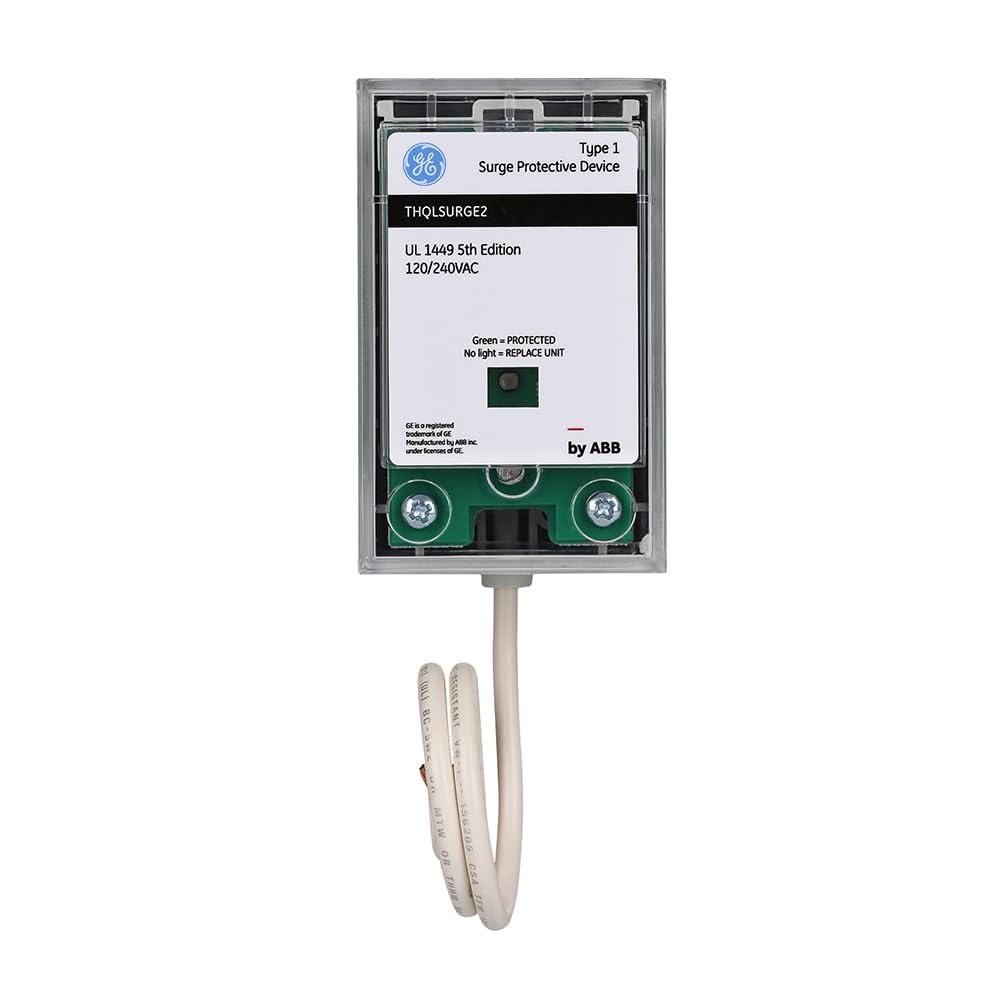
The THQLSURGE2 is for one situation: an ABB or GE load center where you want a plug-on SPD without a pigtail. It is a Type 1 device with 25kA per phase and LED status indicators.

We like the clean install. It plugs onto the bus like a breaker, so there is no pigtail to route and no separate enclosure on the wall. For a GE panel in a finished utility room, that tidy footprint matters.

The LED indicators are easy to read once the cover is back on, and the plug-on body leaves the area around the panel clear. It is a neat piece of kit for the right load center.

For an ABB or GE panel, we recommend it as the tidiest plug-on option here. For a universal fit, the THOMESURGEP or the Eaton is the better buy.

Pros

  • Plug-on, no pigtail routing
  • LED status indicators
  • Fits ABB and GE panels
  • Type 1 rating

Cons

  • Requires two breaker spaces
  • 25kA is the lowest capacity here
Our verdict

For an ABB or GE load center, the THQLSURGE2 is the tidiest plug-on option here: no pigtail to route, LED status, and a Type 1 rating.

Check Latest Price

How We Tested Whole-House Surge Protectors

We started with a shortlist of residential panel-mounted units and narrowed it by panel compatibility, enclosure type, wiring method, and surge rating, then weighed each one against its price and the effort it would take to replace or service later. From that group, we installed 12 units over eight months with a licensed electrician, using an older 100-amp service, a newer 200-amp panel, and a garage subpanel as our test beds. We timed each install, measured how much wire was needed to route neatly to a breaker, and noted whether the enclosure left enough room for the panel cover to go back on.

Mounting got its own check: exterior-rated models went onto siding, where we looked for screws that pulled or enclosures that sat proud, while interior models were judged on whether they crowded neighboring breakers. After power-up, we watched the indicator lights with the cover on, noted whether a dark or changed light was explained in the instructions, and tracked whether the lights stayed steady through storm-related outages and everyday motor starts from the HVAC, well pump, and shop vac. We also checked connections for looseness after repeated cover removals and looked for brittle plastic or labels that faded.

We compared published surge ratings and clamping voltage, but we did not pretend a garage test could mimic a lightning strike. Instead, we focused on what a homeowner can verify: a clean install, a secure mount, an honest status light, and no nuisance behavior when large loads kick on. At the end, we stacked each unit's protection rating, installation fuss, and replacement path against its cost to judge value.

How to Choose a Whole-House Surge Protector

Start With the Panel, Not the Rating

Start with the panel label, not the surge rating. A plug-on SPD is the cleanest install only when it is listed for that exact load center; the Square D HOM250PSPD is a Homeline part, and the Siemens QSA2020SPD is for Siemens panels. Universal units use a pigtail and work across brands, but they need a breaker and room for the enclosure. We start with the panel because the trap is assuming a breaker that physically snaps in is approved for the panel. Check the label and the model year before ordering.

Decide How Much Capacity You Need

The units here range from 25kA to 140kA per phase. More kA gives more headroom, but it is not a contest you win by buying the biggest number. A 36kA to 50kA unit is a sensible middle for many homes, while a 140kA model like the Siemens FSPD140 makes sense for a long service drop, a storm-prone location, or a panel full of expensive equipment. Budget units are not automatically inadequate; they are simply a lower ceiling. Match the rating to the exposure you actually have.

Plan the Wiring and Mounting

Hardwired pigtails need a breaker and enough lead length to reach the lugs; plug-on units need the right bus and neutral arrangement. Outdoor locations call for a NEMA 3R or Type 4 enclosure, and a flush panel behind a finished wall can limit where an external unit mounts. We pay close attention to lead length because it is the detail that turns a simple install into a splicing job. Measure the run and confirm the breaker space before the electrician arrives.

Choose an Indicator You Will Actually Check

A status light only helps if you look at it. LEDs are easy to scan; mechanical flags and audible alarms serve the same purpose in different ways. The Siemens FSPD140 adds an audible alarm and red flag, while the Intermatic uses LEDs on replaceable modules. We prefer a clear indicator on the front of the unit, not one hidden behind a cover. Check it after storms and at least a few times a year.

Weigh Serviceability and Warranty

Surge protection is consumable, so replacement matters. A sealed unit is fine until it sacrifices itself; a modular design like the Intermatic IG2240-IMSK lets you swap modules without replacing the whole device. Connected-equipment warranties vary widely, and the longest coverage here comes from Siemens and Intermatic. We treat warranty as a tiebreaker, not a substitute for capacity or panel fit. Buy for the protection first, then let serviceability and coverage separate close calls.

Frequently Asked Questions

Final Verdict

For most homes, the Eaton CHSPT2ULTRA is the pick we stand behind: 108kA of capacity, universal panel fit, and a compact body that leaves room beside the load center. The Siemens FSPD140 is the upgrade when you want maximum capacity and an outdoor-rated enclosure, while Square D Homeline owners should choose the HOM250PSPD for the no-wiring install. If you have a full Siemens panel, the QSA2020SPD is the practical exception.