Best Studio Strobes of 2026

A studio strobe does one thing: it dumps a fixed packet of light in a few thousandths of a second, then has to be ready to do it again. Good ones make that rhythm invisible. Bad ones announce themselves — a fan that never quits, a power dial that lurches from a whisper to a flood, a recycle so slow your subject shifts weight while you stare at the ready light. What you're buying is repeatability.

Eleven strobes have lived in my studio and in the trunk of my car over the past nine months, and the ones that earned a permanent spot were rarely the most spec-heavy. Watt-seconds get all the attention, but a bare head and that same head behind a large softbox are two different lights, so headroom matters less than how finely a unit dials down. Mount type matters too: a common bayonet fitting means the modifiers you already own will actually go on.

A couple of these run on batteries, the rest need an outlet, and that choice shapes where you shoot more than any spec sheet does. Here's how each one held up.

Keeper Score summarizes customer ratings and review volume. Read it alongside the product details and trade-offs. How the score works.

1

Best Overall

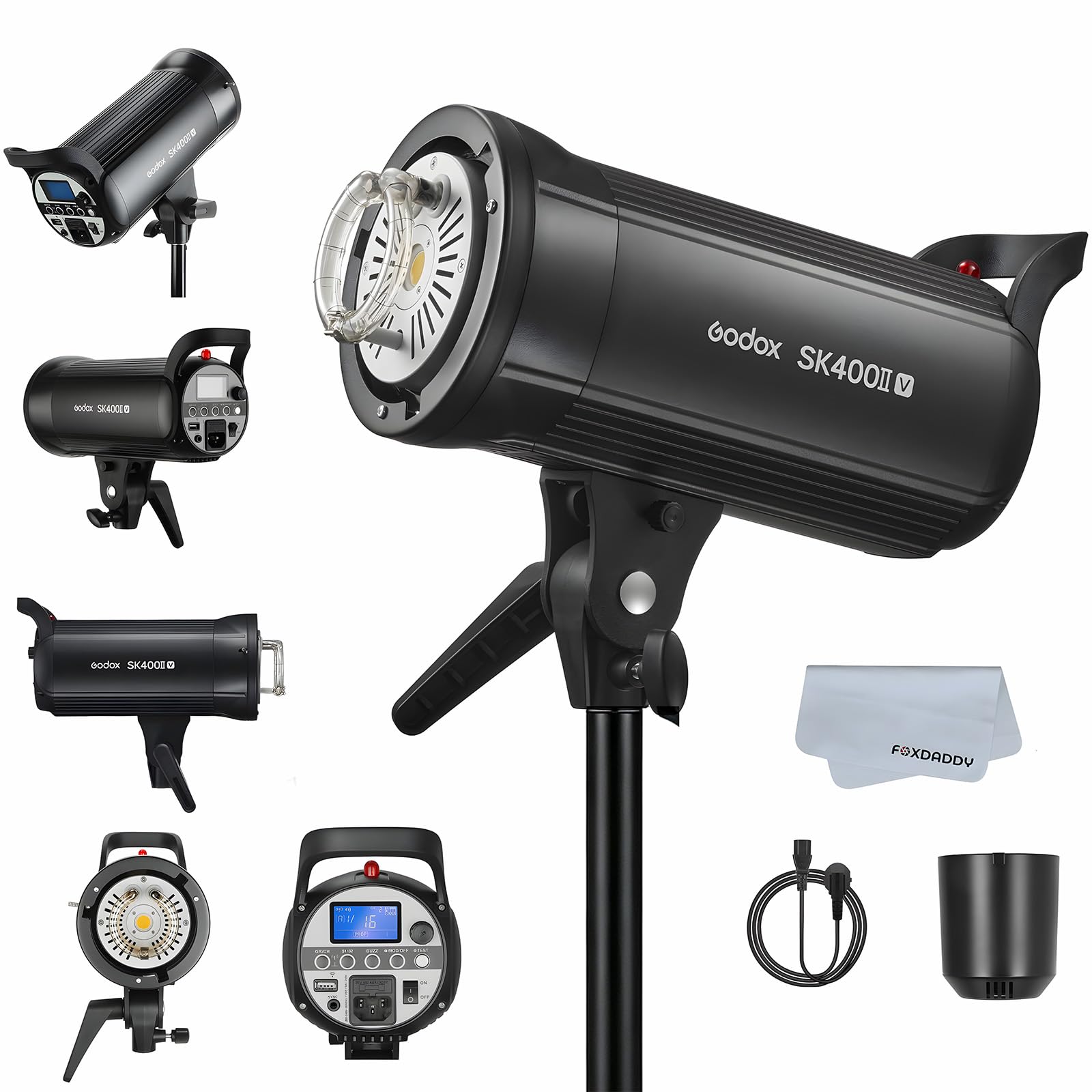
Godox SK400II-V

86 /100
Keeper Score Excellent

Key details

Flash Power
400Ws
Power Range
1/16–1/1 in 40 steps
Recycle Time
0.1–1.5s
Modifier Mount
Bowens
Check Price on Amazon

Set against the MS300, this head asks for more money and gives back the two things a fixed studio runs on: power and pace. Four hundred watt-seconds through a Bowens mount fills a four-foot softbox at working apertures, and the 0.1–1.5s recycle keeps a portrait session moving without anyone waiting on the light. It's the strobe we recommend first to someone turning a spare room into a studio.

The power range runs from 1/16 to 1/1 in 40 steps, and the floor is the number we keep bumping into. Sixteen into 400 leaves 25Ws at minimum, which is comfortable through a softbox at f/8 and too hot when you're wide open at ISO 400 with the light a couple of feet from your subject. Small rooms and fast lenses want a lower setting than this head offers.

Godox's 2.4G X system is built in, so output, modeling level and the audible beep can be changed from an XPro, X2T or X1T on the camera, and one transmitter runs a mixed set of Godox heads. The panel holds your settings three seconds after the last adjustment and restores them on power-up — a small thing we've come to value when two heads have to match again after a lunch break.

Pros

  • 400Ws with 0.1–1.5s full-power recycle
  • 40 power steps with auto memory
  • Built-in Godox 2.4G wireless control
  • Bowens mount takes standard modifiers

Cons

  • 10W modeling lamp is dim in daylight
Our verdict

The head we recommend first for a fixed studio: 400Ws, fast recycle and full Godox remote control, with one power-floor caveat worth checking.
Check Latest Price
2

Best Budget

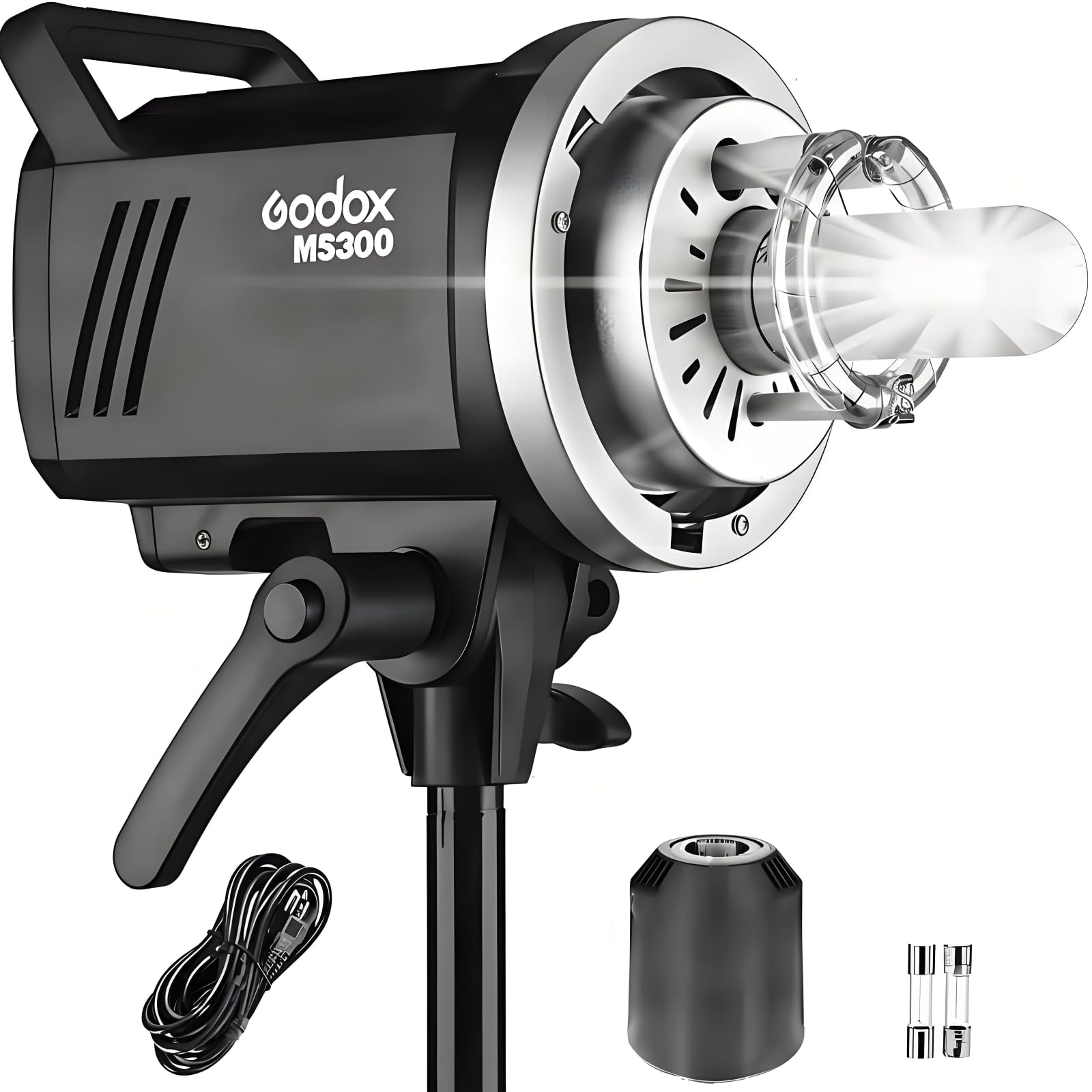
Godox MS300

85 /100
Keeper Score Excellent

Key details

Flash Power
300Ws
Power Range
1/32–1/1 in 50 steps
Modeling Lamp
150W
Modifier Mount
Bowens
Check Price on Amazon

A 150W modeling lamp is the reason this head stands out in a group of LEDs. Where our top pick previews with a 10W LED, this one lights the room, so you can see the shadow under a chin and where the falloff lands before you fire a frame. If you're learning to shape light, we think that preview is worth more than an extra stop of flash.

Fifty steps from 1/32 to 1/1, output held within a 2% tolerance over a long session, and the same Godox 2.4G radio as our top pick — the MS300 covers the practical basics and leaves money for a second head. We point first-time studio buyers here, and it's also the sensible way to add a third or fourth unit for background and hair without rethinking the kit.

The trade-offs are power and pace. Three hundred watt-seconds is generous through a medium softbox close in and starts to feel thin when you move the light back for a full-length frame or stack a grid in front of it. Recycle is 0.1–1.8s, a beat behind the 400Ws head. Neither gap matters for a light that stays in one room, and both show up if you're the only photographer chasing a five-year-old around a set.

Pros

  • Brightest modeling lamp in this group at 150W
  • Fine 1/32–1/1 range in 50 steps
  • Lowest-priced head of the four
  • Holds output within 2% over long sessions

Cons

  • Modeling lamp runs hot on long sessions
Our verdict

The budget head we point first-time studio buyers to, because its 150W modeling lamp teaches you more about light than an extra stop of power would.

Check Latest Price
3

Best Cordless Value

NEEWER Q300

87 /100
Keeper Score Excellent

Key details

Battery
7800mAh
Flash Power
300Ws
Recycle Time
0.4–2.5s
Full-power Flashes
1000
Check Price on Amazon

A thousand full-power flashes on a charge is the figure that makes the Q300 worth carrying: a 7800mAh battery, 300Ws of output and a Bowens mount on a head with no cable to tape down. For product work in a client's office, interiors, or any room where a cord across the floor is a nuisance, that is most of the argument.

Among the two cordless heads here it's the value option. The 13W modeling lamp is a preview rather than a modeling light, so in a bright room you'll be judging the lighting from test frames, and the body is heavier than the more powerful Q6 — you feel the difference on the walk in from the car.

Power runs from 1/64 to 1/1, the lowest floor of any head in this group, which is exactly what you want shooting a small product at f/2.8 in a conference room. Manual, multi and optical S1/S2 modes cover the work: a second unit can be slaved optically without a transmitter, Neewer's Q system handles five groups and 32 channels when you do want remote control, and the adjustable handle is a small thing we appreciated on a heavy head.

Pros

  • 1,000 full-power flashes per charge
  • No cables to tape down on location
  • 1/64 power floor for tight setups
  • Bowens mount and 2.4G wireless built in

Cons

  • Full-power recycle stretches to 2.5s
  • Heavier than the more powerful Q6
Our verdict

The cordless head we choose when a shoot has no usable outlet, as long as the work is composed rather than chased.

Check Latest Price
4

Best for Location TTL

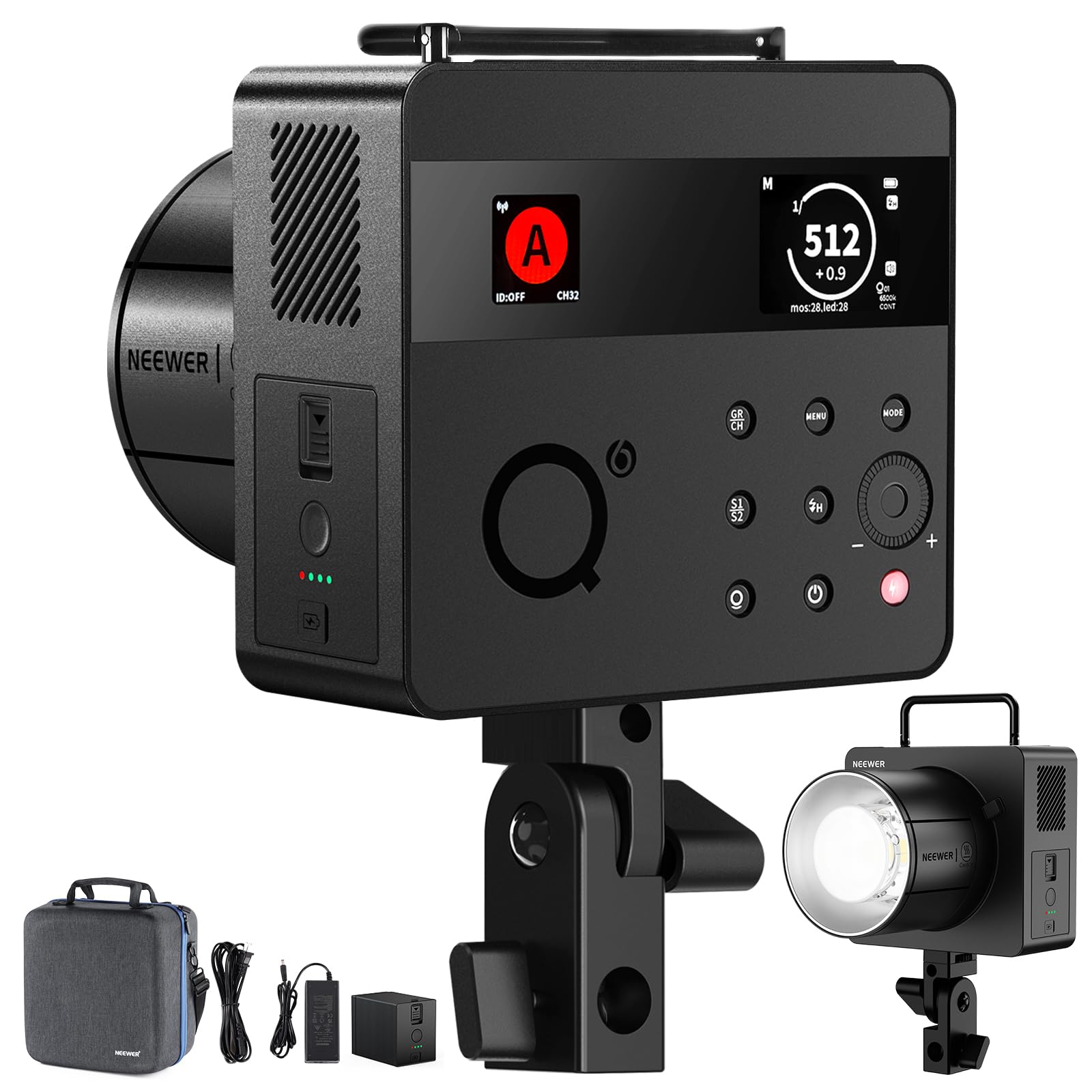
NEEWER Q6

85 /100
Keeper Score Excellent

Key details

Flash Power
600Ws
Power Range
1/1–1/512
Recycle Time
0.01–0.9s
Modeling Light
30W bi-color LED
Check Price on Amazon

This is the only head here that will set its own exposure. TTL works across Canon, Nikon, Sony and Fujifilm bodies, high-speed sync reaches 1/8000, and the power range runs from 1/1 down to 1/512 — nine stops, enough to use it as a hair light a couple of feet from a model without blowing out the highlights.

The combination is what interests us: 600Ws from a body that weighs 2kg and folds a handle into itself, recycling in 0.01–0.9s, with a 30W bi-color LED modeling light that shows both the shape and the color of what you're about to fire. Compare it with the Q300 — twice the power, less weight, and a modeling light you can actually see in daylight.

For a fixed studio it's more head than the job needs. The SK400II-V does the manual work for less, and 600Ws only earns its keep when you're lighting groups, filling a big modifier at distance, or fighting the sun at midday. Where the Q6 pays off is a kit that leaves the house: five wireless groups, 32 channels, app control for settings and firmware updates, and a body you can pick up one-handed. One check before you commit — the listing claims Godox X-system compatibility, and a cross-brand radio claim is worth proving with your own trigger on arrival.

Pros

  • TTL and 1/8000 high-speed sync
  • 600Ws in a 2kg battery body
  • 1/1–1/512 range with 0.01–0.9s recycle
  • 30W bi-color LED modeling light

Cons

  • Costliest head in this group
  • 400 full-power flashes per charge, under half the Q300's
Our verdict

Buy the Q6 if your studio has wheels: TTL, 1/8000 sync and 600Ws in a 2kg body, and more head than a fixed room needs.

Check Latest Price

How We Chose and Tested These Strobes

We started with a list of roughly 40 strobes and cut anything we couldn't trigger wirelessly, anything with a fixed output, and anything that used a proprietary modifier mount. That left 11 units, which we bought at retail and kept for nine months.

They lived where strobes actually live: a spare room turned into a small studio for headshots and tabletop product work, a rented hall where we built two- and three-light setups and tore them down again, and a handful of location days that meant packing everything into cases, driving across town, and setting up outdoors. The two battery-powered units went to jobs with no outlet at all, which is where their limits showed fastest.

Recycle time we timed with a stopwatch, firing at full power until the ready light lagged behind us, then repeating at the lowest settings where the spread between models is widest. For color, we shot the same gray card at every power step and compared the frames side by side. Brightness we judged through real modifiers rather than bare bulb, since a large softbox swallows most of what a head puts out, and we noted how usable each modeling lamp was for focusing in a dim room.

For build, we hung a big modifier on every head, carried the whole thing by the yoke, and wrote down which knobs slipped and which mounts flexed. Ease of use got tested with the room lights off — could we change power and channel by feel? By month six we'd stopped babying them, which is when the durability picture got honest: cracked housings, rattling fans, loosened clamps.

How to Choose a Studio Strobe

Power Is Only Half the Story: the Modifier Eats the Rest

Watt-seconds tell you what the head emits, not what reaches your subject. A four-foot softbox with double diffusion swallows a stop or more before the light lands, and a grid takes another bite, which is why the same 300Ws head can be generous for a headshot and thin for a full-length frame from the same stand.

All four heads here use the Bowens mount, so softboxes, beauty dishes and grids fit interchangeably. Choose the modifier you actually like first, then buy enough power to fill it at the distance you work.

The Bottom of the Power Range Matters More Than the Top

Most home-studio problems are too much light, not too little. Our top pick bottoms out at 1/16, which is 25Ws — comfortable at f/8 through a softbox, awkward when you're wide open at ISO 400 in a spare bedroom. The Q300 reaches 1/64 and the Q6 goes to 1/512, which is where hair lights and small product setups live.

If your room is small or your apertures are wide, read the minimum setting before you read the maximum.

AC or Battery Is a Working-Style Decision

A corded head costs less for the power and never runs flat mid-session, which is why it remains the honest default for a light that stays on a stand in one room. A battery head buys freedom from outlets and charges you in weight, charge management and usually recycling speed at full power — the Q300 stretches to 2.5s at 1/1.

It's the difference between a studio you build and a studio you carry.

Modeling Lamps: Bright and Hot, or Cool and Dim

The modeling lamp is how you see the light before you fire it: shadow shape, falloff, whether the reflector is doing anything. A 150W lamp like the MS300's is bright enough to work in a lit room and throws real heat; a 10W LED is nearly invisible in daylight and stays cool; the Q6's 30W bi-color LED splits the difference and shows color temperature too.

Shooting in a dimmed room, LED is fine. Matching daylight in a bright space, brightness wins.

Buy Into One Trigger System

Radio systems don't talk to each other. Godox heads answer Godox X transmitters, Neewer's Q system answers Neewer's own triggers, and mixing the two means falling back on optical slaving or running two transmitters on the camera. Decide which system you're building before you buy the second head, because a TTL head on a manual-only trigger is simply a manual head.

TTL and high-speed sync need both ends to support them — of the four heads here, only the Q6 does.

Frequently Asked Questions

Final Verdict

The Godox SK400II-V is the head we recommend to most people, and the reasoning is simple: 400Ws, 0.1–1.5s recycle and Godox's radio system in a body that lives on a stand. Two of them make a working portrait studio, and the 1/16 floor is the only thing to check against your room.

If your work happens in borrowed rooms, open shade and midday sun, the NEEWER Q6 is the alternative worth the premium — TTL, 1/8000 sync and 600Ws you can carry in one hand. And where the budget decides, the MS300's 150W modeling lamp will teach you more about light than the extra power would.