Best Sony FE Lenses of 2026

Every full-frame lens is a negotiation between light, size, and price. I have lugged a bag that was one stop too fast and left the house with a zoom that made me miss the shot I actually wanted. What most of us need is a lens that stays on the camera: sharp enough to crop, quick enough to catch a dog mid-run, and light enough that you don't think twice about packing it. The best ones also render backgrounds you want to look at, not just blur them.

Over nine months, our team shot with eight full-frame mirrorless lenses—zooms, fast primes, and a supertelephoto—on the same camera bodies and in the same ordinary places I take pictures. I paid attention to value, because a lens is a long-term buy, and to focus noise, because quiet autofocus matters more than spec sheets admit. The picks below are the ones I kept reaching for after the novelty wore off.

Keeper Score summarizes customer ratings and review volume. Read it alongside the product details and trade-offs. How the score works.

1

Best Overall

Sony FE 24-70mm F2.8 GM II

89 /100
Keeper Score Excellent

Key details

Weight
1.5 lb
Autofocus
Four XD linear motors
Focal Range
24-70mm
Maximum Aperture
f/2.8
Check Price on Amazon

One lens has to cover a room, a street, and a portrait without a break for a swap. That is the job we ask the Sony FE 24-70mm F2.8 GM II to do, and it is the lens we recommend first for most full-frame Sony owners. The 24-70mm range is familiar for a reason: 24mm takes in a room or a landscape, 50mm feels normal, and 70mm gets close enough for people without turning every shot into a telephoto exercise.

The f/2.8 aperture is what makes it a working tool rather than a convenient kit zoom. We can shoot indoors and at dusk without immediately pushing ISO, and the shallow depth of field at the long end gives portraits some separation. It stays sharp across the range, which matters more than any single peak figure because you can use any focal length without apologizing for it.

Handling is where the GM II earns its suffix. It weighs 680 g by the spec sheet, and the barrel is short enough to balance on an A7-style body instead of pulling forward. The four XD linear motors focus quickly and quietly, and we noticed the difference when tracking moving subjects. The aperture ring is a useful touch for video and stills, and the lens feels dense and precise rather than hollow.

The cost is real. This is a premium lens in this group, and the price is the one part we debate. If your work does not need f/2.8, the 24-105mm f/4 G OSS gives up a stop but adds reach and optical stabilization for less; the Tamron 28-75mm f/2.8 G2 gives up 24mm at the wide end and some autofocus polish for a lower price. The GM II is the one we choose when the job is unpredictable.

What keeps it at the top is not one spectacular specification but the absence of a deal-breaking one. The range, aperture, autofocus, and size all land on the right side of usable, so the lens disappears into the work. That is the highest compliment we can pay a standard zoom, and it is why this is the one we reach for when we do not know what the day will ask for.

Pros

  • Constant f/2.8 across 24-70mm
  • Fast, quiet four-motor autofocus
  • Lighter than the previous 24-70mm GM
  • Sharp across the zoom range

Cons

  • No optical stabilization
Our verdict

Our top pick for most full-frame Sony shooters: a fast, sharp 24-70mm that handles events, travel, and portraits with few compromises.

Check Latest Price
2

Best Value Standard Zoom

Tamron 28-75mm F2.8 G2

90 /100
Keeper Score Outstanding

Key details

Weight
1.18 lb
Focal Range
28-75mm
Minimum Focus
7.1 in (wide)
Maximum Aperture
f/2.8
Check Price on Amazon

The Tamron 28-75mm F2.8 G2 is the lens we point to when the Sony GM II is more money than the job justifies. It gives up 4mm at the wide end and some autofocus polish, but it keeps a constant f/2.8 aperture and a much lighter build. For a lot of full-frame Sony shooters, that is the more sensible trade.

At 535 g, it is the standard zoom we are happy to carry all day. The 28mm wide end still takes in a room or a street scene, and the 75mm end is long enough for tighter portraits and details. The close-focus distance of 7.1 inches at the wide end is a small joy for food, flowers, and foreground texture, and the moisture-resistant construction plus fluorine coating make it feel like a working lens rather than a fair-weather toy.

The VXD motor focuses quickly and quietly in ordinary light, and eye AF kept up with people moving through a scene. We also appreciate the simple, dense feel of the barrel; the zoom and focus rings fall where our fingers expect them, and the lens does not call attention to itself on a small body.

The 28-75mm range stops before the 85mm portrait sweet spot, and that is the one place we noticed the compromise. For events and travel, where we are usually moving between groups and details, the lighter lens earns its place in the bag. It is the standard zoom we recommend when the fast aperture matters more than the last 4mm.

Pros

  • Constant f/2.8 through 28-75mm
  • Light 535 g build
  • Close focus to 7.1 in at wide
  • Moisture-resistant with fluorine coating

Cons

  • Autofocus can hunt in low contrast
  • No optical stabilization
Our verdict

Our value pick for full-frame Sony shooters who want a constant f/2.8 standard zoom in a light, all-day package.

Check Latest Price
3

Best Travel Zoom

Sony FE 24-105mm F4 G OSS

93 /100
Keeper Score Outstanding

Key details

Weight
1.5 lb
Focal Range
24-105mm
Minimum Focus
1.25 ft
Maximum Aperture
f/4
Check Price on Amazon

A travel day rarely announces which focal length it needs. You start with a street scene, move to a detail across the table, then want a tighter frame of a person without changing lenses in the middle of a crowd. That is the day the Sony FE 24-105mm F4 G OSS is built for.

This is the zoom we take when the point is to come home with the shot rather than change lenses on the street. The 24-105mm range is the reason: 24mm covers architecture and landscapes, while 105mm gives you a useful portrait and detail lens without carrying a second barrel. It is sharp through the range, and the extra reach over a 24-70mm is worth more than a faster aperture when you are walking all day.

Optical SteadyShot helps handheld shots in low light, and the close focus distance of 1.25 feet lets us fill the frame with smaller subjects. Autofocus is quick and quiet, and it tracked people and pets without fuss in our testing. The lens also feels solid in the hand, with a zoom ring that moves smoothly rather than slipping under pressure.

The f/4 aperture is the honest compromise. It keeps the lens smaller than an f/2.8 standard zoom, but it gives up some separation and low-light headroom. If most of your work is indoors or at night, the GM II is the better lens. If you are chasing reach and stabilization for travel, this one is easier to live with. We leave it mounted when we do not know what the day will bring.

Pros

  • Useful 24-105mm range
  • Optical SteadyShot stabilization
  • Sharp through the zoom range
  • Close focus at 1.25 ft

Cons

  • 1.5 lb feels substantial on small bodies
Our verdict

The travel zoom we recommend for full-frame Sony shooters who want more reach and stabilization in one lens, with dependable autofocus.

Check Latest Price
4

Best Wide-Angle Prime

Sony FE 35mm F1.4 GM

93 /100
Keeper Score Outstanding

Key details

Weight
1.2 lb
Focal Length
35mm
Angle Of View
63 degrees
Maximum Aperture
f/1.4
Check Price on Amazon

The 24-70mm GM II can do almost everything, but it cannot make an f/1.4 image at 35mm. That is the gap the Sony FE 35mm F1.4 GM fills. It is the lens we reach for when the light is low, the background needs to fall away, or we want a wide view without the sterile look of a smaller aperture.

For a G Master wide-angle, it is compact and manageable on a full-frame body at 1.2 lb. The two extreme aspherical elements and ED glass deliver the kind of contrast and sharpness we expect from this class, and the 11-blade aperture keeps out-of-focus highlights round and clean. We stopped down less than we expected because the center and midframe look good wide open.

Autofocus is fast and quiet, which makes the lens useful for events and video as well as street photography. The dust- and moisture-resistant build and fluorine coating on the front element mean we do not baby it outdoors. What we did not expect was how often it would stay on the camera for ordinary days, not just low-light jobs.

Pros

  • Bright f/1.4 aperture
  • Sharp wide open with smooth bokeh
  • Fast, accurate autofocus
  • Dust- and moisture-resistant build

Cons

  • Premium price for a 35mm prime
  • Heavier than the 35mm F1.8
Our verdict

The wide-angle prime we choose for low light and subject separation, with G Master sharpness and fast autofocus for events and everyday work.

Check Latest Price
5

Best Budget Prime

Sony FE 50mm F1.8

91 /100
Keeper Score Outstanding

Key details

Weight
6.6 oz
Focal Length
50mm
Diaphragm Blades
7
Maximum Aperture
f/1.8
Check Price on Amazon

A 50mm f/1.8 is the least glamorous lens in a full-frame kit. It does not zoom, it does not impress anyone at the camera club, and it often sounds like it is working harder than it is. That is also why it stays in our bag more than we expect.

For the money, this is the prime we recommend to anyone who wants a fast normal lens without turning a lens purchase into a project. The 50mm view is flattering for people, the f/1.8 aperture gives you low-light headroom and soft background blur, and the 6.6 oz barrel disappears on a small body. The seven-blade aperture and aspherical element deliver pleasing out-of-focus highlights without obvious distortion.

The focus motor is the compromise. It can be slow to lock in low contrast, and it is audible enough to notice in a quiet room or during video. For portraits, street shots, and travel, those limitations rarely cost us the frame. We kept it in a jacket pocket on a walk and forgot it was there, which is exactly what a budget prime should do.

Pros

  • Bright f/1.8 aperture
  • Very light 6.6 oz
  • Pleasing seven-blade bokeh
  • Affordable entry to full-frame primes

Cons

  • Audible focus motor
Our verdict

The budget prime we recommend for portraits, low light, and a light bag, as long as you can live with leisurely, audible focusing.

Check Latest Price
6

Best Wildlife Lens

Sony FE 200-600mm F5.6-6.3 G

91 /100
Keeper Score Outstanding

Key details

Weight
4.7 lb
Focal Range
200-600mm
Maximum Aperture
f/5.6-6.3
Image Stabilization
Optical
Check Price on Amazon

The moment a bird lifts off or a runner breaks clear, reach stops being a specification and becomes the whole game. The Sony FE 200-600mm F5.6-6.3 G is built for that moment, and it is the supertelephoto we recommend when 600mm needs to be usable without a teleconverter.

The internal zoom is the design detail we appreciate most. The barrel stays the same length as you zoom, so the balance does not shift in your hands and the lens is easier to handle on a gimbal or a monopod. That matters more than the spec sheet suggests, because a supertelephoto that changes length can feel like a different lens at each end of the zoom.

Sharpness holds up through the range, and the direct-drive supersonic wave motor focuses quickly and quietly enough for birds and field sports. The five ED elements and Nano AR coating help keep contrast clean when the light is behind the subject, and the optical stabilization makes handheld panning less of a gamble.

At 4.7 lb, it is not a lens we carry casually. A monopod makes a long session far more pleasant, and a proper bag is part of the cost of ownership. We found the internal zoom and rear-weighted balance made it easier to handhold than the weight suggests, but we still plan support for a full day.

What earns it a place is the combination of reach, sharpness, and a barrel that does not grow. It is the lens we pack when the subject is likely to be far away and moving, and the fixed-length zoom is the detail that makes it feel less like a compromise than the weight suggests.

Pros

  • Long 200-600mm reach
  • Internal zoom keeps balance constant
  • Fast, quiet direct-drive autofocus
  • Sharp through the range

Cons

  • f/6.3 at 600mm asks for good light
Our verdict

The supertelephoto we recommend for wildlife and field sports: 600mm reach, internal zoom, and fast focus in a lens that stays balanced.

Check Latest Price
7

Best Budget Telephoto

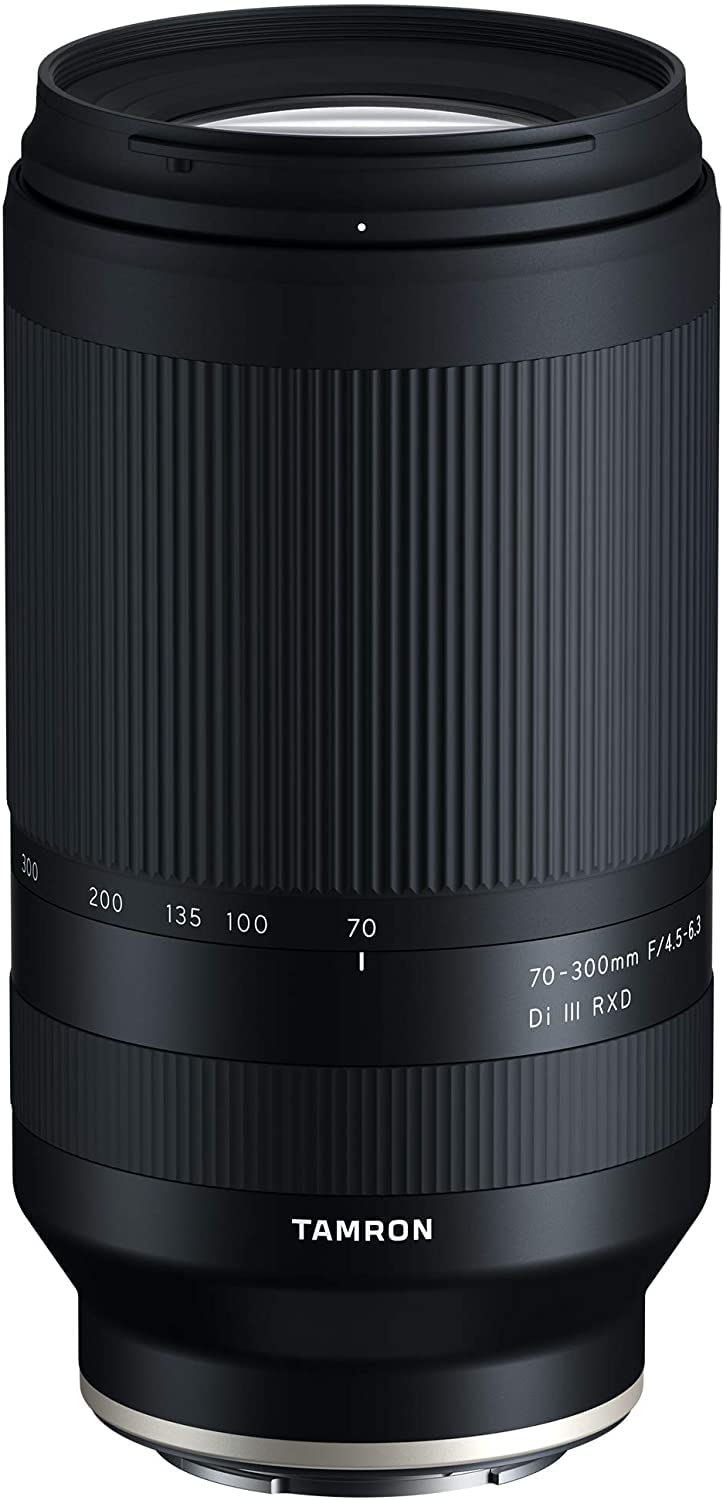
Tamron 70-300mm F4.5-6.3

92 /100
Keeper Score Outstanding

Key details

Focal Range
70-300mm
Elements/groups
15 elements in 10 groups
Weather Sealing
Moisture-resistant construction
Maximum Aperture
f/4.5-6.3
Check Price on Amazon

Reaching 300mm usually means carrying a bigger lens and spending more than a standard zoom. The Tamron 70-300mm F4.5-6.3 Di III RXD is the alternative for the days when you want the reach without committing your whole bag to it. It is the telephoto we suggest when the long lens is a companion rather than the main event.

The 70-300mm range covers portraits, pets, youth sports, and travel compression without the size of a 70-200mm f/2.8. The 15-element design keeps the lens compact enough to carry as a second barrel, and the RXD motor focuses smoothly for still subjects and slow movement. Moisture-resistant construction is welcome at this price, and the zoom ring moves with enough resistance to feel controlled.

Close focus is a useful bonus. At the wide end you can get within about 31.5 inches, which makes flowers and details possible when the long end is not needed. The lens is not a low-light specialist, and the aperture is the obvious trade for its size, but for daylight reach in a light bag it earns its place. We would pack it before a heavier telephoto we might leave at home.

Pros

  • Affordable way to reach 300mm
  • Lightweight for a telephoto
  • Moisture-resistant construction
  • Close focus at 31.5 in wide

Cons

  • f/6.3 at 300mm limits low-light use
Our verdict

A budget telephoto for full-frame Sony shooters who need occasional reach, with a useful 70-300mm range and close-focus flexibility.

Check Latest Price
8

Travel Landscapes

Sony FE 20-70mm F4 G

86 /100
Keeper Score Excellent

Key details

Weight
1.08 lb
Focal Range
20-70mm
Angle Of View
94 degrees
Maximum Aperture
f/4
Check Price on Amazon

The extra 4mm at the wide end is the kind of difference you feel before you can explain it. A 20mm start takes in more of a room, a street, or a landscape than a 24mm zoom, and it does so without making you carry a separate ultra-wide. That is why the Sony FE 20-70mm F4 G is the travel-first zoom we recommend when wide angle matters more than f/2.8.

At 488 g, it is light enough to leave on the camera all day, and the 20-70mm range covers the way many trips actually look: wide interiors, environmental portraits, and details at the long end. The two XD linear motors focus quickly and quietly, and the lens stays sharp across the frame in the kind of even daylight that travel photography loves. We also appreciate the close focus for food and foreground detail.

The f/4 aperture is the trade. It keeps the lens compact and the price lower than an f/2.8 standard zoom, but it gives up low-light headroom and some background separation. For video, the reduced focus breathing and quiet focus make it easy to live with. If most of your shooting happens after dark, look at the faster standard zoom; if you shoot daylight travel and landscapes, this one is the more useful shape.

Pros

  • Unusual 20-70mm range
  • Light 488 g body
  • Fast, quiet XD linear autofocus
  • Close focus for near-macro details

Cons

  • Premium price for an f/4 zoom
Our verdict

A travel-first zoom for Sony shooters who want a 20mm-wide view in a compact, light package, with sharp images and quiet autofocus.

Check Latest Price
9

Everyday Carry

Sony FE 35mm F1.8

89 /100
Keeper Score Excellent

Key details

Weight
9.9 oz
Focal Length
35mm
Diaphragm Blades
9
Maximum Aperture
f/1.8
Check Price on Amazon

The 35mm f/1.4 GM is the more impressive lens. The Sony FE 35mm F1.8 is the one we carry when weight matters and the bag is already full. It gives up a stop of aperture and some of the GM's bite, but it keeps the 35mm view that makes a scene feel the way your eye remembers it.

For everyday carry, this is the 35mm we reach for. At 9.9 oz it adds almost nothing to a small body, and the 8.66-inch minimum focus distance with 0.24x magnification turns it into a useful detail lens for flowers, food, and hands. It is sharp wide open, with the kind of quiet confidence that makes you forget you are using a budget-friendly prime.

Autofocus is fast and quiet thanks to the linear motor, and the lens tracks well enough for street and family work. We did notice some chromatic aberration at wide apertures in high-contrast edges, which is the main place it shows its price. For travel and everyday shooting, that is a fair trade for a lens this small.

Pros

  • Light 9.9 oz build
  • Sharp wide open
  • Close focus to 8.66 in with 0.24x magnification
  • Fast, quiet linear autofocus

Cons

  • Chromatic aberration at wide apertures
  • f/1.8 gives up a stop to the GM
Our verdict

A compact everyday 35mm for full-frame Sony shooters who value portability and close focus over the last stop of aperture.

Check Latest Price
10

Ultra-Wide Scenes

Sony FE 16mm F1.8 G

85 /100
Keeper Score Excellent

Key details

Weight
10.7 oz
Focal Length
16mm
Angle Of View
107 degrees
Maximum Aperture
f/1.8
Check Price on Amazon

A 16mm lens changes the way you move through a scene. You step closer, look up, and let the edges stretch instead of backing into a wall. The Sony FE 16mm F1.8 G is the ultra-wide prime we recommend when you want that view without carrying a bulky zoom or sacrificing a fast aperture.

At 304 g, it is small enough to live in a corner of the bag until the scene calls for it. The f/1.8 aperture is unusual for an ultra-wide, and it gives you handheld headroom in dim interiors and evening streets. The two XD linear motors focus quickly and quietly, and the close focus distance of 0.5 ft lets you put the foreground almost against the glass for dramatic perspective.

The specialist field of view is the trade. People near the edges stretch, straight lines bend if you tilt the camera, and not every scene needs this much width. When it fits, though, the lens is a pleasure: compact, fast, and sharp enough to crop. We kept it mounted for interiors and wide landscapes, and it earned its place as the lens that changes how a place feels rather than simply recording more of it.

Pros

  • Bright f/1.8 aperture
  • Compact 304 g body
  • Close focus to 0.5 ft
  • Fast XD linear autofocus

Cons

  • No optical stabilization
Our verdict

An ultra-wide prime for Sony shooters who want a fast 16mm in a genuinely compact body, with the specialist field of view as the trade.

Check Latest Price

How We Tested These Full-Frame Lenses

We started by building a shortlist from the full-frame mirrorless catalog, filtering out lenses that duplicated a focal range or aperture we'd already covered, and weighing price against the features that actually change how often a lens gets used. That left eight lenses: standard zooms, wide and normal primes, a wide-angle zoom, and one long telephoto zoom. I mounted each on the same two bodies and carried it for a week at a time over nine months—on morning dog walks, at a dimly lit birthday dinner, on a windy overlook, at a kid's soccer game, and through an airport with a backpack.

In the field, I shot each lens wide open and stopped down at the same scenes, then checked the files at 100 percent for sharpness across the frame, color, and contrast rather than trusting the rear screen. For autofocus, I tracked a dog running toward me, focused on a face in low light, and switched between near and far subjects to see whether the lens hunted or snapped into place. I noted how fast it acquired focus and how quickly it kept up during a burst, and I listened for the whine or chatter of the focus motor in a quiet room. Between shoots I checked the mount and control rings for play, and looked for dust behind the front element.

Bokeh got its own test: I photographed a backlit subject against bare branches and a busy street, looking for smooth falloff instead of nervous edges. Weight was judged at the end of a long carry, with the lens on the camera and a spare battery in the bag, not on a kitchen scale alone. For value, I compared what each lens let me shoot without swapping—reach, low-light headroom, or a smaller bag—against what it asked me to carry and spend. The lenses that scored best were not always the sharpest on a chart; they were the ones that made the next shot easier.

How to Choose a Sony Fe Lens

Start with the focal range, not the badge

Your first decision is whether you want one lens to do everything or a specialist that does one thing beautifully. A 24-70mm f/2.8 is the default because it covers interiors, groups, and portraits; a 24-105mm f/4 adds reach and stabilization for travel, while a 35mm or 50mm prime buys a faster aperture in a smaller package. We reach for the standard zoom when the day is unpredictable.

The mistake is buying a fast standard zoom for f/2.8 and then never shooting wider than f/4. If most of your work is outdoors, the longer f/4 zoom buys more useful range. If you shoot people in dim rooms, the faster lens is the one that stays on the camera.

Decide how much aperture you need to carry

Every stop of aperture costs weight, size, and money. An f/1.4 prime like the 35mm GM is a low-light and subject-separation tool; the 35mm f/1.8 is much smaller and still bright enough for most indoor work. In zooms, f/2.8 makes a standard zoom viable at receptions and in dim rooms, while f/4 keeps a travel zoom manageable.

We prioritize f/2.8 when people are moving in poor light. Otherwise, put the savings into reach or a second prime. There is no point paying for speed you stop down to f/4.

Autofocus is where the price gap shows

Lens autofocus matters most when the subject moves or the light drops. Linear motors, like the XD units in Sony's GM lenses and the VXD motor in the Tamron 28-75mm G2, are generally quicker and quieter than the motor in the budget 50mm f/1.8. Quiet focusing matters for video; speed matters for eye AF and tracking.

Before buying, update the lens and camera firmware, then try continuous eye AF in the light you actually shoot in. A lens that locks instantly in a bright shop can feel different at a dim reception.

Plan for weight, support, and weather

A lens you leave at home is no bargain. The 24-70mm GM II is a 680 g standard zoom, the 24-105mm f/4 is 1.5 lb, and the 200-600mm is 4.7 lb; those differences decide whether a lens goes in a day bag or a case. For long telephoto work, budget for a monopod or tripod and a bag that fits the lens with the hood reversed.

Moisture-resistant construction is useful in rain and dust, but it is not a license to dunk a lens. We check the mount seal and use a rain cover when the weather turns.

Frequently Asked Questions

Final Verdict

We recommend the Sony FE 24-70mm F2.8 GM II as the default for full-frame Sony owners because it covers the most situations without making you change lenses. If you shoot in good light and want more reach, the 24-105mm f/4 G OSS is the travel-first alternative; if the budget is tighter, the Tamron 28-75mm f/2.8 G2 keeps the fast aperture at a lower price.

Start with the focal range you use most, and the rest of the decision gets easier.