Best Shotgun Microphones of 2026

Ask a shotgun mic to do its job and you learn fast that capsule shape is only half the story. The tube and interference slots cancel whatever arrives from the sides and leave the voice in front of the lens clean — but only if the mic is quiet on its own and sensitive enough that you aren't cranking the camera's preamp. Get that right and a two-person interview sounds like it was cut in a studio.

I've had shotgun mics bolted to my cameras for years, and over the past six months my team and I ran 11 of them through real shoots — on rigs, on booms, plugged into phones and recorders. We listened for pickup at working distances, handling noise up the mount, self-noise with gain added, and how long the battery really lasted.

One thing first-time buyers get wrong: the tightest spec sheet doesn't win. A low-noise capsule you can gain up usually beats a more directional one that hisses. Below are the mics that survived that trade-off.

Keeper Score summarizes customer ratings and review volume. Read it alongside the product details and trade-offs. How the score works.

1

Best Overall

Sennheiser MKE 600

92 /100
Keeper Score Outstanding

Key details

Power
1 AA battery or 48V phantom
Output
XLR
In The Box
Shock mount and foam windshield
Polar Pattern
Super cardioid
Check Price on Amazon

Most XLR shotguns assume something upstream is sending 48 volts, and a mirrorless camera's audio input isn't. The MKE 600 takes a single AA when nothing is powering it, and the shock mount in the box slides onto a camera's hot shoe — which is exactly why it's the mic we point most people to. It's the same microphone on top of a camera and at the end of a boom.

Point it at a voice from a few feet away and the sides and rear fall off. That rejection is what you're paying for, and it's the difference between dialogue that sounds like dialogue and a recording of a room with somebody in it. The tone is fuller than the compact on-camera mics here, closer to a broadcast mic than a scratch-track accessory, and self-noise stays low enough that pushing gain doesn't flood the track with hiss. Outdoors, the switchable low-cut filter is the one setting we changed between takes — it lifts the rumble out of wind without hollowing out the voice.

Two things to live with. The body is long, so it overhangs the front of a compact rig; on a boom that length is an advantage, because it keeps your hands further from the capsule. And the included hot-shoe mount is the first part to replace for handheld work — a proper suspension mount is the difference between clean audio and every finger tap showing up in the take. In a reverberant room no shotgun flatters you, so treat this as an outdoor and treated-space mic.

Pros

  • Runs on phantom power or a single AA
  • Strong side and rear rejection
  • Low self-noise when gain is pushed
  • Shock mount and windshield included

Cons

  • Long body overhangs compact camera rigs
Our verdict

The MKE 600 is the shotgun we point most people to: it mounts on a camera or a boom, runs on phantom or a AA, and sounds clean doing it.

Check Latest Price
2

Best for Boom Work

Audio-Technica AT875R

90 /100
Keeper Score Outstanding

Key details

Length
Under 7 inches
Weight
2.88 oz
Acceptance Angle
Narrow, for long-distance pickup
Check Price on Amazon

If the MKE 600 is the mic that fits whatever you already own, the AT875R is the one that makes you want a recorder. It's under seven inches and just under three ounces, so it disappears at the end of a boom or on a compact rig, and its personality is refusal: sound arriving from the sides and rear doesn't make it onto the track.

We reach for it indoors, which isn't something we say about most shotguns in this guide. The narrow acceptance angle and a response tailored to keep camera and handling noise down mean it does its best work about two feet from the person speaking — close enough to feel present, far enough that you aren't fighting plosives. Its tone is neutral enough to cut together with a longer boom mic in the same scene, which is a hard thing for a short shotgun to pull off.

The catch is that this is a specialist's tool. It rewards a hand that's actually aiming; point it roughly and you'll hear the room instead of the voice, and there's no switch or filter that rescues that afterwards. What you get in return is the shortest, quietest mic here that still behaves like a real shotgun, at a price that leaves room for the pole and mount you'll want.

Pros

  • Short and light enough for tight rigs
  • Excellent side and rear rejection
  • Neutral tone that cuts with longer boom mics
  • Strong value for a production shotgun

Cons

  • Needs phantom power from a recorder or interface
Our verdict

Buy the AT875R if your audio goes into a recorder or interface and you want a short, quiet shotgun that keeps the room out of the take.

Check Latest Price
3

Best for Run-And-Gun

RØDE VideoMic Pro+

90 /100
Keeper Score Outstanding

Key details

Power
LB-1 rechargeable, 2x AA or USB
Output
3.5mm TRS
Weight
4.32 oz
Controls
High-pass, HF boost, pad, safety channel
Check Price on Amazon

The VideoMic Pro+ turns itself on when the camera wakes and off when you stop rolling. That reads like a small convenience until you've shot a morning with a dead mic because a switch moved in the bag.

Power is the theme throughout: an LB-1 rechargeable in the box, two AAs as a fallback and USB if you're caught short, which is more redundancy than anything else here. The safety channel keeps a backup track in case the main one clips, so a sudden laugh doesn't end the take, and the high-pass filter, high-frequency boost and pad are all built in. The Rycote Lyre suspension does the isolating, and it's the reason knocks and cable rustle stay out of the recording. Set the dial once and it's about as close to a self-managing mic as we've used in this group.

Where it earns its premium is a rig you can't babysit: gimbal work, a camera on a slider, a second unit running unattended. Where it doesn't is a controlled interview, where a longer XLR shotgun beats it on rejection and self-noise. You're paying for the power system and the safety track more than for the capsule, and on a shoot with no second take that's money well spent.

Pros

  • Auto power on and off with the camera
  • Safety channel protects against clipping
  • LB-1 rechargeable plus AA and USB options
  • Rycote Lyre suspension kills handling noise

Cons

  • Wider pattern than a long XLR shotgun
  • Premium price for a 3.5mm on-camera mic
Our verdict

For run-and-gun shooting where nobody's watching levels, the VideoMic Pro+ earns its premium with a safety channel and automatic power.

Check Latest Price
4

Best Compact On-Camera

Sennheiser MKE 400

90 /100
Keeper Score Outstanding

Key details

Power
1 AAA battery
Connectors
3.5mm TRS and TRRS
Monitoring
Headphone output with volume
Polar Pattern
Super cardioid
Check Price on Amazon

A headphone jack on an on-camera mic sounds like a gimmick until you've wrapped a shoot without one. The MKE 400 has it, with its own volume dial, so you can confirm the take is clean while it's happening instead of finding a hum in the edit. That alone is why we reach for it when monitoring matters more than size.

The rest of the package is compact and sensible: a supercardioid capsule, interchangeable 3.5mm TRS and TRRS cables for cameras and phones, integrated wind protection and an internal suspension mount so handling noise doesn't ride along, plus a low-cut filter and a three-step sensitivity switch for matching the mic to whatever preamp you're plugged into. It runs on a single AAA.

The housing does more outdoor work than its size suggests, and adding a furry cover on top handles the rest. What it asks in return is that you set the sensitivity switch deliberately rather than leaving it wherever it landed — matched to the camera, the mic is quiet; set wrong, you'll spend the edit fighting the noise floor.

Pros

  • Headphone jack with volume for monitoring
  • Interchangeable TRS and TRRS cables
  • Integrated wind protection and internal suspension
  • Low-cut filter and 3-step sensitivity switch

Cons

  • One more AAA to keep stocked
  • 3.5mm only
Our verdict

We choose the MKE 400 when we need to hear what's being recorded — its headphone jack is worth the extra bulk on a small rig.

Check Latest Price
5

Best Budget

RØDE VideoMic GO II

90 /100
Keeper Score Outstanding

Key details

Power
No battery required
Weight
2.12 oz
Outputs
3.5mm TRS and USB-C
Polar Pattern
Super cardioid
Check Price on Amazon

Sixty grams at the front of a gimbal doesn't move the balance, and that's the whole argument for the VideoMic GO II. There's no battery to charge and no switch to remember — it draws plug-in power from whatever it's connected to, so it's ready every time you pull it out of the bag.

Two outputs in one small body is the trick: 3.5mm TRS for cameras and a USB-C digital output for phones, tablets and computers, with the HELIX mount soaking up knocks and the included windshield doing more outdoors than most bundled foams. The sound is clear and slightly warm, which flatters a voice at arm's length and holds up for vlogs, interviews and voiceover. It is not a substitute for a boom mic across a room — no short on-camera mic is.

Control is where it gives ground. There are no gain or filter switches on the body; the high-pass filter, high-frequency boost and pad live in RØDE's app, which means a phone or computer is doing the adjusting. We set ours once and haven't opened the app since, but if you like trimming levels by feel mid-take you'll miss a dial. At this price, that's a trade we'll take.

Pros

  • Battery-free
  • 3.5mm and USB-C outputs
  • 60 g, so it barely affects gimbal balance
  • HELIX mount and windshield included

Cons

  • Plastic body feels less rugged than metal rivals
Our verdict

Nothing here is easier to live with on a phone or a gimbal than the VideoMic GO II — no battery, 60 g, two outputs.

Check Latest Price
6

Starter Kits

Movo X1-Mini

86 /100
Keeper Score Excellent

Key details

Outputs
3.5mm TRS, TRRS and USB-C
In The Box
Rycote shock mount, two windscreens, case
Digital Audio
Up to 24-bit
Polar Pattern
Super cardioid
Check Price on Amazon

Count what's in the box: the mic, a dual Rycote shock mount, a foam windscreen, a furry one, a TRS cable, a TRRS cable, a USB-C cable and a carrying case. That's the accessory list most people assemble one piece at a time over their first month, and it's the reason the X1-Mini is the kit we suggest to someone starting from nothing.

The body is aluminum rather than plastic, and it's a proper shotgun shape with a supercardioid capsule, so it works as a boom mic on a pole as readily as it does on a camera. In digital mode it records up to 24-bit over USB-C, and the dual shock mount holds the capsule clear of the body.

It's a short shotgun, so it wants to be within a few feet of the person talking; across a room you'll hear the room. Next to the VideoMic GO II it's the more complete package and the less refined sound, which is roughly what the price difference says.

For a first mic, completeness counts more than the last word in clarity, and nothing else here hands you wind protection for two conditions, every cable you need and a real shock mount in one purchase. The mount itself is the giveaway: the grip is tight enough that the mic has to be worked into it, which is annoying when you're swapping mics and reassuring when you're moving fast.

Pros

  • Full kit: two windscreens, three cables, case
  • Aluminum body with a dual Rycote mount
  • Works on a camera or a boom pole
  • 3.5mm TRS, TRRS and USB-C outputs

Cons

  • USB-C digital mode limited to 24-bit
Our verdict

The X1-Mini is the fullest starter kit in this guide: two windscreens, three cables and a real shock mount, at the bottom of the price range.

Check Latest Price
7

Wireless Boom Work

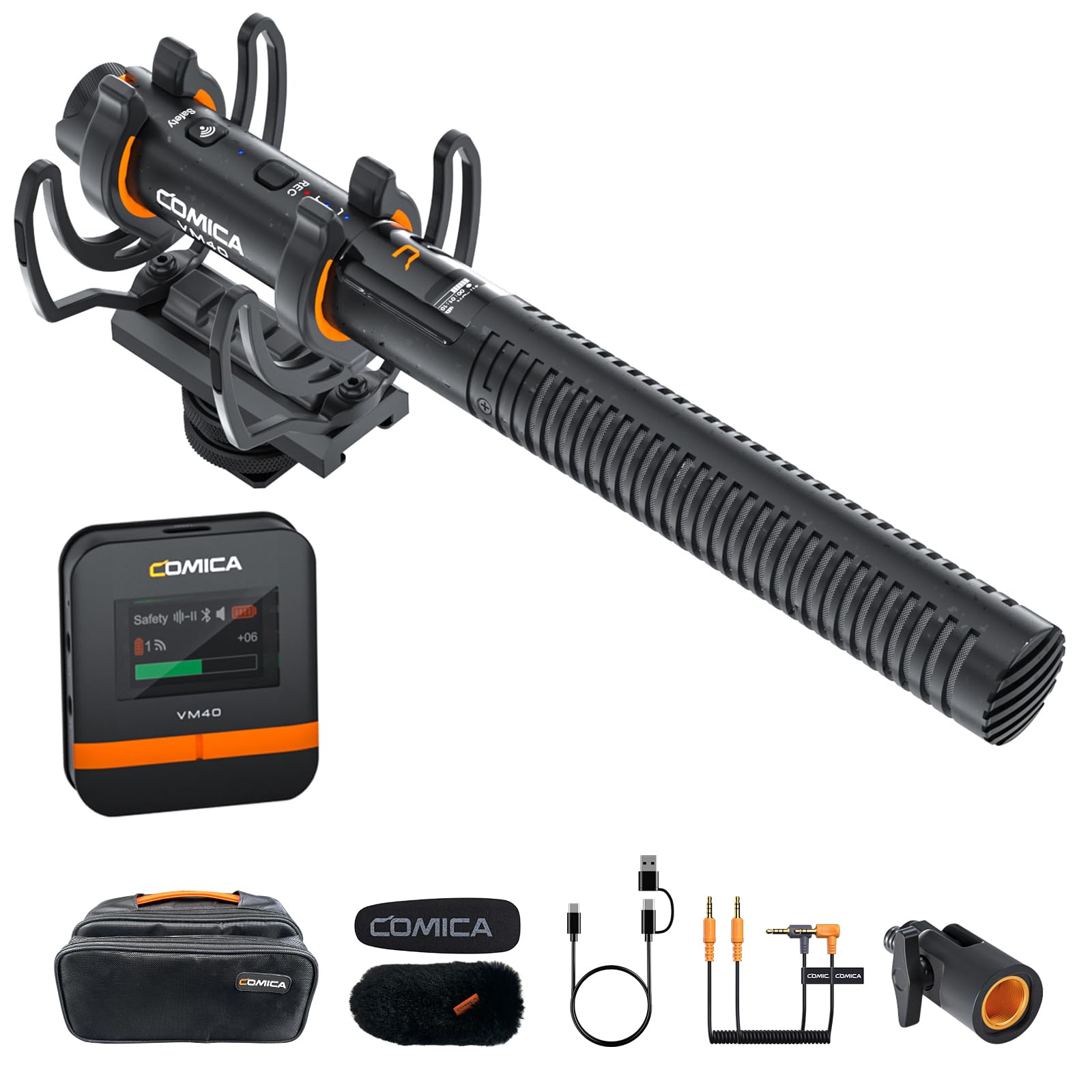
Comica VM40

86 /100
Keeper Score Excellent

Key details

Storage
32GB internal
Wireless
2.4GHz, up to 200 m
Recording
48kHz/32-bit float
Working Time
Up to 32 hours
Check Price on Amazon

Recording inside the microphone is the idea worth paying attention to. The VM40 is a shotgun that also carries 32GB of storage and records 48kHz/32-bit float to it, so when the wireless link hiccups or the camera gain is set wrong, there's still a clean file on the mic. For a one-person shoot, that's insurance you can't otherwise buy at this size.

It works two ways: wired over 3.5mm or USB-C like any other on-camera mic, or wireless over 2.4GHz with the receiver on the camera and the mic on a pole, at a range the spec puts at up to 200 metres. Safety mode splits the audio into two tracks, one-key denoise and the low-cut and high-frequency boost are there when a room needs them, and working time runs to about 32 hours.

Versatility is the sell and complexity is the cost. There are more modes, menus and app screens here than on anything else in this guide, and most of the setup happens before you roll — what we noticed most is how much of it you want to get right at home rather than on location. The receiver's charge is a single point of failure too: a receiver that stops charging takes the wireless feature with it, so keep the cable in the bag.

What it replaces is a wireless kit and a separate recorder in the same bag. For a solo shooter, that's one less thing to charge, sync and forget at home.

Pros

  • Records 32-bit float to 32GB internally
  • Wired and wireless modes in one mic
  • Safety track and one-key denoise
  • Up to 32 hours of working time

Cons

  • Receiver's charge is a single point of failure for wireless
  • More modes and menus than most shooters need
Our verdict

If your shoots are one-person and unforgiving, the VM40's built-in 32-bit float recording is the feature that sells it.

Check Latest Price
8

First XLR Mic

Boya BY-BM6060

85 /100
Keeper Score Excellent

Key details

Power
24–48V phantom or 1 AA
Output
3-pin XLR
Weight
8.11 oz
Polar Pattern
Super cardioid
Check Price on Amazon

Every XLR shotgun has a price floor, and the BY-BM6060 sits just above it. You get a 3-pin XLR condenser with a supercardioid capsule, a suspension shock mount, foam and furry windscreens in the box, and the choice of 24–48V phantom power or a single AA when your recorder can't supply it.

For the money the audio is better than it has any right to be: clean on speech, with the low-noise circuitry doing what it promises. What you're buying at this price is the absence of refinement rather than a flaw. It's a sensitive mic with a wider pickup than the long shotguns here, so it needs to be close to the subject and your gain set conservatively before the first take. In a quiet room that's a pleasure; in a busy one it's work.

The AA option matters more than it sounds. Plugged into a camera or a recorder that doesn't supply phantom, it's the difference between a working mic and a paperweight — and at 230 g it's an easy thing to hold on a pole for an hour.

Pros

  • 3-pin XLR with phantom or AA power
  • Shock mount and both windscreens included
  • Clean speech for the money
  • 230 g, comfortable on a pole

Cons

  • Picks up more of a busy room than a long shotgun
Our verdict

The BY-BM6060 is the least expensive way into an XLR shotgun here, and a sensible first boom mic if you watch your gain.

Check Latest Price

How We Tested the Best Shotgun Mics

We built the shortlist from spec sheets and owner reviews, narrowing by the connections that matter — 3.5mm TRS for cameras, TRRS for phones, USB-C for computers, XLR with phantom power for recorders — plus whether each mic carried its own battery or leaned on plug-in power, and what actually came in the box, since a real shock mount and a decent windshield change the value math. Then we brought in 11 and spent six months using them where they belong: on a mirrorless camera at a kitchen-table interview, on a boom in a carpeted room and a bare-floored hallway, handheld at a street market, and clamped to a phone for cutaways.

For pickup, we recorded the same scripted lines at three, six, and ten feet, then stepped to 90 and 180 degrees off-axis to hear how much voice leaked in from the sides. Each mic also recorded a minute of room tone pointed at a bare wall, and again with the gain lifted in the edit, so we could hear hiss and the low electronic whine that only shows up in quiet rooms. In a tight room with a monitor speaker, we pushed each one until it started to ring.

Mounting got rough treatment: cold shoe, shock mount, boom pole, a deliberate tap on the camera body mid-take, and a pan across a tripod, with notes on how much of that thump reached the recording. We logged which mounts adjusted and locked without a tool and whether the loaded rig still fit a small bag. Battery-powered models ran continuously until dead with a clock going, and we watched what happened when one quit mid-take and whether a safety channel rescued the line.

How to Choose a Shotgun Microphone

Start With Power, Not the Capsule

Your camera decides more than your taste does. A mirrorless or DSLR 3.5mm input supplies plug-in power, not phantom, so an XLR shotgun needs a recorder, an interface, or a battery compartment before it will make a sound. That's why the MKE 600 and the BY-BM6060 take a AA and the AT875R doesn't. If you want one cable from mic to camera, buy a 3.5mm mic and stop there; if you're building toward a recorder, start in XLR.

The far end matters too. USB-C gets you into phones, tablets and laptops, TRRS gets you into a phone's headset jack, and a mic like the VideoMic GO II can skip the camera entirely. Decide which of those you'll actually use before you fall for a capsule.

Rejection Only Works Up Close

A shotgun's interference tube earns its keep when the source is a couple of feet away. At ten feet it's still more directional than an omni, but it's collecting the room around the speaker as well as the speaker, and no filter takes that back out afterwards. So the useful question isn't how far the mic reaches — it's how close you can put it. Short shotguns like the AT875R suit tight rooms and small rigs; a longer tube suits open exteriors where you can keep your distance.

Self-Noise, Output and the Preamp Behind Them

Every mic hisses a little; the question is whether you have to turn it up to hear it. The gain you need depends on the mic's sensitivity and on the preamp behind it, and a hot output into a modest camera input is worth more than a very quiet mic you have to crank. That's the practical case for the low-noise designs here, and for features like the VideoMic Pro+'s safety channel, which keeps a backup track when the main one clips.

Mounts and Windshields Carry Half the Load

Handling noise is the most common reason a technically fine take is unusable, and it travels through the mount rather than the capsule. A Rycote-style suspension — the VideoMic Pro+, the X1-Mini — decouples the mic from the camera far better than a rigid clip, and a furry windshield does more outdoors than any electronic filter. Everything here ships with a mount of some kind, so the question is whether it's a suspension mount or a clip, and whether the windshield is a foam puff or a furry one.

Wired, Wireless, or Recording Inside the Mic

Wireless shotguns used to mean a transmitter taped to a boom and a receiver on the camera. The Comica VM40 folds both into the mic and adds internal recording, which changes what you can rescue afterwards: a dropped link or a wrong gain setting no longer costs you the take. The price is complexity — more modes to set, more batteries to charge, more to go wrong at the worst moment. If you shoot tethered and alone, cable is still the more reliable answer.

Frequently Asked Questions

Final Verdict

Our pick is the Sennheiser MKE 600. It's the only mic here that works on a camera and on a boom without an adapter or a second purchase, its rejection and self-noise hold up on a real dialogue track, and the AA option means a camera without phantom power doesn't sideline it.

If your audio already runs into a recorder or an interface, the AT875R is the shorter, more surgical specialist for that kit. Shooting on a phone or a gimbal? Start with the VideoMic GO II and put the savings toward a better pole.