Best Rechargeable AAA Batteries of 2026

Somewhere in your house there's a remote that only works when you hold it at an angle, and the culprit is almost always a tired AAA. Rechargeables fix that for good — but only if you buy the right ones. Cheap cells are where people get burned: capacity printed on the wrapper that a game controller never delivers, and a useful life measured in months.

For four months, we've kept 15 rechargeable AAAs from eight brands cycling through the things that actually eat batteries — remotes, game controllers, a toddler's toy, LED candles, a headlamp — with a spare pair of each parked in a drawer to see which held their charge. The gaps were not subtle. Pack size mattered as much as cell quality: four is a start, 24 is a household supply, and the price per battery swings wide.

Every pack here is batteries only, so you'll need a charger on hand — and pre-charged matters more than it sounds, since it's what lets you open the pack and use them today.

Keeper Score summarizes customer ratings and review volume. Read it alongside the product details and trade-offs. How the score works.

1

Best Overall

Eneloop AAA 12-Pack

95 /100
Keeper Score Outstanding

Key details

Capacity
800 mAh minimum, 850 mAh typical
Pack Size
12-count
Recharge Cycles
Up to 2,100
Charge Retention
70% after 10 years
Check Price on Amazon

The number that decides this one isn't capacity — it's ten years. Panasonic rates these cells to keep up to 70% of their charge after a decade in a drawer and to survive 2,100 recharges, and we paid close attention to both figures, because together they're the difference between batteries you use and batteries you keep buying. A spare set that still works after a long sit in a kitchen drawer is worth more than a cell that's a hundred milliamp-hours bigger and flat by spring.

Everything else is plain NiMH: 800 mAh minimum, 850 typical, 1.2 volts, charged at the factory before packing. That capacity is mid-pack here — the EBL and HiQuick packs both claim 1,100 mAh — so if runtime in a flashlight is your only measure, this isn't the biggest number on the page. It is the most predictable cell in the devices that make up most AAA use: remotes, clocks, a wireless mouse, a toy that gets played with in bursts and then ignored for a week.

Price is where it asks something back. Per cell it costs more than the Amazon Basics, EBL and POWEROWL bulk packs, and that premium buys cycle life and storage rather than milliamp-hours. Twelve cells also means you're outfitting devices in batches, which suits a household with a spare set per remote better than someone replacing two batteries in one handset.

Where these stop making sense is a camera flash or a flashlight used hard — the Eneloop Pro exists for exactly that and gives up cycle life to get there. For everything else in the house, these are the cells we stop thinking about, which is the whole point.

Pros

  • Holds 70% of charge for up to 10 years
  • Up to 2,100 recharges per cell
  • Ships pre-charged and usable immediately
  • Rated to work down to -4°F

Cons

  • Twelve cells may exceed a small household's needs
Our verdict

For remotes, clocks and controllers, these are the cells to buy: a decade of storage life and 2,100 recharges in a pack that arrives ready to use.

Check Latest Price
2

Best Bulk Value

Amazon Basics AAA 24-Pack

93 /100
Keeper Score Outstanding

Key details

Capacity
800 mAh
Pack Size
24-count
Recharge Cycles
Up to 1,000
Charge Retention
80% after 2 years
Check Price on Amazon

Twenty-four cells is a different kind of purchase from a four-pack. It's the point where you stop rationing batteries and start leaving a set in every remote, toy and clock in the house — and once you divide the pack price by 24, the cost per cell is the lowest in this group, well under the Eneloop and the Duracell.

On paper the cells are ordinary: 800 mAh, 1.2 volts, up to 1,000 recharges and 80% of their charge retained after two years. We wish the consistency matched the arithmetic. A pack this size can include cells that go flat inside a week while the rest keep working, with nothing on the outside to tell you which is which, so the sensible routine is to charge all 24, run them through a couple of low-stakes devices and set aside the ones that won't hold.

For roughly the price of one premium pack you get enough cells to fill everything you own and still have spares left, and 1,000 recharges is more than a household will cycle through in a decade. If you want batteries you never think about, spend more on the Eneloops. If you want the drawer full, this is the one.

Pros

  • Lowest cost per cell in this group
  • Up to 1,000 recharges
  • Retains 80% of charge for two years
  • Arrives pre-charged

Cons

  • 800 mAh limits runtime in high-drain devices
Our verdict

A 24-pack for the least money per cell in this group, and the pack we suggest when every remote in the house needs two batteries.

Check Latest Price
3

Best for High-Drain Devices

Eneloop Pro AAA 4-Pack

95 /100
Keeper Score Outstanding

Key details

Capacity
950 mAh
Pack Size
4-count
Recharge Cycles
Up to 500
Charge Retention
85% after 1 year
Check Price on Amazon

A flashlight, a flash unit and a game controller all want the same thing from an AAA cell: current, now. The Pro is the capacity-first Eneloop — 950 mAh against the standard cell's 800 — and that extra 150 mAh is why we keep a set for the devices that dim noticeably as the battery fades rather than dying politely mid-remote.

We noted that the trade runs the other way from the standard cell, and it's steeper than the capacity difference suggests. You get 500 recharges instead of 2,100, and 85% of the charge retained after a single year instead of 70% after ten. High-capacity NiMH works that way: thinner electrodes hold more but cycle less. That makes the Pro a poor choice for the clock in the hallway and a good one for the headlamp you take camping.

The other catch is cost. Per cell, these are the most expensive batteries in this group, and that is the price of the capacity. If one device matters enough to justify it — the flashlight in the car, the flash unit you shoot a wedding with — the maths works out. If you're outfitting a whole house, standard Eneloops or a bulk pack will do the job for less.

Pros

  • 950 mAh, the highest capacity in the Eneloop line
  • Pre-charged at the factory
  • Holds 85% of charge for a year

Cons

  • Only four cells to a pack
Our verdict

Worth the extra per cell for a flashlight, a flash unit or a controller — the capacity is the highest in the Eneloop line and you feel it in devices that dim as they fade.

Check Latest Price
4

Best Small Pack

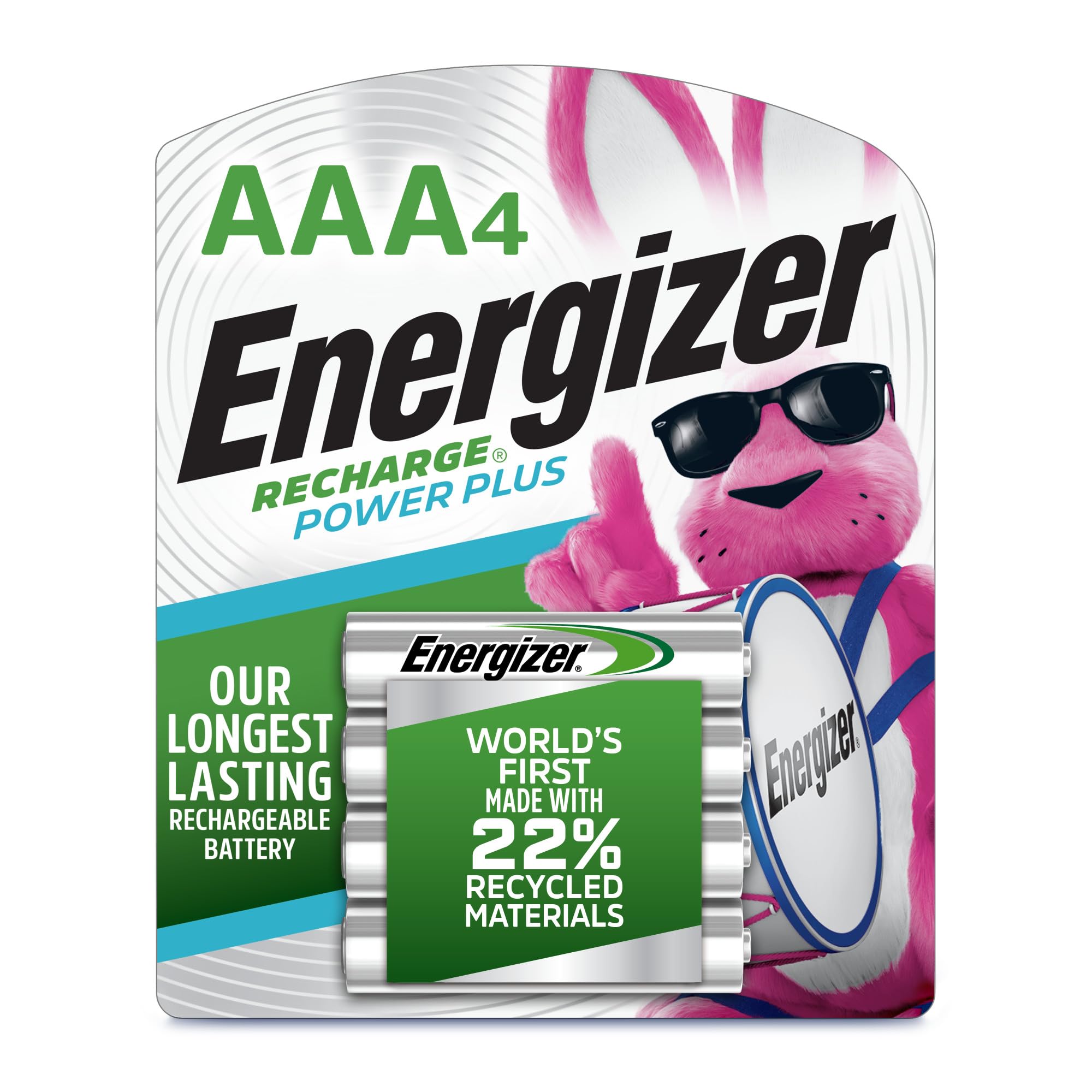
Energizer Power Plus AAA 4-Pack

95 /100
Keeper Score Outstanding

Key details

Capacity
800 mAh
Pack Size
4-count
Leak Protection
Designed to prevent leaks
Check Price on Amazon

Not everyone needs a drawer of batteries. Four cells is the right size if you're replacing the set in one cordless handset, one controller or one flashlight, and this is the pack we point people to when they want a known brand without committing to twenty-four.

The cells are 800 mAh at 1.2 volts, made with 22% recycled materials, with Energizer's leak-resistant construction. Nothing here is exotic. What you're buying is a predictable spec and the ability to pick up more at almost any store — which matters more than it sounds when you're one cell short and the device is already open.

But we appreciate that this is the pack with the least to prove: no high-capacity badge, no exotic chemistry claim. The softer part is how they sit. Charge retention over months of idling is where these are least convincing, so top them up before they go into anything you only use occasionally — with four cells, that's a two-minute job.

Pros

  • 800 mAh in a compact four-pack
  • Made with 22% recycled materials
  • Leak-resistant construction

Cons

  • Costs more per cell than the bulk packs here
Our verdict

The four-pack we suggest when one cordless handset or one controller needs cells and a 24-count makes no sense.

Check Latest Price
5

Best High-Capacity Bulk Pack

EBL AAA 1100mAh 16-Pack

93 /100
Keeper Score Outstanding

Key details

Capacity
1,100 mAh
Pack Size
16-count
Charge Retention
80% after 3 years
Check Price on Amazon

At 1,100 mAh, this is the biggest number on any AAA cell in this group. On paper that's roughly a third more capacity than an 800 mAh Eneloop or Amazon Basics cell, and in a flashlight or a motorized toy it should translate into longer runs between charges.

We wondered whether the badge would survive contact with a real device. Capacity ratings on budget cells are a ceiling rather than a promise — a pack badged 1,100 mAh can behave like an 800 mAh cell under a hard load — so treat the extra as a bonus rather than a figure you can plan around.

What the big pack actually buys you is slack. Sixteen cells means a failure costs you a cell rather than a device, and it means you can dedicate a set to the flashlight, a set to the toy box and still have spares. For a household with a lot of kid-powered gadgets that's a fair deal; for four devices and a couple of remotes, a smaller pack is less to keep track of.

Pros

  • Highest stated capacity in this group
  • Holds 80% of charge for three years
  • Sixteen cells at a low per-cell cost

Cons

  • Some cells won't take a charge
Our verdict

The largest capacity claim here, in a pack big enough to supply every toy and flashlight in the house without a second order.

Check Latest Price
6

Cordless Phones

Duracell Rechargeable AAA 4-Pack

95 /100
Keeper Score Outstanding

Key details

Capacity
900 mAh
Pack Size
4-count
Charge Retention
Up to 1 year
Storage Guarantee
10 years
Check Price on Amazon

Duracell built this cell for the devices that live in a base or on a wall: cordless handsets, thermostats, remotes. That's the honest read of a four-pack with a 10-year storage guarantee behind it — it isn't aimed at someone stocking a whole house.

The practical details are sound. They arrive pre-charged, hold charge for up to a year unused, and use the leak-resistant construction Duracell puts in its rechargeables — which is the failure that actually kills the devices people forget about for a season.

In a cordless handset, which is what most people buy these for, the chemistry is exactly right: NiMH at 1.2 volts is what the charging cradle expects, and the cells get topped up every time the phone is set down. Four to a pack suits that job and a couple of remotes. It doesn't stretch to a houseful of devices.

So while we recognize the appeal of a familiar name in a small pack, this is one of the priciest ways to buy AAA capacity here. Buy it for the handset, the thermostat or the smoke alarm — the devices where a cell sits in place for a year — rather than as your household's whole supply.

Pros

  • Holds charge up to a year unused
  • 10-year storage guarantee
  • Arrives pre-charged
  • Leak-resistant construction

Cons

  • Rated 900 mAh; cells often measure closer to 800
Our verdict

The right cells for a cordless handset or a thermostat, where the device tops them up constantly — less compelling if you're buying AAA capacity in bulk.

Check Latest Price
7

Everyday Mixed Use

HiQuick AAA 8-Pack

93 /100
Keeper Score Outstanding

Key details

Capacity
1,100 mAh
Pack Size
8-count
Recharge Cycles
Up to 1,200
Charge Retention
80% after 3 years
Check Price on Amazon

Eight cells is the size most households actually need — enough for a few devices with a spare set, not so many that half of them sit unused until they've self-discharged. HiQuick fills that slot with a 1,100 mAh cell rated for 1,200 recharges and 80% charge retention after three years, at a cost per cell below every brand-name pack here.

What you accept at this price is consistency. A cell that charges normally at first can stop taking a full charge after a handful of cycles, and in an eight-pack that's a quarter of your supply — so charge all eight when they arrive, note which ones the charger finishes quickly, and keep the weaker ones for the low-stakes jobs.

We think it's a fair trade for the money when the batteries are headed for remotes, a mouse, kitchen scales and the other slow-drain devices that make up most of a house's AAA use. It's a poor trade for the flashlight you rely on, where capacity is the thing you notice running out at the worst possible moment.

Pros

  • Up to 1,200 recharges
  • Holds 80% of charge for three years
  • Eight cells at a low cost per cell

Cons

  • Capacity falls short of the 1,100 mAh rating on some cells
Our verdict

A sensible middle-sized pack at a low per-cell cost, best suited to remotes, scales and mice rather than anything that pulls hard.

Check Latest Price
8

Holiday Decor

POWEROWL AAA 24-Pack

91 /100
Keeper Score Outstanding

Key details

Capacity
1,000 mAh
Pack Size
24-count
Recharge Cycles
Over 1,200
Charge Retention
70% after 3 years
Check Price on Amazon

Twenty-four AAA cells is a supply, not a set. If your house runs on batteries — window candles in December, solar path lights, a toy box that eats AAAs in pairs — a pack this size means you stop thinking about batteries for a year, and 1,000 mAh is a step above the standard 800 mAh cell.

The supporting numbers are decent: over 1,200 recharges, pre-charged out of the box, and a 30-day return window with a 12-month guarantee behind it. None of it is class-leading here, but all of it is enough for the jobs this pack is aimed at.

Bulk buying does mean bulk variance. In a 24-pack, expect a cell or two the charger rejects outright — a nuisance rather than a disaster when you still have twenty-two — so charge the whole box on arrival, mark the rejects and put the rest into service. A smart charger that flags bad cells saves a lot of guessing here.

For a drawer of spares headed to decorations, solar stakes and toys, we think this is the best value in the group. It isn't the pack for the flashlight you depend on — the Eneloop Pro is — and it isn't pretending to be.

Pros

  • 24 cells at a low cost per cell
  • 1,000 mAh beats the standard 800
  • Over 1,200 recharges

Cons

  • Charge retention trails the other bulk packs here
Our verdict

The bulk pack we suggest for holiday lights, solar stakes and toy boxes, where you need a lot of cells and none of them are critical.

Check Latest Price

How We Tested Rechargeable AAA Batteries

We started with the specs shoppers can actually compare: the milliamp-hour rating on the label, the claimed cycle count, whether the cells arrive pre-charged, and whether the listing promises low self-discharge. We dropped anything without a stated chemistry or cycle rating, then bought packs in the sizes people realistically order — four cells for a single device, 24 for a whole house — and calculated a straight price per battery so a big pack couldn't disguise a bad deal.

Fifteen cells went into service for four months. Each freshly charged set went into the same rotation of devices — a wireless game controller, a TV remote, a headlamp, a noisy kids' toy — and we logged hours of use until the device died, then ran it again, watching for a set that faded noticeably faster on the third or fourth round than on the first.

Charging got its own set of notes: how long a full charge took, whether the cells got warm enough to notice by touch, and whether the charger flagged them as done at roughly the same time. To check the low self-discharge claims, we charged a pair of each, labeled them, and left them in a drawer for two months before checking voltage and dropping them into a remote to see if it woke up.

We also drained each cell on a charger that reports delivered capacity, to see how close it came to the number printed on the wrapper — most landed under their rating, one or two by a lot. And we treated cycle counts as a filter rather than a result: 2,000 charges is years away, so what we actually watched for was the early sag that shows up in the first few dozen rounds.

How to Choose Rechargeable Aaa Batteries

Match the Cell to the Device

Most of a house's AAA use is slow: remotes, clocks, a kitchen scale, a wireless mouse. Those devices care about a cell that holds its charge while sitting idle, not one with the biggest number printed on it. Save the capacity-first cells for the handful of devices that pull hard — a flashlight, a camera flash, a game controller, a motorized toy.

The Eneloop Pro is the clearest example of the trade in this set: 950 mAh of capacity bought by dropping from 2,100 recharges to 500. Buy capacity for one or two devices and cycle life for everything else.

Compare Retention Claims on the Same Clock

Every low-self-discharge claim here comes with a time attached, and the times are wildly different: 85% after one year, 80% after two years, 70% after ten. A two-year figure and a ten-year figure aren't the same kind of promise, so read the years before you read the percentage.

If the cells will live in a drawer between jobs, the long-horizon claim is worth paying for. If they go straight into a device and get charged every few weeks, retention barely matters and you should be shopping on cost per cell instead.

Let Pack Size Set Your Cost per Cell

Cost per cell falls as the pack grows, and it falls a long way — the four-counts here cost several times more per cell than the 24-counts. The catch is variance: a big box means more cells you haven't tested yet, and two that won't charge hurt more when you've counted on them.

For most households, eight or sixteen cells covers every device plus a spare set without leaving a shoebox of unknowns. Buy the size that matches your device count, not the biggest box on the page.

Check the Charger and the Battery Compartment

All of these are 1.2-volt NiMH, not the 1.5 volts an alkaline delivers, so a device with a crude battery gauge can read them as low early or refuse to start. That's the chemistry, not a fault. You also need a charger rated for NiMH; a smart one with individual channels will flag a bad cell for you.

Then check fit. AAA cells vary slightly in diameter, and a snug compartment in a cordless handset or a toy can turn a bargain pack into a stuck battery. Test one cell in your tightest bay before you commit to twenty-four.

Frequently Asked Questions

Final Verdict

The Eneloop 12-pack is the set we point most people to. A decade of storage life and 2,100 recharges beat a bigger milliamp-hour number for the remotes, clocks and controllers that use most of a house's AAA cells, and they arrive ready to use.

If money is the constraint, the Amazon Basics 24-pack costs the least per cell here and does the same job with less consistency. And for the one device that pulls hard — a flashlight, a flash unit, a controller — the Eneloop Pro's 950 mAh is the upgrade worth paying for.