Best Sandbags for Light Stands of 2026

Light stands don't fall over because they're flimsy. They fall over because someone brushes past a boom arm, a garage door rolls up, or the wind picks up halfway through shooting outdoors — and the stand goes over with a camera on top of it. A sandbag is the cheapest insurance in photography, and also the piece of gear most likely to betray you: split a seam or skip a zipper and you're sweeping sand out of your lenses and floor for a month.

Over four months, my team and I filled 16 sandbags — saddlebag designs, single sacks, two-packs and eight-packs — and hung them from light stands, boom arms, backdrop stands, and the legs of a canopy on a gusty afternoon. Here's what nobody tells a first-time buyer: the bag isn't the weight, the sand is. You're really paying for a liner that keeps sand where it belongs, a zipper that stays shut under load, and a strap that clips onto a stand without sliding down it. The picks below are the ones that held their fill, stayed put, and cost the least per pound.

Keeper Score summarizes customer ratings and review volume. Read it alongside the product details and trade-offs. How the score works.

1

Best Overall

Eurmax 4-Pack Sandbags

89 /100
Keeper Score Excellent

Key details

Set
4 bags, 4 aluminum clips
Shell
1680D polyester
Liners
8 PE inner bags included
Closure
Two zip pouches per bag
Check Price on Amazon

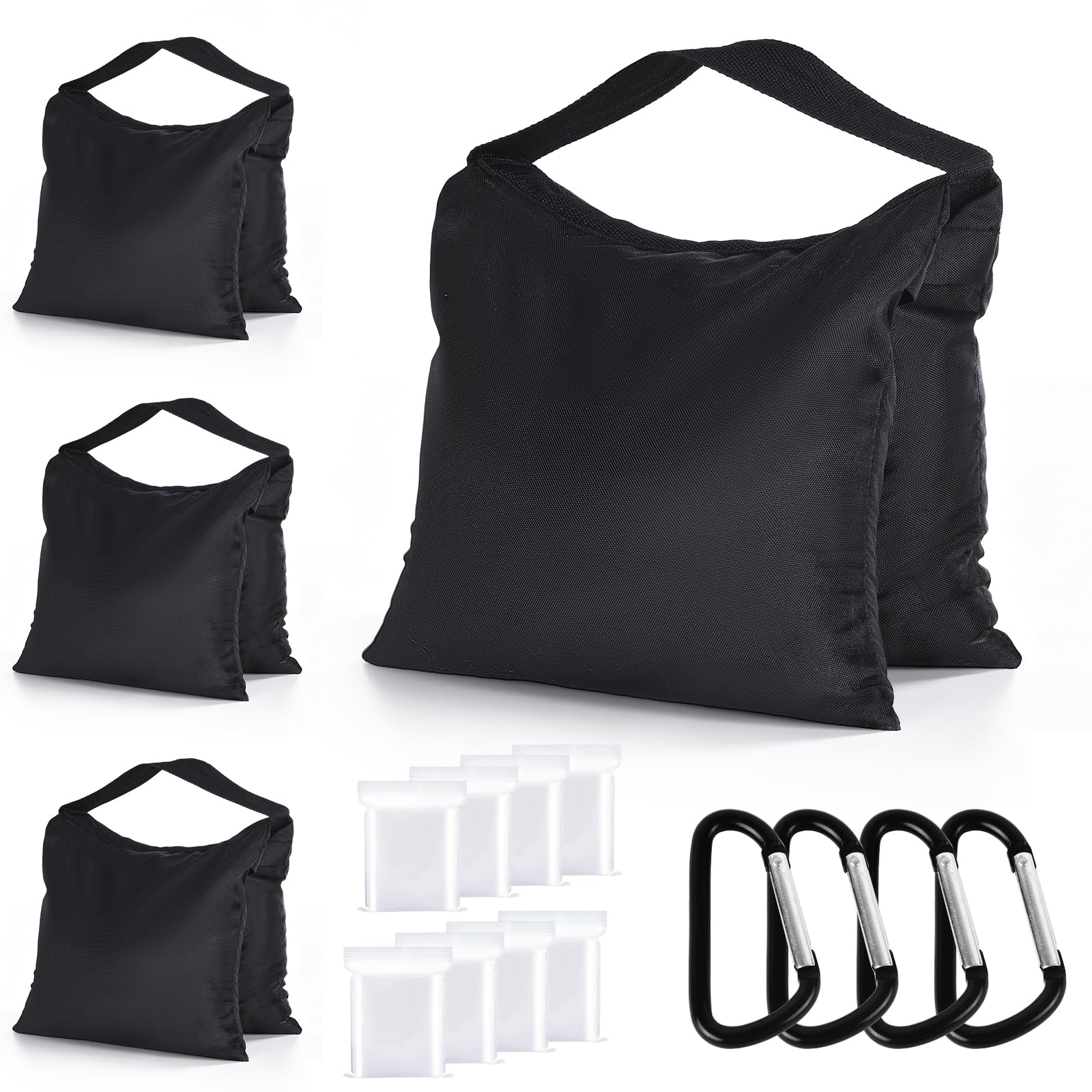
Four pouches arrive with eight sealed liners, and that surplus is the whole idea. You fill a liner, seal it, drop it into the pouch, and close the outer zip, so the sand never touches the sewn fabric. At the end of a shoot the bag is clean enough to fold into a case instead of shedding grit into the back of the car.

That double containment is why this is the set we hand to people who ask what to buy. The shell is 1680D polyester, the highest stated fabric weight in this guide, and each pouch has its own zip, so a failed pull costs you one side rather than the whole bag. Four aluminum clips come in the box, enough for one bag per leg on a four-stand setup, and it is the least expensive of the four-packs here. No capacity is published, so we fill each side until the pouch is firm and the zip closes without a fight; an overstuffed pouch is what kills zips.

Nothing about it feels premium — plain black, no padded handle, no rubberized trim. What it has is the pair of things that matter when a bag splits at a venue: a liner catching the mess and a shell that shrugs off being thrown in a van.

Pros

  • Sealed inner liners keep the shell clean
  • 1680D polyester is the heaviest shell here
  • Separate zip per pouch limits a failure
  • Least expensive of the four-packs here

Cons

  • No published weight rating per bag
Our verdict

Our pick for most shooters: sealed liners keep sand out of the seams and the 1680D shell survives van life, at the lowest price of the four-packs here.
Check Latest Price
2

Best for Maximum Weight

ABCCANOPY 4-Pack Sandbags

93 /100
Keeper Score Outstanding

Key details

Set
4 bags, 4 carabiners
Shell
600D polyester
Liners
PE sealed bags included
Max Load
27 lbs of wet sand per bag
Check Price on Amazon

Twenty-seven pounds of wet sand per bag is the biggest stated fill in this set, and it is the reason to pick these: one bag over a C-stand base does the work of two lighter pouches. Wet is the operative word. Dry play sand is fluffier and you will pack less mass into the same pouch, so if you want to approach the number, fill with damp sand, pea gravel, or something denser than the bag from the hardware store.

Each side has its own zip, and the set includes PE liners and a carabiner per bag, so there are two layers between the sand and the studio floor. Two zips also mean a failed pull costs you a pouch rather than the bag. We fill to about three-quarters and press each zip flat before loading, which is the habit that keeps a saddlebag sealed through a day of moving between setups.

At 13 by 7.4 inches the bag drapes over a stand leg without much bulk, and the empty shell is light enough to carry a set in one hand. Filled, these are a two-hand lift — plan on two trips rather than one, especially up stairs.

Pros

  • Largest stated capacity in this set
  • PE liners and carabiners included
  • Zip on each side contains one failure
  • Compact 13 by 7.4 inch drape

Cons

  • Seam beside the zip can split and leak
Our verdict

If you need real mass on a C-stand or a boom, these hold more wet sand per bag than anything else here — just fill them short and watch the seams.

Check Latest Price
3

Best Bulk Set

Aimosen 8-Pack Sandbags

92 /100
Keeper Score Outstanding

Key details

Set
8 bags, 8 aluminum clips
Shell
PVC-coated Oxford
Liners
16 PE bags included
Closure
Dual zips on each side
Check Price on Amazon

Eight bags in one box is a different purchase from a four-pack. This is the set for a backdrop, two light stands, and a boom in the same room, with enough left over that you are not decanting sand between setups. Each bag is a saddlebag with a zip on both sides, and the box adds sixteen PE liners and eight aluminum clips — two liners per bag, which lets you run one side with sand and the other with gravel and keep them apart.

The lining is the reason to choose it. The Oxford shell is PVC-coated inside, which gives the liner a smooth surface to sit against and leaves a wipe-clean layer if one does split. Compared with the other eight-bag set here, that is the detail that decides it: you are buying a bag you can rinse out rather than one that holds grit in the weave.

The handles are the part to watch. They are the first thing to go if the set lives outdoors or gets dragged across a parking lot, and a strap that gives way with a loaded bag is a bad afternoon. Carry them by the body and store them dry.

Pros

  • Eight bags cover several stands at once
  • PVC-coated lining wipes clean
  • Two PE liners per bag

Cons

  • Handle webbing degrades with outdoor storage
Our verdict

Buy the eight-pack if you are weighting several stands and a backdrop in one go; the coated lining and two liners per bag make it the tidiest bulk set here.

Check Latest Price
4

Best Visibility on Set

StudioFX 4-Pack Sandbags

92 /100
Keeper Score Outstanding

Key details

Color
Yellow
Shell
Nylon
Closure
Dual zips per bag
Compartments
Two, 10.25 x 9.25 in each
Check Price on Amazon

The yellow is not a styling quirk you stop noticing. On a dark stage or a dim venue floor it is the difference between a bag someone steps around and a bag someone kicks, and we have come to prefer high-visibility weights for exactly that reason. It is why this nylon four-pack earns a place even at a higher price than the basic black sets.

Each bag carries two compartments measuring 10.25 by 9.25 inches — a wide mouth to fill from and enough room for a few pounds of gravel a side. There is no liner in the box, so we put a heavy zip-top bag in each compartment before adding filler; it keeps the nylon clean and gives you a second seal behind the zip.

The zips are the strongest part of the design story. Two per bag, one per compartment, with pulls that are easy to work in a cold room or with gloves on. That doubling is what gives the set its composure when you are hanging it one-handed off a ladder.

What you give up is weight per bag. This is a set for weighting four stands at a moderate load, not for counterbalancing a boom arm or a big softbox on a C-stand — for that, the larger saddlebags here concentrate more mass in fewer bags.

Pros

  • High-visibility yellow on dark sets
  • Two 10.25 by 9.25 inch compartments per bag
  • Double zips with easy pulls

Cons

  • Costs more than the other four-packs here
Our verdict

The easiest set to spot and the easiest zip to work on a dark set, as long as you are weighting stands rather than counterbalancing a boom.

Check Latest Price
5

Best Zip-Free Closure

Evekea 8-Pack Sandbags

87 /100
Keeper Score Excellent

Key details

Set
8 bags, 8 clips
Size
22.4 x 10.4 in
Closure
Hook-and-loop flaps
Max Load
26 lbs per bag
Check Price on Amazon

Hook-and-loop flaps instead of zippers: that is the whole argument for this set. There is no pull to jump its track and no teeth to split, and the flap still seals flat enough to drape over a stand leg. If a zip has ever let go over a client's floor, that is a meaningful thing to be able to skip.

Eight bags at a stated 26 pounds each, with a PE liner and a clip per bag, and a 22.4 by 10.4 inch body that lies across a leg rather than hanging off one side. The flaps take a little more care than a zip — you want both halves pressed together across the full width, and a flap closed only halfway will peel when the bag is wedged into a case. We press them flat and check the edges before hanging.

For a working shooter who has already lost a bag mid-job, we take the trade. The shell is a dense polyester with an Oxford lining, the bags fold flat when empty, and filling one in a parking lot does not require three hands. Buy it for the closure. Eight bags is a bonus, not the reason.

Pros

  • No zippers to fail under load
  • PE liner and clip with each bag
  • Eight bags fold flat when empty

Cons

  • Stated 26-pound capacity per bag is optimistic
Our verdict

For anyone who has lost a bag to a broken zip, the hook-and-loop flaps on this eight-bag set remove the failure mode entirely.

Check Latest Price
6

First Set or Spares

Amazon Basics 4-Pack

92 /100
Keeper Score Outstanding

Key details

Set
4 bags with carry handle
Shell
Heavy-duty polyester
Closure
Zipper pouch on each side
Max Load
20 lbs per bag
Check Price on Amazon

Four dual-pouch saddlebags with a carry handle, a stated 20-pound fill, and a price that puts a full set within reach of anyone building a first kit. The shape is the familiar one: two pouches joined over the top, a handle in the middle, and a zip on each side.

Twenty pounds is plenty for a speedlight stand or a small LED panel, and the handle is the detail that sold us — it turns a bag of sand into something you can carry four of in one trip. We line each pouch with a heavy zip-top bag before filling, which keeps fine sand out of the zip teeth and puts one more layer between the fabric and the grit.

The zips are the weak link. They are doubled, one per side, but the pulls are thin enough that we close them gently rather than yanking a full pouch shut. Pea gravel suits these better than fine sand: it does not sift through a gap in the teeth and it does not turn to mud if the bag gets damp in a car boot.

Where it earns its place is as a first set or a spare set — the kind you buy, fill once, and leave in the van. It is not the set we carry to a paid shoot where a sand spill costs you the client.

Pros

  • Carry handle moves a loaded set easily
  • Dual pouches drape over a stand base
  • 20-pound fill suits most small stands

Cons

  • Thin zip pulls on a fully loaded pouch
  • No sealed inner liners supplied
Our verdict

A simple, affordable first four-pack that does the job if you bag your own filler — just close the zips gently.

Check Latest Price
7

Boom-Arm Rigs

NEEWER 6-Pack Sandbags

89 /100
Keeper Score Excellent

Key details

Set
6 bags
Size
11.8 x 11.1 in
Closure
2 zip pouches per bag
Max Load
20 lbs per bag
Check Price on Amazon

The handle on these is fabric-lined rather than a bare strip of webbing, and the stitching runs even along every seam — small things that show up when you are lifting a loaded bag off a stand twenty times in an afternoon.

Six bags at 20 pounds each is the middle ground between a four-pack and the eight-bag bulk sets: enough for two stand legs, a boom, and a spare for the stand behind the backdrop. Two zip pouches on every bag, plain black shells, and the filler is on you.

That is the trade. You are paying a premium for the sixth bag, and the extra money does not buy a tougher closure or an inner liner — what it buys is a set that matches a specific rig without buying two boxes and ending up with spares you never fill. We rate the construction higher than the closure.

Where it gives up ground to our top pick is at the seams and zips under a full load. This is a set to fill to a comfortable weight rather than to chase the stated 20 pounds a side.

Pros

  • Six bags cover two stands and a boom
  • Even stitching and a fabric-lined handle
  • 20-pound rating per bag

Cons

  • Seams and zips are the wear point under load
Our verdict

Six well-sewn bags that fit a two-stand-plus-boom rig, though the money buys count rather than a tougher closure.

Check Latest Price
8

Small LED Stands

IFKDNR 2-Pack Sandbags

88 /100
Keeper Score Excellent

Key details

Size
10.24 x 9.45 in
Liners
2 PE bags included
Max Load
8 lbs per bag
Attachment
Buckle strap per bag
Check Price on Amazon

Eight pounds does not sound like much until you watch a lightweight LED panel take a nudge from a doorway draft on a stand that weighs less than the light itself. That is the situation these two bags are built for, and the buckle strap is why they work there: instead of draping a saddlebag over a base plate, you clip around the leg and let the bag hang where you can reach it. It is the case where we reach for a two-pack over a four.

Each bag is 10.24 by 9.45 inches with a PE liner, and the strap is faster to move than a drape when you are repositioning a small setup every few minutes. The buckle needs a firm press to seat properly — a half-closed clip is the one way to drop a bag mid-shoot.

Capacity is genuinely small, and that is the point. At eight pounds a side this set suits tabletop stands, small panels, and light tripods; it is not the answer for a C-stand with a boom, and it is not trying to be. If your rig is heavier than that, go to one of the four-packs.

The rest is straightforward: an Oxford cloth shell that folds into a corner of a kit bag, and a two-bag pack that makes a spare pair easy to justify for a second location.

Pros

  • Buckle strap clips around a stand leg
  • Two-pack suits a single-stand kit

Cons

  • Eight-pound cap limits it to light stands
Our verdict

A small, cheap pair for lightweight LED panels and tabletop stands, where a buckle strap beats a saddlebag drape.

Check Latest Price

How We Tested 16 Sandbags (and Which Ones Leaked)

We started with the listings photographers actually buy from — the two-, four-, six-, and eight-packs sold for light stands, tripods, backdrop stands, canopies, and patio umbrella bases — then narrowed by closure type, whether a sealed inner bag came included, what kind of hardware the bag hung from, and price per bag. Sixteen sandbags across eight designs made the cut; the rest were near-duplicates with different labels.

Each bag got the same play sand, weighed on a kitchen scale so we knew exactly how much it held before the seams started to strain. I filled every one with a scoop first and only reached for a funnel when the opening was too narrow to load quickly, and I watched whether grit puffed out through the stitching while filling, since sand containment problems announce themselves early.

Then the abuse: zipping and unzipping each bag a few dozen times, dragging the loaded bags across concrete, and hanging them full from a boom arm for a week at a stretch. Zippers that skipped a tooth, separated under load, or had no flap covering them got flagged fast, as did handles that stretched or stitching that opened at the corner.

In the studio they went onto light stands and backdrop stands; outside they were strapped to canopy legs on a windy afternoon and draped over an umbrella base to see whether they shifted or slid. I also carried each one to and from the car by its handle or carabiner, because a bag that's miserable to move never gets moved. At the end, we divided price by the pounds of sand each bag actually held — that's where value for money separates.

How to Choose Sandbags for Light Stands

The Closure Is What Fails

Two zips per bag, one on each side, is the configuration we look for. A pull that jumps its track then costs you a pouch instead of the whole load, and you can fill the two sides to different weights when a stand is sitting on uneven ground. A single zip across the top has no second chance if it opens.

Hook-and-loop flaps sidestep the problem entirely, since there is no track to jump and no teeth to split, but they have to be pressed across their full width or they peel under load. Whichever closure you choose, close the bag empty once before filling it and watch how it seats. A pull that feels gritty on a brand-new bag will not improve with sand pressing against it.

Insist on a Liner, Then Pick Your Filler

Sealed inner bags are the cheapest insurance in this category. Fill the liner, seal it, drop it into the pouch, and the outer fabric stays clean, the zip teeth stay clear of grit, and a split seam becomes an inconvenience rather than a spill in a hallway. Sets here include one or two liners per bag; two lets you keep sand on one side and gravel on the other.

Filler changes the number on the box more than the bag does. Dry play sand pours easily and is light for its volume, so you pack less mass into a pouch than the rating suggests. Pea gravel is heavier per scoop and does not sift through a gap in a zip, and steel shot or scrap nuts and bolts pack the most weight into the smallest bag — at the cost of a bag you will not want to drop on a wood floor.

Match the Weight to the Stand

An eight-pound bag is plenty for a small LED panel on a lightweight stand and nowhere near enough for a C-stand carrying a boom and a softbox. Work backwards from the load: a bare stand with a speedlight is fine with one 15-to-20 pound bag low on the base, while a boom needs weight on the counterweight side as well, and the stand's own rating still governs what it can take.

Where the bag sits matters as much as what is in it. Drape it over the base plate or a lower leg so the mass lowers the center of gravity. That is the trap with these things: a full bag clipped at chest height because it was convenient to hang there makes the whole rig easier to tip, not harder.

Count Bags, Not Pounds

Four bags is the working default and covers one four-legged stand or four separate ones. Six- and eight-bag sets make sense when a boom, a backdrop, and a couple of spares travel to the same job, and the cost per bag usually falls as the count rises.

Empty weight matters when you travel. A four-pack of shells runs one to three pounds, while the same set filled is 60 to 100 pounds in the car — which is really a decision about whether you fill at home or at the location. Buy filler where you are shooting when you can, and keep the folded set in the case for the days you do not need it.

Frequently Asked Questions

Final Verdict

Buy the Eurmax four-pack. It is the least expensive of the four-bag sets here and the only one that pairs sealed liners with a 1680D shell, which is exactly the combination that keeps sand where it belongs on a working day. Fill each side until the pouch is firm rather than stuffed, and the zips will outlast the novelty of a new set.

If your rig is a C-stand or a boom, step up to the ABCCANOPY for the extra capacity in every bag. And if a zip has already failed on you mid-shoot, the Evekea's hook-and-loop flaps are the trade worth making.