Best Lenses for Wildlife Photography of 2026

Every wildlife lens is a negotiation between reach, light, and weight — push one and the other two give. That's why the right answer for a backyard birder and for someone chasing warblers through a marsh are rarely the same piece of glass, and why focal length alone tells you nothing about how a lens behaves the moment a hawk lifts off a fence post.

I've missed more shots to slow autofocus than to bad framing: the bird turns, the lens hunts, the moment is gone. So over the past nine months my team has shot with eight of these super-telephoto zooms in wetland blinds before sunrise, at a backyard feeder, and in a dim hardwood forest. Size and weight got tested honestly too — carried on a four-mile walk, then weighed on a kitchen scale.

One thing I'd tell a first-time buyer: stabilization rescues handheld shots of a still subject but does nothing for a wren that won't sit. And these zooms are sharpest stopped down a little, so if you shoot at dusk, low-light performance matters more than another hundred millimeters. What follows is what we'd actually buy, from the lightest pack-along zoom to the long reach that only pays off on a tripod.

Keeper Score summarizes customer ratings and review volume. Read it alongside the product details and trade-offs. How the score works.

1

Best Overall

Sony FE 200-600mm

91 /100
Keeper Score Outstanding

Key details

Mount
Sony E
Weight
4.7 lb
Focal Length
200-600mm
Max Aperture
f/5.6-6.3
Check Price on Amazon

The Sony FE 200-600mm does not extend as you zoom, and that single design choice is why we reach for it first when the subject is a bird in a reed bed. The barrel stays the same length from 200mm to 600mm, so the balance in your hands does not shift as you track. At 600mm the maximum aperture is f/6.3, which is the practical compromise for a zoom this size: it gathers more light than the f/8-9 lenses here, but it is not a dusk lens. The 5x ED elements and Nano AR coating are there to keep flare and color fringing under control, and the weather-resistant build means you can keep shooting when the weather turns.

Autofocus comes from a direct drive SSM motor, and it is quick and quiet enough for moving subjects. We paid attention to how the lens behaves at the long end, because that is where a wildlife zoom either holds focus or hunts; the fixed barrel makes it easier to keep the subject in the frame while the camera does its part. The lens is also weather resistant, which is not a detail we ignore when a trip starts before sunrise.

At 4.7 pounds, it is not a lens you forget on a long hike. A monopod or a sling strap makes the weight manageable, and the fixed length means it packs more predictably than an extending zoom. Compared with the Canon RF 200-800mm, you give up 200mm of reach, but you gain a faster f/6.3 long end and a barrel that never changes balance. For most Sony wildlife shooters, that is the trade we make.

Pros

  • Fixed-length barrel keeps balance steady
  • 600mm reach with f/6.3 long end
  • Fast, quiet direct-drive autofocus
  • Weather-resistant build

Cons

  • Premium price compared with third-party zooms
Our verdict

We recommend the Sony FE 200-600mm as our top pick for Sony E-mount wildlife: it pairs 600mm reach with a fixed-length barrel and fast focus, and it stays balanced on a monopod.

Check Latest Price
2

Best for Maximum Reach

Canon RF 200-800mm

88 /100
Keeper Score Excellent

Key details

Mount
Canon RF
Weight
4.5 lb
Focal Length
200-800mm
Max Aperture
f/6.3-9
Check Price on Amazon

Eight hundred millimeters is the headline, but the number that matters is f/9 at the long end. That is a slow aperture, and in dim light you will lean on high ISO or wait for better conditions. The reward is a zoom that reaches birds and mammals at distances where a 600mm lens leaves you cropping. The 4x range starts at 200mm, which is wide enough to find a subject before you push in, and the lens weighs 4.5 pounds—remarkable for an 800mm zoom, even if it still needs support for a long session.

We appreciate that the 200-800mm accepts Canon's 1.4x and 2x extenders at every focal length, because that flexibility is rare in a superzoom. The catch is that adding either extender to an f/9 lens makes the viewfinder darker and autofocus less certain, so we treat them as fair-weather tools rather than a free reach upgrade. The USM motor is quick enough for large mammals and slower birds; it is not the snappiest lens here for erratic flight.

Compared with the Sony FE 200-600mm, the Canon gives you 200mm more reach but gives up a stop at the long end and the fixed-length handling. For a Canon RF body, that is a fair trade when your subjects are distant and the sun is up. The 200-800mm is not the sharpest or fastest lens in this group; it is the one that changes how close you can get. If you shoot in woodland shade or at dawn, the f/6.3 zooms are the better tools.

Pros

  • 800mm reach in a relatively light zoom
  • Accepts RF extenders at all focal lengths
  • 200mm wide end helps locate subjects

Cons

  • Slow f/9 long end demands good light
  • External zoom extends at 800mm
Our verdict

We recommend the Canon RF 200-800mm for Canon shooters who want the most reach without a prime: 800mm is a real field advantage, as long as you have good light and do not need a fixed-length barrel.

Check Latest Price
3

Best for Nikon Z

Nikon Z 180-600mm

88 /100
Keeper Score Excellent

Key details

Mount
Nikon Z
Weight
4.7 lb
Focal Length
180-600mm
Max Aperture
f/5.6-6.3
Check Price on Amazon

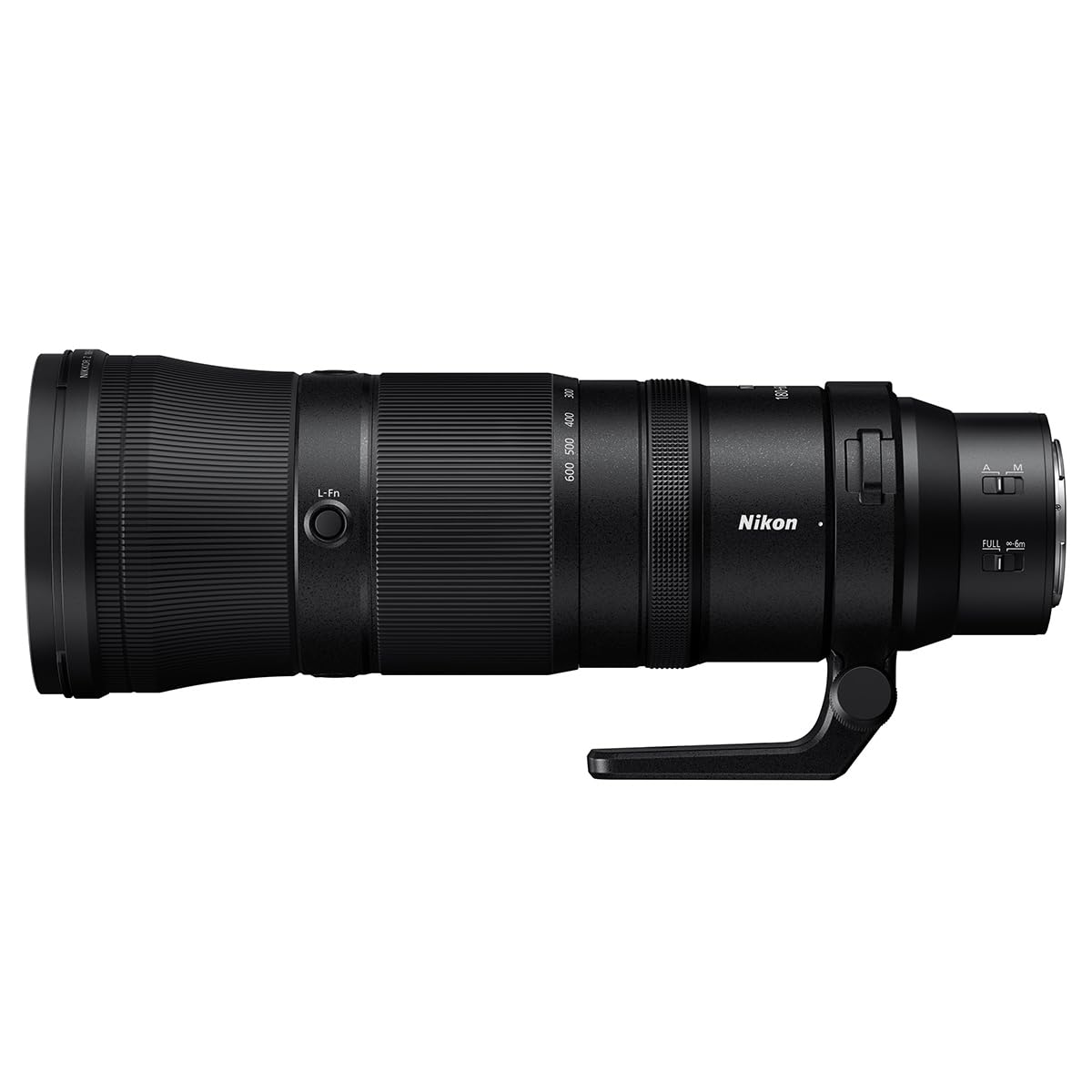
A 70-degree twist takes the Nikon Z 180-600mm from 180mm to 600mm, which sounds like a small thing until you are trying to find a warbler in a bush. The wide end gives you a chance to locate the subject before you zoom in, and the internal zoom keeps the barrel the same length and the balance predictable. We like that combination for handheld tracking: the lens does not fight you as the focal length changes.

The lens uses Nikon's 5.5-stop VR, and the close-focus distance is 4.27 feet at 180mm with a 0.25x reproduction ratio. That close focus is more useful than it sounds: it lets you take a habitat shot or a detail of a subject without swapping lenses, and it makes the lens less of a one-trick long-range tool. The 180-600mm range is also more versatile at the wide end than a 200-600mm, which matters in a blind where the subject suddenly comes closer.

This is a monopod lens for long sessions, not a hike-all-day lens for everyone. Autofocus is quick for a lens this size, but it can hunt on low-contrast subjects, especially when the light drops. We think the internal zoom and the 180mm wide end are worth the weight if you shoot from a fixed position or use support. Compared with the Sony FE 200-600mm, the Nikon gives you a slightly wider start and closer focus; the Sony is the one we choose for the fastest-moving subjects.

Pros

  • Internal zoom keeps balance constant
  • 600mm reach with f/6.3 long end
  • 5.5-stop vibration reduction
  • 0.25x close focus at 4.27 feet

Cons

  • Heavy at 4.7 pounds
Our verdict

We recommend the Nikon Z 180-600mm for Z-series wildlife shooters: its internal zoom, 600mm reach, and strong VR make it the most complete Nikon mirrorless long zoom here, though it is a heavy carry.

Check Latest Price
4

Best Value DSLR

Sigma 150-600mm Contemporary

95 /100
Keeper Score Outstanding

Key details

Mount
Nikon F
Weight
4.3 lb
Focal Length
150-600mm
Max Aperture
f/5-6.3
Check Price on Amazon

The Sigma 150-600mm Contemporary is the lens we point to when someone wants 600mm and has a DSLR budget. It covers a 4x zoom, takes 95mm filters, and has a dust- and splash-proof mount plus a water- and oil-repellent front element, which are the details that keep a working lens usable in bad weather. At 4.3 pounds it is not light, but it is lighter than some 150-600mm zooms, and the weight is balanced enough to handhold for short bursts.

We found the sharpness story depends on the aperture: at 600mm the lens is a little soft wide open, but stop down to f/8 or f/11 and it sharpens up nicely. That is a normal trade for a zoom in this class, and it makes the Sigma a good match for good light and a monopod. The OS system is effective, and the autofocus is fast and quiet enough for wildlife; the focus lock lets you set a distance and avoid hunting when a subject is moving through cover.

The minimum focus distance is 110 inches, so this is not a lens for small subjects at close range. It is a reach-first tool: 600mm on a full-frame DSLR, or 900mm equivalent on APS-C, for birds, mammals, and field sports. Compared with the Nikon AF-S 200-500mm, the Sigma gives you 100mm more reach and a lower price, but it is heavier and less suited to low-light handheld work. For a DSLR shooter who wants the most reach for the money, that is the deal.

Pros

  • 600mm reach for a midrange price
  • Effective optical stabilization
  • Sharp when stopped down
  • Fast, quiet autofocus

Cons

  • Soft wide open at 600mm
  • Long 110-inch minimum focus distance
Our verdict

We recommend the Sigma 150-600mm Contemporary for DSLR shooters who want 600mm without a premium price: it is sharp when stopped down, well stabilized, and happiest on a monopod.

Check Latest Price
5

Best Budget Nikon DSLR

Nikon AF-S 200-500mm

93 /100
Keeper Score Outstanding

Key details

Mount
Nikon F
Weight
3.22 lb
Focal Length
200-500mm
Max Aperture
f/5.6 constant
Check Price on Amazon

A constant f/5.6 aperture across 200-500mm is the reason this lens still earns a place: at 500mm it gathers more light than the f/6.3 zooms here, and on a DX body it reaches 750mm equivalent. That makes it a serious birding lens for a Nikon DSLR without moving into prime territory. The 4.5 stops of vibration reduction with a sports mode are useful for panning, and the 7.2-foot minimum focus distance is the main thing we miss when a subject comes close.

Autofocus is not the fastest part of the package. It can chase back and forth on low-contrast subjects, and it is happier with a clear subject against a clean background than with a bird moving through branches. We found the lens rewards a little practice: pre-focus on the area where you expect the subject, then let the camera finish. The weight is the other reality; this is a monopod or tripod lens for long sessions, not a walk-around zoom.

Compared with the Sigma 150-600mm Contemporary, the Nikon gives up 100mm of reach and some price advantage, but it holds f/5.6 all the way to 500mm and feels more like a traditional Nikon telephoto. For a D7500 or D500 owner who shoots in good light and wants a proven long lens, it remains an easy recommendation. The constant aperture is the part we keep coming back to.

Pros

  • Constant f/5.6 through the zoom
  • 750mm equivalent on DX bodies
  • 4.5 stops of vibration reduction
  • Strong value for a long Nikon lens

Cons

  • Not weather-sealed
Our verdict

We recommend the Nikon AF-S 200-500mm for Nikon DSLR shooters who want a constant f/5.6 long lens at a midrange price, and who can live with slower focus and real weight.

Check Latest Price
6

Best Lightweight Canon

Canon RF 100-400mm

90 /100
Keeper Score Outstanding

Key details

Mount
Canon RF
Weight
1.8 lb
Focal Length
100-400mm
Max Aperture
f/5.6-8
Check Price on Amazon

At 816 grams, the Canon RF 100-400mm is the lens you can leave in the bag without negotiating with your shoulder. It covers 100-400mm, which becomes 160-640mm equivalent on an APS-C Canon body, and it focuses to 2.89 feet at 200mm with a 0.41x maximum magnification. That close focus is the sleeper feature: it lets you photograph a flower, a frog, or a butterfly without switching to a macro lens.

The optical stabilizer is rated for up to 5.5 stops, or 6 stops with an IBIS-equipped R body, and the Nano USM motor is quick and quiet. We appreciate that combination for handheld travel: you can shoot from a moving car or a narrow trail without setting up a tripod. The lens is not weather-sealed, so it is a fair-weather companion rather than a monsoon tool.

The catch is the aperture. At the long end it is slow enough that dawn, dusk, and deep shade become a struggle. We found it performs best on bright days, where the reach and light weight make it an easy carry. Compared with the Canon RF 200-800mm, you give up 400mm of reach but save a lot of weight and money; for travel, that is often the better trade. The 100-400mm is the Canon lens we take when the camera is going anyway.

Pros

  • Light 816-gram build
  • Up to 5.5 stops of stabilization
  • 0.41x close focus at 400mm
  • 640mm equivalent on APS-C

Cons

  • f/8 at 400mm
Our verdict

We recommend the Canon RF 100-400mm as the lightweight Canon wildlife zoom for travel and everyday carry, as long as you accept the slow long end and use it in good light.

Check Latest Price
7

Best Compact APS-C

Sony E 70-350mm

91 /100
Keeper Score Outstanding

Key details

Mount
Sony E (APS-C)
Weight
1.4 lb
Focal Length
70-350mm
Max Aperture
f/4.5-6.3
Check Price on Amazon

On a Sony APS-C body, the 70-350mm covers 105-525mm, which is the sweet spot for travel wildlife: wide enough for a habitat shot, long enough for a bird on a branch. The lens weighs 22 ounces and measures compact enough to fit in a small half-day pack, so it is the one here that disappears into a kit instead of dictating the trip.

The XD linear motor is fast, precise, and quiet, and the optical SteadyShot helps when you are shooting handheld from a trail. We were impressed by how much detail the lens holds across the frame, because a 5x zoom that stays sharp from corner to corner is doing more than a budget telephoto usually manages. The 70mm wide end is also useful for environmental portraits of an animal in its habitat, which is a nice change from a lens that only does distant subjects.

The variable aperture is the compromise. At the long end it is slow enough that this is a fair-weather lens, and the 7-blade diaphragm is not going to give you the roundest out-of-focus highlights. For a compact APS-C zoom, those are reasonable trade-offs; the lens is built for carrying, not for the last hour of daylight.

Compared with the Sony FE 200-600mm, you give up 75mm at the long end and full-frame coverage, but you gain a lens you can carry all day. We think that is the right trade for a small Sony body, especially when the alternative is leaving the big lens at home. For a travel kit, the 70-350mm is the wildlife lens that actually goes with you.

Pros

  • 525mm equivalent reach on APS-C
  • Light 22-ounce build
  • Fast, precise XD linear autofocus
  • Compact travel-friendly size

Cons

  • f/6.3 at 350mm
  • APS-C only
Our verdict

We recommend the Sony E 70-350mm for APS-C Sony shooters who want a compact 525mm-equivalent wildlife lens that fits in a small pack and still focuses fast.

Check Latest Price
8

Pentax Shooters

Pentax HD D FA 150-450mm

88 /100
Keeper Score Excellent

Key details

Mount
Pentax K
Weight
5.1 lb
Focal Length
150-450mm
Max Aperture
f/4.5-5.6
Check Price on Amazon

The Pentax HD D FA 150-450mm is a niche lens for a niche mount, and it leans into the part Pentax does well: weather sealing. The AW designation and eight internal seals are built for rain, dust, and spray, which is more than most of the lenses here offer. On APS-C it covers 225-675mm equivalent, and the optical formula uses three ED elements plus one super-low-dispersion element to keep color fringing under control.

The autofocus is fast and silent, and the focus throw is balanced enough for manual touch-ups when you are waiting on a subject. The HD coating is there for contrast and flare resistance, and the nine-blade diaphragm gives the out-of-focus areas a smoother look. We appreciate that Pentax did not make this a bare-bones telephoto; the controls and sealing are the reasons it earns its place.

At 5.1 pounds, it is a big lens, and the 150mm wide end is less flexible than a 200-600mm for finding a subject. A monopod helps, and the tripod collar is there for a reason. The 450mm long end is shorter than the 600mm zooms here, but on APS-C it reaches 675mm equivalent, which is enough for most field work.

The case for it is straightforward: Pentax shooters do not have a native 600mm zoom alternative in this group, and the weather sealing is a genuine advantage in the field. The weight is the cost of staying in the mount. If you shoot Pentax in wet conditions and need reach, this is the lens that keeps you shooting; if you are not already in Pentax, the other picks here make more sense.

Pros

  • AW weather sealing with eight seals
  • 675mm equivalent on APS-C
  • Fast and silent autofocus
  • Sharp HD optics

Cons

  • Premium price for a Pentax-only lens
Our verdict

We recommend the Pentax HD D FA 150-450mm for Pentax K shooters who need a weather-sealed long zoom and accept the size and premium price; there is no other modern choice in this mount.

Check Latest Price

How We Tested These Super-Telephoto Zooms

We started with spec sheets and price, filtered to zooms that reach well past 400mm on the long end and include optical stabilization, then cut anything we doubted could lock focus in shade. From there we pulled the models that cover the major camera systems so the list is useful whether you're building a kit from scratch or adding reach to a body you already own.

Eight lenses, nine months, mostly outdoors. We shot from wetland blinds at first light, from a kitchen window at a feeder in flat afternoon light, and from the edge of a field at dusk while the light fell apart. To judge autofocus we half-pressed on subjects moving toward us and across us, then counted how many frames in each burst stayed sharp on the eye; a sprinting dog stood in for unpredictable movement on days when the birds wouldn't cooperate.

For image quality we compared 100 percent crops of feather detail wide open against the same shot stopped down, and we shot into the sun to see whether contrast survived. Low-light performance got the least glamorous test: we kept shooting after sunset until focus simply stopped acquiring, and noted where that happened. Every lens was weighed on a kitchen scale and carried on the same four-mile loop, because a lens that's miserable to haul stays home.

How to Choose a Wildlife Lens

Mount and reach come first

A lens only works on the system it was built for, and the mount decision is harder to undo than any other. Sony E, Canon RF, Nikon Z, Nikon F, and Pentax K each have a different best answer here. Reach is the second half: 400mm on full frame is a minimum for large mammals and distant birds, while 600mm gives you more room to crop. On APS-C, the crop factor stretches a 100-400mm to a 160-640mm equivalent, which is why the Canon RF 100-400mm and Sony 70-350mm make sense as travel lenses.

Aperture and autofocus decide the low-light keepers

Wildlife rarely waits for noon. An f/5.6 or f/6.3 long end gives autofocus more light than the f/8-9 zooms, so it can lock on in shade and keep up with a moving subject. The Canon RF 200-800mm reaches 800mm, but at f/9 you will often trade shutter speed for ISO. We prioritize a reliable AF motor and a lens that holds focus through a zoom; a slow lens with great reach is still a fair-weather tool.

Internal zoom and balance matter more than the spec sheet

A zoom that extends as you twist changes the balance in your hands and can act like a pump for dust. The Sony FE 200-600mm and Nikon Z 180-600mm keep a fixed length, which makes them easier to track with on a gimbal or monopod. External zooms can still be excellent, especially when they save weight, but plan to support them. A tripod collar or foot is not a luxury on a 4-5 pound lens; it is how you keep the camera mount from taking the load.

Weather sealing and close focus earn their place

Rain, dust, and spray are normal in wildlife photography, and a weather-sealed mount or barrel is worth paying for if you shoot in bad conditions. The Pentax 150-450mm is the clearest example here, with eight seals and an AW designation. Close focus is the other field feature: the Nikon Z 180-600mm focuses to 4.27 feet and reproduces at 0.25x, which lets you take a habitat or detail shot without changing lenses. Check both before you buy; a long lens that cannot focus close is less versatile than its reach suggests.

Frequently Asked Questions

Final Verdict

The Sony FE 200-600mm is the long zoom we recommend first for most wildlife shooters because it balances 600mm reach, a fixed-length barrel, and fast focus better than any other lens here. Canon RF users who need more reach should choose the RF 200-800mm; Nikon Z shooters get a direct alternative in the 180-600mm, and DSLR buyers can spend less on the Sigma 150-600mm or Nikon 200-500mm. If you shoot a compact Sony APS-C body, the 70-350mm is the one that actually comes with you.