Best Lenses for Travel Photography of 2026

I once hauled four lenses through a week of sightseeing and shot the entire trip on one of them. What I remember isn't the glass that stayed in the hotel safe — it's the shots I missed while swapping lenses on a windy overlook, dust blowing straight into the mount. A travel lens gets judged by whether it's in the bag when the moment happens, not by how it looks on a test chart. So it has to cover the frames you actually shoot, stay light enough to carry all day, and lock focus before the scene walks away.

My team has spent the past nine months shooting with 11 lenses — compact zooms, wide primes, and long-range all-in-ones — on weekend trips, long walks, and the ordinary days where a camera only comes along if it's small enough to earn the space. The tradeoff that catches first-time buyers is how hard zoom range and size fight each other, and how quickly a heavy lens stops leaving the house. The picks below are the ones that kept earning a spot in the bag: sharp where it counts, light enough to forget, and priced so you don't wince.

Keeper Score summarizes customer ratings and review volume. Read it alongside the product details and trade-offs. How the score works.

1

Best Overall

Nikon NIKKOR Z 28-400mm f/4-8 VR

90 /100
Keeper Score Outstanding

Key details

Mount
Nikon Z
Weight
1.6 lb
Focal Range
28-400mm
Stabilization
5.0-stop VR
Check Price on Amazon

A 14.2x zoom that starts at 28mm and reaches 400mm is the kind of range that changes how you pack. We chose the NIKKOR Z 28-400mm as our top pick because it lets a Nikon Z traveler leave the rest of the kit at home: wide enough for a street scene, long enough for a distant bird or a detail across a square. At 1.6 pounds it is light for a 400mm superzoom, though you will know it is on the camera after a long day.

The 5.0-stop VR is the feature we appreciate most at the long end. Handheld shooting at 400mm is realistic in good light, and the stabilizer helps when you are bracing against a wall or shooting from a moving vehicle. Close focus is the surprise: 0.2 m at the wide end and 0.35x maximum magnification let you get near a flower, a menu, or a market stall without switching lenses.

The compromise is the f/4-8 aperture. This is a daylight lens, and indoor or evening shots will push your ISO; a fast prime is the better second lens for those situations. Autofocus is quick in good light but can slow in dim, low-contrast scenes, so it is not the first choice for fast action at dusk. For a one-lens travel kit, though, the range is the broadest here.

The 77mm filter thread is a practical bonus: polarizers and ND filters for it are easy to find.

Pros

  • 28-400mm range replaces multiple lenses
  • 5.0-stop VR steadies handheld tele shots
  • Close focus to 0.2 m at wide end
  • Light for a 400mm superzoom

Cons

  • f/4-8 aperture is a daylight compromise
  • Not weather-sealed
Our verdict

We recommend the NIKKOR Z 28-400mm to Nikon Z shooters who want one lens that covers everything from a wide street to a distant subject without changing glass.

Check Latest Price
2

Best Compact Prime

Canon RF 28mm f/2.8 STM

91 /100
Keeper Score Outstanding

Key details

Mount
Canon RF
Weight
2.08 oz
Focal Length
28mm
Max Aperture
f/2.8
Check Price on Amazon

At 59 grams, the Canon RF 28mm f/2.8 STM is the lens we forget is in the bag until we need it. It is a full-frame pancake prime, and on a Canon R body it turns a full-size kit into something you can carry all day without thinking about the weight. The 28mm angle is wide enough for a market street or a landscape, but not so wide that faces at the edges stretch badly.

We like the f/2.8 aperture for evening streets and indoor markets. It is not a low-light monster like a 50mm f/1.8, but the compact size means you are more likely to have it with you when the light drops. The minimum focus distance of about 9 inches is another useful travel detail: you can get close to a plate, a sign, or a flower without a macro lens.

The trade-off is obvious: there is no zoom. You frame with your feet, and for distant subjects you will want a second lens. On an APS-C Canon body the 28mm becomes roughly a 45mm equivalent, which is a normal lens rather than a wide one, so check the crop factor before you buy. For a minimalist full-frame RF kit, though, it is the prime we reach for first.

The 55mm filter thread is small enough that a compact polarizer or UV filter barely adds bulk.

Pros

  • Weighs just 59 g
  • 28mm f/2.8 suits streets and landscapes
  • Focuses to about 9 inches
  • Sharp, compact full-frame RF prime

Cons

  • No zoom; you frame with your feet
  • f/2.8 is modest for dark interiors
Our verdict

For Canon RF travelers who want a full-frame kit that fits in a jacket pocket, this 59-gram 28mm prime is the one we pack first.

Check Latest Price
3

Best Budget Telephoto

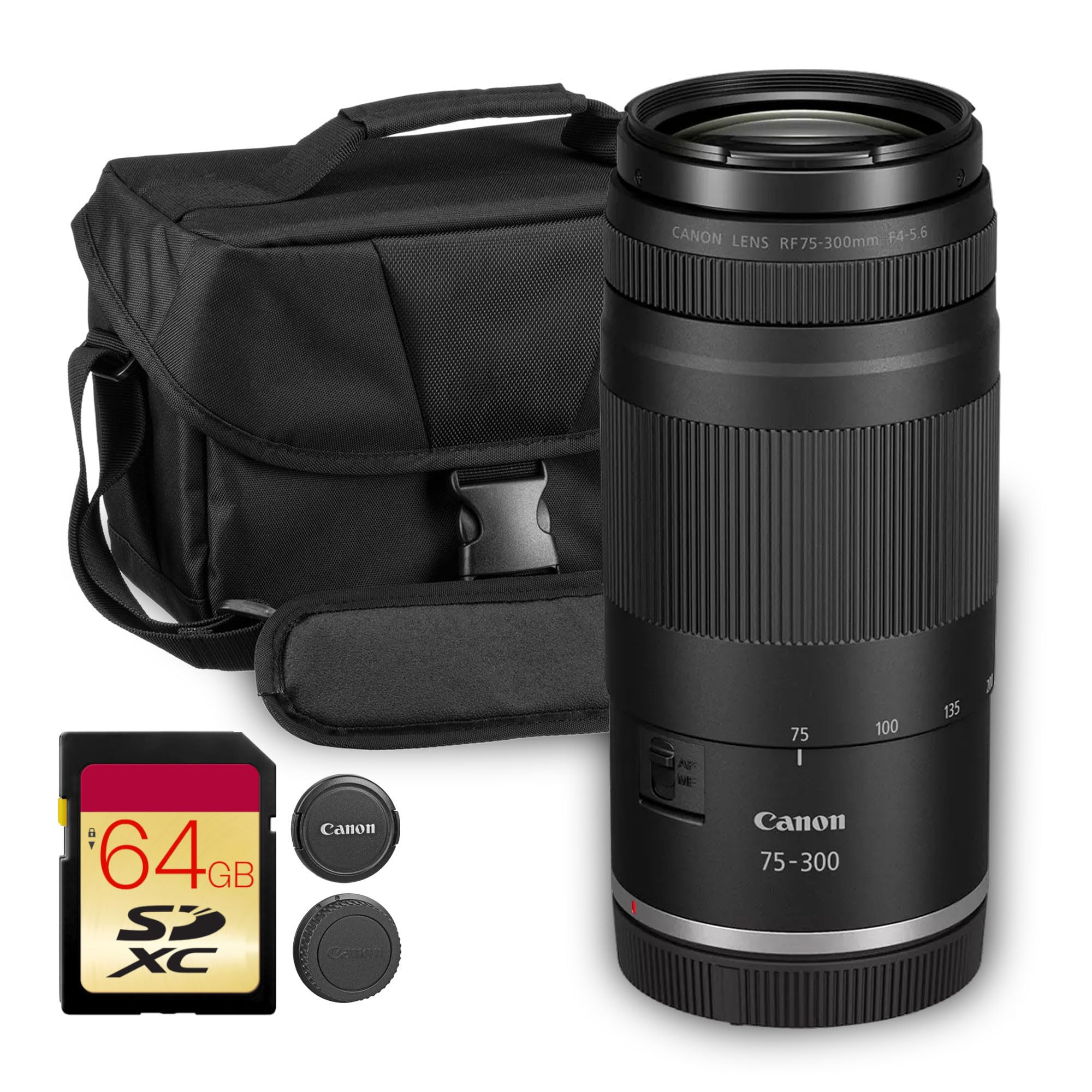
Canon RF 75-300mm f/4-5.6

87 /100
Keeper Score Excellent

Key details

Mount
Canon RF
Weight
16 oz
Focal Range
75-300mm
Minimum Focus
4.9 ft
Check Price on Amazon

The bundle is the first thing you notice: the Canon RF 75-300mm f/4-5.6 arrives with a camera bag and a 64GB memory card, which makes it an easy add-on for a Canon RF traveler who wants reach. At just over a pound, it is light enough to slip into a daypack, and the 75-300mm range gives you 120-480mm equivalent on an APS-C body. That is a lot of reach for the size.

We like it as a second lens rather than a do-everything travel lens. The 75mm starting point is too tight for a street scene or a group shot, so pair it with a wide prime or a standard zoom. The f/4-5.6 aperture is a daylight compromise, and the autofocus is smooth rather than lightning quick; for moving subjects, prefocus or use burst shooting. Close focus of 4.9 feet and 0.25x magnification is a useful bonus for semi-macro details.

The Super Spectra coating helps contrast when you are shooting toward the light, and the seven-blade diaphragm gives a reasonable background blur for a budget telephoto. The included bag is basic, but it is one less thing to buy before a trip. If you mainly shoot cities and interiors, this is not the lens to carry alone; if you want wildlife, sports, or architectural details without spending a lot, it earns its place.

The 58mm filter thread means a polarizer or UV filter you already own for a kit lens may fit.

Pros

  • 75-300mm reach in a 1-pound lens
  • Bundle includes bag and 64GB card
  • Close focus to 4.9 feet
  • Smooth autofocus for stills

Cons

  • f/4-5.6 aperture limits low light
  • Telephoto-only range needs a second lens
Our verdict

We recommend this bundle to Canon RF travelers who need affordable reach and don't mind carrying a second lens for the long shots.

Check Latest Price
4

Best for Sony Full-Frame

Sony FE 28-60mm f/4-5.6

80 /100
Keeper Score Excellent

Key details

Mount
Sony E
Weight
5.89 oz
Focal Range
28-60mm
Max Aperture
f/4-5.6
Check Price on Amazon

The Sony FE 28-60mm f/4-5.6 is the lens that makes a full-frame Sony kit feel like a point-and-shoot. At 167 grams, it is the lightest full-frame zoom in this group, and it collapses small enough to live in a small shoulder bag. The 28-60mm range is narrower than a 24-70mm, but it covers the travel basics: wide streets, group shots, and portraits.

We like the image quality in good light. The lens is sharp and the autofocus is snappy, which makes it an easy daytime walk-around lens. The f/4-5.6 aperture is the catch: indoors or after sunset you will lean on the camera's stabilization or a fast prime. That is a fair trade for the size, but it is worth knowing before you pack it as your only lens.

This is a renewed lens, so condition matters. Check the glass, the zoom action, and the mount when it arrives; the mount can be stiff enough to make removal awkward, and that is easier to deal with before a trip than during one. The 40.5mm filter thread is unusual, so buy the filter or step-up ring before you leave. For a Sony full-frame traveler who wants the smallest possible zoom, it is the one we pack when bag space is the deciding factor.

Pros

  • 167 g full-frame zoom
  • 28-60mm covers everyday travel
  • Sharp images in good light
  • Collapses small for packing

Cons

  • f/4-5.6 aperture is dim indoors
  • Renewed stock can have stiff mounts
Our verdict

Sony full-frame travelers who want the smallest possible zoom should start here, provided they can live with a slow aperture and renewed stock.

Check Latest Price

How We Tested Travel Lenses

We started by rounding up every full-frame mirrorless lens a traveler might plausibly carry — compact zooms, wide-angle primes, and long-range all-in-ones — then filtered down to 11 based on mount coverage, zoom range, filter size, and whether the weight stayed inside what we'd actually sling over a shoulder for eight hours. Testing ran for nine months across weekend trips, two long flights, and countless everyday walks where the camera came along only because it fit in a small bag.

Weight and size got measured, not guessed. Every lens went onto a kitchen scale with caps and hood attached, then into the same small shoulder bag to see how much room was left for a water bottle and a jacket. I carried each one for a full day of walking and noted when my shoulder started complaining, because the lens you leave behind is the one that fails.

For sharpness, I photographed the same rooftop and the same shaded doorway at every aperture from wide open down, then zoomed to 100 percent on a laptop to compare centers and corners. Autofocus got the harder job: dogs running toward me, cyclists crossing an intersection, a speaker moving behind a market stall. We counted keepers and noted how often the lens hunted before locking on, especially in low light.

Value was the final filter. A lens that covered most of a trip at a reasonable price beat one that was brilliant in a narrow range and stayed home the rest of the time. Throughout, we watched for the things reviews miss — zoom creep, a stiff focus ring, a hood that won't stay put — since those are what wear you down on day six of a trip.

How to Choose a Travel Lens

Start with the mount and the range

A lens only works on its own system, so the first decision is not image quality or price; it is whether the lens fits your camera. From there, choose between one lens that covers a lot of ground and two lenses that cover it better. A 28-400mm superzoom like the Nikon is the one-lens answer for Nikon Z travelers, while the Canon RF 28mm prime and RF 75-300mm split wide and long into two small packages. If you shoot a crop-sensor body, check the equivalent range before you commit: a 28mm prime becomes a normal lens, and a 75-300mm becomes a 120-480mm.

Size and weight you will actually carry

Travel photography is full of good lenses left in the hotel room. The difference between a 59-gram prime and a 1.6-pound superzoom is the difference between a lens that lives in your jacket and one you plan around. We prioritize a lens that balances well on the camera and fits the bag you already carry. If you walk all day, a compact prime or a small standard zoom is often the better choice; if you need reach, accept the weight and use a sling or a padded insert to keep it comfortable.

Aperture and low light

A fast aperture buys you handheld shots indoors and after sunset, but it usually adds size, weight, and cost. Most travel zooms here use variable f/4-5.6 or f/4-8 apertures, which are fine in daylight and limiting in dim interiors. A compact f/2.8 prime is a useful companion: it covers the evening while your zoom covers the day. If you shoot mostly in good light, a slower zoom is the more versatile choice; if you shoot markets, restaurants, and night streets, put more of your budget into a faster lens.

Stabilization, autofocus, and condition

Stabilization matters most at the long end. Nikon's 5.0-stop VR makes handheld 400mm shots more realistic, and it is worth prioritizing if you shoot telephoto. Autofocus speed and noise matter for moving subjects and video; a quiet STM motor is a real advantage when you are recording in a quiet street or a museum. If you buy renewed, check the glass, zoom action, and mount on arrival, and confirm the warranty. A stiff mount or a scratchy zoom is easier to return before you leave than to live with on the road.

Frequently Asked Questions

Final Verdict

For most Nikon Z travelers, the NIKKOR Z 28-400mm is the lens we recommend: it covers more ground than any other pick here and still fits a day bag. Canon RF shooters who want to travel light should start with the 59-gram RF 28mm f/2.8; add the RF 75-300mm when you need reach. Sony full-frame travelers get the smallest package in the FE 28-60mm, provided they accept the slower aperture and renewed stock. Choose the mount first, then decide whether one lens or two suits the way you shoot.