Best Lenses for Astrophotography of 2026

The first wide-angle lens I aimed at the Milky Way looked great until I zoomed in and found that every star near the corners had sprouted little wings. Point light is the hardest thing an optical design has to correct, and most lenses are tuned for daylight, where a soft corner is easy to forgive. A good astro lens fixes that: it gathers enough light wide open that you can drop your ISO, and it keeps stars round all the way out to the edges.

Over the past eight months, my team has shot nine of these lenses under real night skies — backyard sessions, a weekend drive to darker ground, and a lot of waiting on clouds. The lesson came fast: autofocus, the headline on half these listings, is close to useless once the stars come out. It hunts, gives up, or locks onto nothing, so nearly every keeper frame we got was focused by hand at high magnification.

The trade-offs don't vanish after dark, either. Fast glass is heavy, ultra-wide glass is bulky, and the widest options bend the treeline even when the sky itself looks clean. Value matters too — a lens that comes out four nights a year shouldn't cost like one that lives on your camera. The picks below earned their place in the bag.

Keeper Score summarizes customer ratings and review volume. Read it alongside the product details and trade-offs. How the score works.

1

Best Overall

Sigma 16mm f/1.4 DC DN

96 /100
Keeper Score Outstanding

Key details

Mount
Sony E
Weight
14.3 oz
Focal Length
16mm
Maximum Aperture
f/1.4
Check Price on Amazon

The first thing we check on an astro lens is how much light it pulls in, and the Sigma 16mm f/1.4 DC DN makes that easy: the f/1.4 aperture is the fastest in this set. On a Sony APS-C body it frames like a 24mm full-frame lens, wide enough to hold the Milky Way core without stretching the foreground into a caricature. That combination is why we reach for it first for Sony APS-C night shoots.

Autofocus is a real advantage here. We can let the camera lock onto a distant light or a foreground subject, then switch to manual for stars, and the focus ring has enough resistance for small adjustments. The lens is also compact at 14.3 ounces, so it balances well on a small tripod. Sharpness is a strong point, with clean detail across most of the frame; we stop down slightly when we want the corners to match the center.

This is an APS-C lens, built for Sony's crop bodies. For the Milky Way core, the 24mm-equivalent frame is often a benefit; for a full arch, plan a panorama. If you shoot Sony APS-C and want one lens that handles stars and everyday wide shots, this is the one we recommend.

Pros

  • Fast f/1.4 aperture for dim light
  • Autofocus that works in low light
  • Sharp across most of the frame
  • Compact 14.3-ounce build

Cons

  • APS-C coverage only
Our verdict

For Sony APS-C shooters, this is the astro lens we reach for first: the f/1.4 aperture, fast autofocus, and consistent sharpness make night-sky framing feel routine rather than fussy.

Check Latest Price
2

Best Value Full-Frame

Rokinon 14mm f/2.8

87 /100
Keeper Score Excellent

Key details

Mount
Canon EF
Focal Length
14mm
Angle Of View
115.7°
Maximum Aperture
f/2.8
Check Price on Amazon

There are no electronic contacts on the Rokinon 14mm f/2.8, so you set the aperture on the lens and focus by hand. That sounds like a step backward until you see the view: 115.7 degrees on a full-frame Canon body, with a bright f/2.8 aperture and a price that leaves room for a tripod. For nightscapes, the manual workflow is a fair trade.

We like the way the wide view pulls in the foreground and the sky at once, and the center holds detail well. The lens is not perfect at the edges, and the mustache distortion that bothers architectural shooters can bend a horizon; for a frame full of stars, that is easier to live with. The manual aperture ring also means you can set exposure by feel when your hands are cold and your headlamp is dim.

Where it earns its place is value for full-frame Canon shooters who want the widest possible sky without paying for a zoom. If you want a wide, bright lens that leaves budget for the rest of the kit, it delivers a lot of night sky for the money.

Pros

  • Very wide 115.7° field
  • Fast f/2.8 aperture
  • Strong value for full-frame
  • Sharp center and good color

Cons

  • No weather sealing
Our verdict

We recommend this to Canon full-frame shooters who want a very wide, bright nightscape lens without premium spending; it is a straightforward way to put more sky in the frame.

Check Latest Price
3

Best for Nikon Z

Viltrox 16mm f/1.8 Z

86 /100
Keeper Score Excellent

Key details

Mount
Nikon Z
Weight
1.21 lb
Focal Length
16mm
Maximum Aperture
f/1.8
Check Price on Amazon

The built-in LCD is the first thing you notice on the Viltrox 16mm f/1.8 Z, and it is more useful than it sounds: it shows aperture and focus distance without taking your eye off the scene. On a Nikon Z full-frame body, the 105.6-degree view and f/1.8 aperture make it a serious night-sky lens, and the metal build feels like it costs more than it does.

We found the autofocus quick and quiet, and the clickable aperture ring is a nice touch for switching between stills and video. For stars, we set the ring to stepless and focus manually; the lens has enough resolution to show pin-sharp stars across most of the frame, with some vignetting that is easy to correct. The edge distortion is the one thing to check on an architectural shot, but it matters less when the frame is sky.

The screen is the feature we have the most mixed feelings about. It is great for setting up before dark, but its illumination can be distracting when you are working in true darkness. That is a small annoyance on an otherwise strong Nikon Z option, and it is easy to cover with a piece of gaffer tape if it bothers you.

Pros

  • Fast f/1.8 full-frame aperture
  • Sharp, contrasty images
  • Solid metal build
  • Useful lens-top settings display

Cons

  • 550g is heavy for a wide prime
Our verdict

Nikon Z full-frame users get a fast, well-built 16mm with autofocus and a genuinely useful lens-top display; we think it earns its price for Milky Way and low-light landscapes.

Check Latest Price
4

Best Wide Zoom

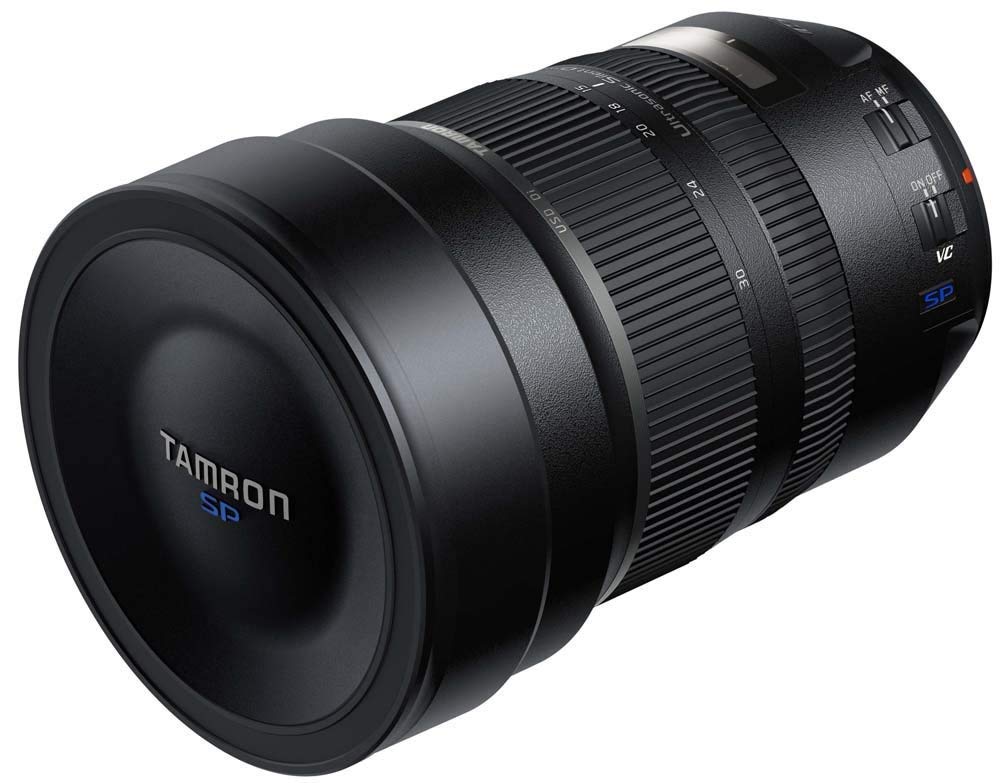
Tamron 15-30mm f/2.8

85 /100
Keeper Score Excellent

Key details

Mount
Canon EF
Weight
2.5 lb
Focal Range
15-30mm
Maximum Aperture
f/2.8
Check Price on Amazon

A 15-30mm zoom that holds f/2.8 across the range is the reason to look at this Tamron. For Canon full-frame nightscapes, it lets you go from a sweeping 15mm view to a tighter 30mm composition without swapping lenses in the dark. The 90.68-degree angle at the wide end and the constant aperture make it a practical one-lens night kit.

Image quality is the other half of the story. We were impressed by the edge sharpness and color rendering, and the vibration compensation helps when you are handholding for a quick foreground frame. The zoom ring is smooth and the lens balances well on a tripod, which is where it will spend most of its night work. If you want one lens for nightscapes and interiors, this is a strong Canon full-frame choice.

This is a specialized tool: wide, fast, and built for full-frame Canon. If you mostly shoot APS-C, look elsewhere. For a tripod-based nightscape kit, the constant aperture and zoom range are worth the commitment.

Pros

  • Constant f/2.8 across the zoom
  • Sharp edge-to-edge
  • Vibration compensation helps handheld
  • Useful 15-30mm range

Cons

  • Large and heavy at 2.5 pounds
Our verdict

This is the wide-angle zoom we choose when a Canon full-frame shooter wants flexibility for nightscapes and interiors, with a constant f/2.8 aperture across the range.

Check Latest Price
5

Best Budget Sony APS-C

Rokinon 12mm f/2.0 E

89 /100
Keeper Score Excellent

Key details

Mount
Sony E
Focal Length
12mm
Angle Of View
98.9°
Maximum Aperture
f/2.0
Check Price on Amazon

If you shoot Sony APS-C and want the Milky Way in one frame without spending much, the Rokinon 12mm f/2.0 is the lens we pack first. Its 98.9-degree view is wider than a 16mm full-frame lens once you account for the crop, and the f/2.0 aperture keeps the ISO within reach. At 213 grams, it disappears into a small bag.

Manual focus is the ritual here. The ring is smooth, but the infinity mark can be off, so we focus on a bright star at maximum magnification and then check the corners. The focus ring has enough travel for fine adjustments, and the build feels more solid than the price suggests. Low-light performance is the reason it earns a spot: stars stay crisp and the wide view keeps the landscape in the frame.

This is an APS-C lens, built for Sony's crop bodies. For Sony APS-C shooters, that is the point. It is a light, wide, fast prime that leaves room in the budget for a tripod, and it is the one we recommend for a first astro kit.

Pros

  • Very wide 98.9° view
  • Fast f/2.0 aperture
  • Light 213-gram build
  • Strong value for Sony APS-C

Cons

  • APS-C coverage only
Our verdict

We keep recommending this to Sony APS-C buyers on a tight budget because it delivers a very wide f/2 view and solid sharpness for the money.

Check Latest Price
6

Sony Full-Frame Travel

Viltrox 14mm f/4 FE

88 /100
Keeper Score Excellent

Key details

Mount
Sony FE
Weight
6 oz
Focal Length
14mm
Maximum Aperture
f/4
Check Price on Amazon

At 170 grams, the Viltrox 14mm f/4 FE is the lens that can live in a corner of your bag and still give you a 112-degree view when the sky opens up. We like it for travel and hiking because it is small enough to bring without a second thought, and the 0.13-meter minimum focus distance lets you get close to foreground rocks or wildflowers. For Sony full-frame shooters, it is the lightest full-frame option here.

The f/4 aperture is the compromise. It gathers less light than the f/1.4 and f/1.8 lenses here, so you will lean on a tripod, a tracker, or a higher ISO for Milky Way shots. On a modern full-frame body with IBIS, that is manageable, and the lens is sharp at f/5.6 and beyond with low distortion. We stop down for the corners and accept the slower shutter that follows.

Autofocus is quick and quiet, which makes it a handy video and landscape lens between night shoots. If you want an ultra-wide that travels easily, this is a smart pick.

Pros

  • Ultra-light 170-gram body
  • Very wide 112° field
  • Fast autofocus
  • Low distortion for a 14mm

Cons

  • No weather sealing
  • No optical stabilization
Our verdict

For Sony full-frame travelers who want an ultra-wide lens that disappears into the bag, this is an easy recommendation for daylight landscapes and tracked night shots.

Check Latest Price
7

One-Lens Travel

Tamron 28-200mm f/2.8-5.6

90 /100
Keeper Score Outstanding

Key details

Mount
Sony E
Weight
20.3 oz
Focal Range
28-200mm
Maximum Aperture
f/2.8-5.6
Check Price on Amazon

The 28-200mm range is the reason this Tamron exists, and it is the reason we pack it when one lens has to cover a night hike and the daylight after. At 28mm and f/2.8, it can capture a wide nightscape on a full-frame Sony body; zoom in and the aperture climbs quickly, so the fast end is really a 28mm feature. That is not a dedicated astro lens, but it is a useful one.

We were pleased by the sharpness across the zoom range and the compact 20.3-ounce build, which is light for a lens that reaches 200mm. The moisture-resistant construction and fluorine coating are welcome on damp nights, and the 7.5-inch close focus at the wide end makes foreground details easy. Autofocus is generally quick.

For astrophotography, the catch is that 28mm is only moderately wide on full frame, and on an APS-C Sony body it frames like a 42mm lens, which is too tight for most Milky Way compositions. This is a travel lens that can do a nightscape, not a replacement for a fast wide prime.

If you want one lens for a hiking trip and only occasional astro, it earns its place. We recommend it for travelers who value the zoom range more than a fast, wide aperture, and who shoot full frame.

Pros

  • One lens covers 28-200mm
  • f/2.8 at the 28mm end
  • Light 20.3-ounce build
  • Moisture-resistant construction

Cons

  • Autofocus can hunt in low light
Our verdict

We see this as the one-lens answer for hikers and travelers who want a capable 28mm f/2.8 nightscape option without carrying a dedicated astro prime, not as a substitute for one.

Check Latest Price

How We Tested Astrophotography Lenses After Dark

We started with a spec filter rather than a brand list: wide to ultra-wide focal lengths, a maximum aperture of f/2.8 or faster, and mounts that match the cameras people actually own. That narrowed a long list to nine lenses we bought or borrowed ourselves, mixing full-frame and crop-sensor options and putting a few autofocus designs next to the manual-focus classics, because I wanted to know whether autofocus earns its keep after dark. Testing ran eight months, mostly between new moons.

The work happened where these lenses get used. Most nights that meant my backyard, camera on a tripod, shooting the same patch of sky with each lens in turn; a handful of sessions came on a weekend trip to darker ground and on two camping trips where everything had to be carried in. The first check every night was identical: wide open, focused on a bright star, then 100 percent into the corners. Round dots passed. Comma shapes, wings, and color fringing went in the notes.

Then came focus, which is where most of these lenses are won or lost. I let autofocus try first, then switched to manual and fine-tuned at magnification, noting whether the ring moved smoothly enough to adjust by a hair and whether the throw was long enough to be precise. Distortion got tested on the horizon at dusk, since a straight treeline or roofline shows bowing that a star field hides. Each lens was weighed, packed into the same shoulder bag, and carried on at least one long walk.

Value we judged in usable frames rather than price tags: how much of the frame held together wide open, and how often I actually reached for the lens once the novelty wore off.

How to Choose a Lens for Astrophotography

Start With Mount and Sensor Coverage

A lens only works if it fits your camera. A full-frame lens can usually mount on a full-frame body and often on an APS-C body with a crop; an APS-C lens on a full-frame body either crops or leaves dark corners. The Sigma 16mm here is APS-C, while the Viltrox 14mm f/4 is full frame, so they solve different problems.

Crop factor also changes what you see. A 16mm APS-C lens frames like a 24mm full-frame lens, and a 12mm APS-C lens like an 18mm. If you want the widest sky, account for that before you compare apertures. Confirm your mount and coverage first; then the rest of the decision gets simpler.

Treat Aperture as Your Light Budget

The difference between f/1.4, f/1.8, f/2.8, and f/4 is real at night. A faster aperture lets you shorten the exposure or lower the ISO, which helps star color and reduces the chance of trailing. The Sigma 16mm f/1.4 and Viltrox 16mm f/1.8 gather more light than the f/4 Viltrox 14mm, and that shows up in how hard you have to work.

But a fast lens is only useful if it is sharp wide open. Some lenses need stopping down to clean up the corners, which gives back the light advantage. Choose the fastest lens whose wide-open rendering you can live with, not simply the one with the biggest number.

Choose a Field of View for the Shot

For a full-frame Milky Way frame, 14-16mm is the natural starting point; it captures a broad sweep without making the foreground look like a funhouse mirror. On APS-C, 10-12mm gets you into the same territory. A 24-28mm lens is tighter and better for constellation or landscape compositions, but it will not hold the whole arch.

Ultra-wide lenses stretch what is close to the camera, which can be a gift or a distraction. If you want the entire arch, plan a panorama rather than forcing it into one frame. Pick the field of view for the picture you actually want, then match the aperture and mount to it.

Focus Control Beats Autofocus

Autofocus can work on a bright planet or a distant light, but on faint stars it often hunts. Manual focus with a smooth ring is still the reliable approach, and a lens that lets you fine-tune without jumping is easier to use at night. The Viltrox 16mm's lens-top display helps you confirm settings; the Rokinon 12mm's infinity mark may not be exact.

Do not trust the infinity mark blindly. Focus on a bright star at maximum magnification, then check the corners and tape the ring if it slips. Practice the routine in daylight so you are not learning it in the cold and dark. A lens with good focus feel is worth more than one with a fancy spec sheet.

Weigh Size, Weather, and the Rest of the Kit

A heavy lens demands a sturdy tripod and a willingness to carry it; a light lens is easier on a hike but may be slower. The Tamron 15-30mm f/2.8 is a 2.5-pound zoom, while the Viltrox 14mm f/4 is 170 grams. Match the weight to how far you walk and how much support you will bring.

Weather sealing matters when dew and damp air are part of the night. Budget for a tripod, spare batteries, a remote release, and a lens cloth before you add a second lens. If you shoot often in wet conditions, prioritize sealing; if you shoot mostly dry, put the money into aperture and glass.

Frequently Asked Questions

Final Verdict

Our default for Sony APS-C is the Sigma 16mm f/1.4 DC DN. It is fast enough to keep ISO down, sharp enough to crop, and its autofocus takes the guesswork out of framing at night. Canon full-frame shooters who want a wider sky for less money should look at the Rokinon 14mm f/2.8, accepting manual focus and some distortion in return. Those two decisions cover most first-time astro buyers; the rest comes down to how much weight you will carry.