Best LED Light Wands for Photography of 2026

Your phone can already shoot watchable video in near-darkness, but watchable and good aren't the same thing: footage turns grainy, shadows go muddy, and skin picks up a gray cast. A light wand fixes that without a studio. It's a battery-powered tube you hold in one hand, prop on a shelf, or stick to anything metal, so you can put soft, directional light where the camera can't go.

I've spent four months shooting with 14 of these wands — at dusk, in dim living rooms, on a desk with a product and a phone, and in corners too small for a softbox. The brightest number on the box turned out to be the least useful; lumens get measured at the LED, not two feet away where your subject sits. What separated them was color rendering, how finely each one dimmed, whether the battery survived a full evening, and whether the extras in the box were worth paying for. The picks below are the ones I keep reaching for.

Keeper Score summarizes customer ratings and review volume. Read it alongside the product details and trade-offs. How the score works.

1

Best Overall

NEEWER TL20C RGB Light Wand

91 /100
Keeper Score Outstanding

Key details

Output
10W, 730 lux at 0.5m
Weight
7 oz
Battery
2550mAh, up to 140 min
Color Temperature
2500K–8500K
Check Price on Amazon

Nine inches and seven ounces, and the TL20C still manages 195 LEDs, a 10W output rated at 730 lux at half a meter, and a color range from 2500K to 8500K. That balance is why it's the one we recommend first: it disappears into a bag you already carry, and it has enough reach to shape a face at arm's length or throw color across a wall behind it. The 8500K top end isn't the widest on this page — the TL60 and the PULUZ both go cooler — but it's wide enough to match office fluorescents and overcast daylight without reaching for a gel.

Battery is where small wands usually embarrass themselves. The 2550mAh cell is rated for 140 minutes at full brightness, the longest full-power figure of any compact wand here, and it charges over USB-C with PD 3.0 support. We stopped thinking about the battery during a normal afternoon of shooting, which is the highest compliment a light this small can get.

The magnets are what we came back to. There are magnetic faces on the body and both ends plus 1/4"-20 threads at each end, so it hangs off a steel shelf, sits on a stand, or screws to a clamp in about a second. We stuck it under a metal shelf to light a desk shot that had no room for a tripod. The caveat is the obvious one: magnets don't hold on aluminum cages or painted walls, so a clamp with a thread is the accessory worth buying alongside it.

What it doesn't do: it isn't water resistant, so it stays inside when the weather turns, and nine inches is a wand rather than a tube — for a longer strip of light in one pass, the Q508A is the better shape. The 17 scene effects are more than we ever used; the useful creative range sits in HSI mode, where you can pull saturation down for a colored wash that reads as lighting rather than a party trick.

Pros

  • Full 2500–8500K plus RGB in a 9-inch body
  • Rated 140 minutes at full brightness
  • Magnets and 1/4"-20 threads at both ends
  • 7 oz, so it lives in a jacket pocket

Cons

  • Not water resistant
Our verdict

The wand we recommend to most people: 2500–8500K, full RGB, 140 minutes at full brightness, and magnets that hold it where a stand won't fit.

Check Latest Price
2

Best Color Accuracy

Godox TL30 RGB Tube Light

90 /100
Keeper Score Outstanding

Key details

Length
11.8 in
Battery
2900mAh, 60 min at max
Color Rendering
CRI 97+, TLCI 99+
Color Temperature
2700K–6500K
Check Price on Amazon

Two figures do most of the work here: CRI 97+ and TLCI 99+, the strongest combined color-rendering rating among these picks. In practice that's what keeps skin tones from going green under mixed light and helps tubes of different makes read as the same white. If you shoot products where the client cares that the red is the actual red, this is the one we reach for. The 2700–6500K range covers warm interiors through clean daylight, and RGB, CCT and HSI modes open up 36,000-odd colors when you want a colored edge.

What we appreciate most is the control. The Godox Light app talks to the light over Bluetooth, so brightness and hue can be nudged from a phone instead of reaching into the shot, and the magnetic back plus three metal plates means it can go on a wall or a shelf where there's no steel to grab. It's 11.8 inches, ships with a wrist strap, a bag and a USB-C cable, and sets up on a desk or a small stand in seconds.

The trade-off is runtime: 60 minutes at full output from the 2900mAh cell, the shortest full-power figure among the premium wands here. For interviews, headshots and tabletop work that's plenty, and running it at half stretches it much further, but a full day of shooting wants the TL20C's longer run or a second light. Buy this one for color and control, not for endurance.

Pros

  • CRI 97+ and TLCI 99+
  • Bluetooth app control for brightness and hue
  • Magnets plus metal plates for non-steel surfaces
  • Compact 11.8-inch tube with bag and wrist strap

Cons

  • One hour at full brightness
Our verdict

For color-critical work, the best color rendering here plus phone control — as long as an hour at full power covers your shoot.

Check Latest Price
3

Best Value Long Tube

LUXCEO Q508A RGB Wand

90 /100
Keeper Score Outstanding

Key details

Colors
36 colors, 12 effects
Output
1000 lumens
Battery
2600mAh, up to 2 hrs
Color Temperature
3000K–6000K
Check Price on Amazon

The Q508A is the best value in a long tube on this page: 21.65 inches of light, 1000 lumens, CRI 95+, 36 colors across 30 brightness levels and a carry bag, for roughly what the compact wands cost. Length is the point. A tube that long lays a rim down a jawline or a product edge in one pass without the hot spot a short wand gives you, and at 0.74 lb it's still light enough to hold through a take.

The battery is a 7.4V 2600mAh pack rated around two hours at full output. The remote is the fussy part: it needs line of sight and a light that's been active recently, so cueing a color change from across a room works and waking a sleeping light from your pocket doesn't. We ended up on the body controls for anything quick, and that's the habit to build with this one.

Color temperature runs 3000–6000K, and the 12 effects — police lights, lightning, candlelight — are for atmosphere rather than accuracy. For warm interiors and clean white light it's everything you need. To match cool office lighting or push toward a daylight edge, the TL20C or the ULANZI go further up the scale.

Pros

  • 21.65 inches of light at 0.74 lb
  • 1000 lumens with CRI 95+
  • 36 colors across 30 brightness levels
  • Two-hour battery and a carry bag

Cons

  • Color temperature tops out at 6000K
  • Micro-USB charging cable required
Our verdict

A 21-inch tube for about the money of a compact wand: 1000 lumens, 36 colors, and two hours of runtime.

Check Latest Price
4

Best for Studio and Crews

NEEWER TL60 RGB Tube Light

90 /100
Keeper Score Outstanding

Key details

Length
26 in
Output
20W
Battery
120 min at full
Color Temperature
2500K–10000K
Check Price on Amazon

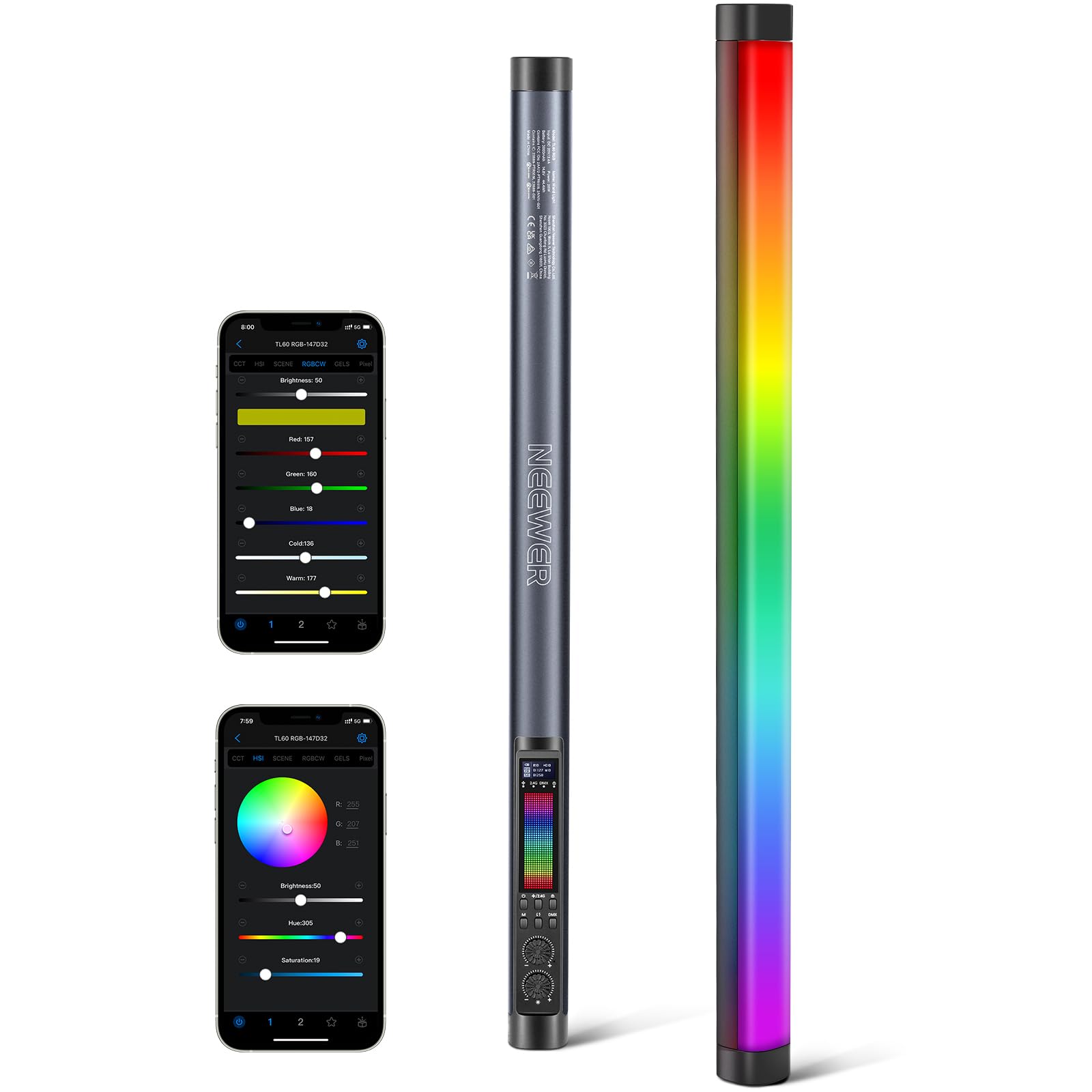
Hand this one to someone else's lighting desk and it fits right in. Alongside the on-body buttons there's the Neewer app, a 2.4G group mode for syncing several tubes to one remote, and DMX over RJ45, so a board operator can cue it with the rest of the rig. If you've ever tried to hit a music cue by hand with a wand in each fist, you know exactly what that's worth.

The hardware holds up its end: 20W — the highest output on this page — through a curved diffuser, a 2500–10000K span that is the widest here, CRI 97+, 36,000 colors in HSI, and eight separately controllable pixel sections for chases and gradients. The battery is rated 120 minutes, and a power adapter, stand mount, cable and bag all come in the box, so it arrives ready for a stand rather than almost ready.

Our take is that this is studio equipment shaped like a wand. At 26 inches it wants a stand or both hands, and it is the biggest outlay on the page — worth it only if you'll actually use group or DMX control. Light a single subject in a spare room and the TL20C does most of the same job for far less. Light a set where four tubes need to change color on cue and nothing else here comes close.

Pros

  • 20W, the highest output here
  • 2500–10000K, the widest color-temperature span
  • Eight pixel sections plus app, 2.4G and DMX
  • 120-minute battery and a full accessory set

Cons

  • 26 inches needs a stand or two hands
  • Deep control menu takes time to learn
Our verdict

For studio and crewed shoots: 20W, the widest color range here, pixel effects, and app, 2.4G or DMX control a board operator can cue.

Check Latest Price
5

Best Pocket Wand

PULUZ TL21C Mini Light Wand

83 /100
Keeper Score Excellent

Key details

Length
6.7 in
Output
6W, 600 lux at 0.3m
Battery
2000mAh, up to 3 hrs
Color Temperature
2500K–9000K
Check Price on Amazon

At 6.7 inches and 178 g, the TL21C is the smallest light here and the only one we've carried in a jacket pocket without noticing. It's 75 LEDs and 6W, rated 600 lux at 0.3m, which tells you exactly what it's for: a face at arm's length, a product on a tabletop, a little fill inside a car. It is not going to light a room.

The battery is the surprise. A 2000mAh cell is rated for nearly three hours at full power and up to 30 at minimum, and the color temperature runs 2500–9000K — wider than several of the bigger wands on this page — with 21 scene effects and full HSI color. A light this small shouldn't be this configurable, and the tiny body makes the range easy to use rather than a menu you avoid.

Where it earns its place is placement. There are magnets and a 1/4"-20 thread at each end, so it parks on a filing cabinet, screws onto a mini tripod, or hides behind a plant for a kicker nobody can source. For a first kit we'd rather have two of these than one bigger wand, and at this end of the range that comes out cheaper than most of the single lights here.

Pros

  • Fits a jacket pocket at 6.7 inches
  • Up to three hours at full brightness
  • 2500–9000K plus 21 scene effects
  • Magnets and threads at both ends

Cons

  • 6W limits it to close-range fill
Our verdict

The pocket wand: 6.7 inches, magnets at both ends, and up to three hours at full power for close-range fill and hidden accents.

Check Latest Price
6

Two-Light Starter Kit

GSKAIWEN LED Wand Light Kit

92 /100
Keeper Score Outstanding

Key details

Power
Mains adapter only
In The Box
Two wands, two stands, bag
Kit Weight
6.5 lb
Check Price on Amazon

What arrives is a two-light studio in a bag: two dimmable LED wands, two retractable stands, two dimming adapters and a zipped carry case, 6.5 lb in total. Assembly takes a couple of minutes and everything folds back into the bag afterwards, which is what makes it easy to keep out of the way between shoots rather than permanently set up in a corner.

Brightness is why it's on the page. These are strong at the top of their range — we lit a single talking head with one and had light to spare — and two of them cross-light a subject cleanly. They stay cool through a long session, so nobody is squinting through a hot lamp, and brightness and color temperature adjust on both units.

The limits are structural rather than optical. Everything runs from the mains adapters, so this is a room-bound kit: a spare bedroom, a market stall, a streamer's desk. It isn't what you take to a park, and the wands can only be handheld while you're tethered to an outlet, which is the whole difference between this and a battery wand.

The stands deserve a word of their own. They're light for the heads they carry, so weight the bases and keep them out of foot traffic; a light that goes over mid-session is the fastest way to end one. Set up that way, it's the practical route to two soft sources at standing height without buying each part separately — just don't expect the bag to leave the house.

Pros

  • Two lights, two stands and a bag in one box
  • Bright enough for one subject at close range
  • Quick to assemble and pack away
  • Stays cool through long sessions

Cons

  • Mains power only
Our verdict

Best for a fixed home studio: two bright wands, two stands and a bag in one box — provided you have outlets and room to leave it up.

Check Latest Price
7

On-Camera Wand

Hagibis RGB Light Wand

88 /100
Keeper Score Excellent

Key details

Length
21.65 in
Output
1000 lumens
Battery
2600mAh, 120 min
Color Temperature
3200K–5600K
Check Price on Amazon

The hot shoe adapter is what separates the Hagibis from the other tubes. A ball head clamps into a camera's shoe and takes this 21.65-inch wand, so the light travels with the camera instead of sitting on a stand beside it. With 1000 lumens, color rendering above 95 and nine color presets, it's built for moving work: events, markets, run-and-gun interviews where setting a stand costs you the shot.

The 7.4V 2600mAh battery is rated 120 minutes at full output, and a lanyard, carrying bag, remote and shoe adapter come in the box. At 0.74 lb it's light enough that the shoe mount doesn't feel like it's straining the camera, which matters more than the spec suggests once you're carrying it around for an hour.

Two things to know before you buy. The remote is line-of-sight and needs a light that's been on recently, so in practice your thumb lives on the body buttons. And battery longevity is the risk with this model — the failure to plan for is a wand that stops holding a charge rather than one that fades — so put it through its paces in the first few weeks while the return window is still open.

Where it earns a place is on-camera fill and a hand-carried rim: clip it in the shoe, walk, shoot, and the light comes with you. The color range is the narrowest here at 3200–5600K, so it's the wrong tool for matching cool interior light or pushing toward a daylight edge — that's TL20C territory.

Pros

  • Hot shoe adapter with an adjustable ball head
  • 1000 lumens with 95+ color rendering
  • 120 minutes at full power
  • 0.74 lb with a bag and lanyard

Cons

  • Color range limited to 3200–5600K
  • Micro-USB charging
Our verdict

A 21-inch tube that clamps into a camera's hot shoe for on-the-move shooting, as long as you watch the battery in the first weeks.

Check Latest Price
8

Building Longer Bars

ULANZI VL110 RGB Light Wand

87 /100
Keeper Score Excellent

Key details

Battery
2600mAh, 1.5 hrs at max
Linking
Lockable screw ends
Magnets
Three-sided
Color Temperature
2500K–9000K
Check Price on Amazon

The trick is at the ends. Each VL110 locks to the next, so two become a rigid two-foot bar and three become a strip you can run across a doorway or along a table. That's a different way of building light from buying one longer tube, and it's why this one stays in the roundup even with stiffer competition above it.

On its own it's a 2500–9000K wand with CRI 95+, three magnetic faces — the most useful magnet arrangement here for wrapping a metal post — HSI, CCT and scene modes with 20 effects, and a 1/4"-20 socket in the handle for a stand. The color range puts it ahead of the Hagibis and the Q508A for mixed lighting, and the magnets hold far better than a single back panel does.

Reliability is the caveat to carry into this purchase. The failure to guard against is a unit that stops working after a few months of use, so keep the receipt and use the light hard in the first weeks rather than saving it for a job. Effect modes are worth testing on camera before a paid shoot too, since a pulse that looks great in the room can look wrong on screen.

Our read: this is the pick for anyone assembling a small multi-light kit a piece at a time — buy one now, link a second when a job pays for it, and lean on the three-sided magnets for stand-free placement in the meantime. If you mostly work alone and want one light you never have to think about, the TL20C is the steadier choice.

Pros

  • Lockable ends let you link wands into one bar
  • Three-sided magnets hold on metal posts
  • 2500–9000K with CRI 95+ and 20 effects
  • 1/4"-20 socket in the handle for a stand

Cons

  • About 1.5 hours at full power
  • Effect modes can flicker on camera
Our verdict

Buy it to build a longer bar over time: lockable ends, three magnetic faces, and a 2500–9000K range that covers warm rooms and daylight.

Check Latest Price

What Four Months and 14 Light Wands Taught Us

We started by pulling every wand with adjustable color temperature, a built-in battery, and some way to mount it hands-free, then cut anything with fixed brightness or a single color. That left 14 wands, tested over four months in dim living rooms after dark, on walking-and-talking vlog clips around the block at sunset, on a desk for tabletop product shots, and in a closet-studio where the magnetic ones went straight onto a metal shelf.

Brightness was checked by placing each wand two feet from a face, shooting the same frame at full power, and noting how much I had to raise the camera's ISO and whether highlights clipped. For color, we filmed the same subject across each wand's temperature range and compared the files for green or magenta casts, then scrolled through the built-in color and effect presets to see how many were usable. I dimmed and shifted color one-handed in the dark while filming to judge adjustability, and tried every remote and app from across the room and from behind the light, where signals drop.

Battery life was timed from full to dead at maximum brightness, then again at half, with recharge times logged. We weighed each wand packed in its case and carried them in a tote next to a camera and cables all four months to see which scratched, rattled, or lost an LED; several also came off a table onto carpet, and we checked the mounts and threads afterward. Last, we tallied what came in the box — bag, stand, hot-shoe adapter — and whether it made up for the price gap against the cheapest wand we tested.

How to Choose an Led Light Wand

Match output to the distance you light from

Lux ratings are only comparable at the same distance, and listings rarely agree on one: the Neewer TL20C is rated at 730 lux at half a meter, the PULUZ at 600 lux at 0.3m. Because light falls off quickly, that small gap in measuring distance makes the PULUZ much the dimmer of the two in real use. Before you compare two numbers, check what distance each was taken at.

As a rule of thumb, a few hundred lux at half a meter shapes a face at arm's length and not much further. A 20W tube like the TL60 is where a wand starts to hold a rim on a full-length shot. If your work is a person two feet from the lens, small and bright wins; if it's a room, buy wattage.

Treat color rendering and RGB as two different jobs

CRI 95+ is the floor for anything you point at a person, and for video a TLCI figure is more relevant — only the Godox TL30 lists one. RGB is for backgrounds, edges and atmosphere, not for skin; a saturated color wash on a face looks like a gel, not like lighting, which is why we pull saturation down rather than pushing it up.

A wide color-temperature span is worth paying for because it lets you match the room instead of fighting it. The TL20C's 2500–8500K covers warm lamps and cool office light; a tube that stops at 5600K will leave you hunting for ways to warm it up.

Read the runtime at full brightness

Almost every runtime claim is measured at minimum output. Compare the full-power figures: 140 minutes on the TL20C against 60 on the TL30 is the difference between a light you forget about and a light you plan around. If a listing only gives one number and doesn't say where it came from, assume it's the best case.

Capacity needs the same care. A 7.4V 2600mAh pack holds roughly twice the energy of a 3.7V 2600mAh one, so a bigger mAh number at a lower voltage is not a bigger battery. And check the port before you buy — micro-USB means one more cable you can't borrow from anyone.

Check where the light can physically go

Magnets are the reason to buy a wand, but they only work on steel. An aluminum cage, a painted wall and a wooden shelf will all refuse to hold, so pair the magnet with a 1/4"-20 thread at each end and a clamp you trust. The TL20C and the PULUZ both give you threads at both ends; the Hagibis gives you a hot shoe for the camera itself.

Lockable ends are the other placement trick. The ULANZI VL110 screws to the next one, so two wands become a rigid bar you can lay across a doorway — a different way to get length than buying a single long tube.

Decide between a wand and a kit

A kit like the GSKAIWEN gets you two lights, two stands and a bag in one purchase, and it needs outlets and floor space. A battery wand goes where there's no outlet at all. Most people shooting alone are better served by one good wand and a clamp; anyone setting up a fixed desk, salon chair or market stall gets far more light for the money from the kit.

Frequently Asked Questions

Final Verdict

The Neewer TL20C is the one we point most people to. A 2500–8500K range, full RGB, 140 minutes at full brightness, magnets and threads at both ends, and a seven-ounce body add up to a light you can carry without planning for it — and it covers a room's worth of lighting jobs without ever needing a stand.

Spend more only for a specific reason: the Godox TL30 if color rendering and phone control decide the job, the Neewer TL60 if someone else will be cueing the lights. For a first wand on a tight budget, start with the PULUZ TL21C — two of them beat one bigger wand, and cost less while doing it.