Best Home Theater Speaker Systems of 2026

A modern TV can hang a starship on your living room wall but still can't make one sound like it's there. What's missing is a center channel to keep dialogue pinned to the screen, rear speakers to put the room around you, and a subwoofer to give an explosion its weight.

Shopping comes down to a fork in the road. One path is a soundbar package with a wireless subwoofer and rear speakers that plug into the wall and mostly set themselves up; the other is an AV receiver and passive speakers, which asks for speaker wire, patience, and an afternoon, and pays you back in upgradability. Both can sound terrific. Over the past six months my team and I have lived with eight systems, judging dialogue, how much height a Dolby Atmos mix really throws overhead, and how much wiring and remote-juggling each one demanded.

Before you buy, know that the subwoofer does more for how big a system feels than two extra surround channels do. The picks below are sorted by what each is best at.

Keeper Score summarizes customer ratings and review volume. Read it alongside the product details and trade-offs. How the score works.

1

Best Overall

ULTIMEA Skywave X50

89 /100
Keeper Score Excellent

Key details

HDMI
eARC with 4K HDR pass-through
Channels
5.1.4
Subwoofer
8-inch wireless
Rear Speakers
Two wireless
Check Price on Amazon

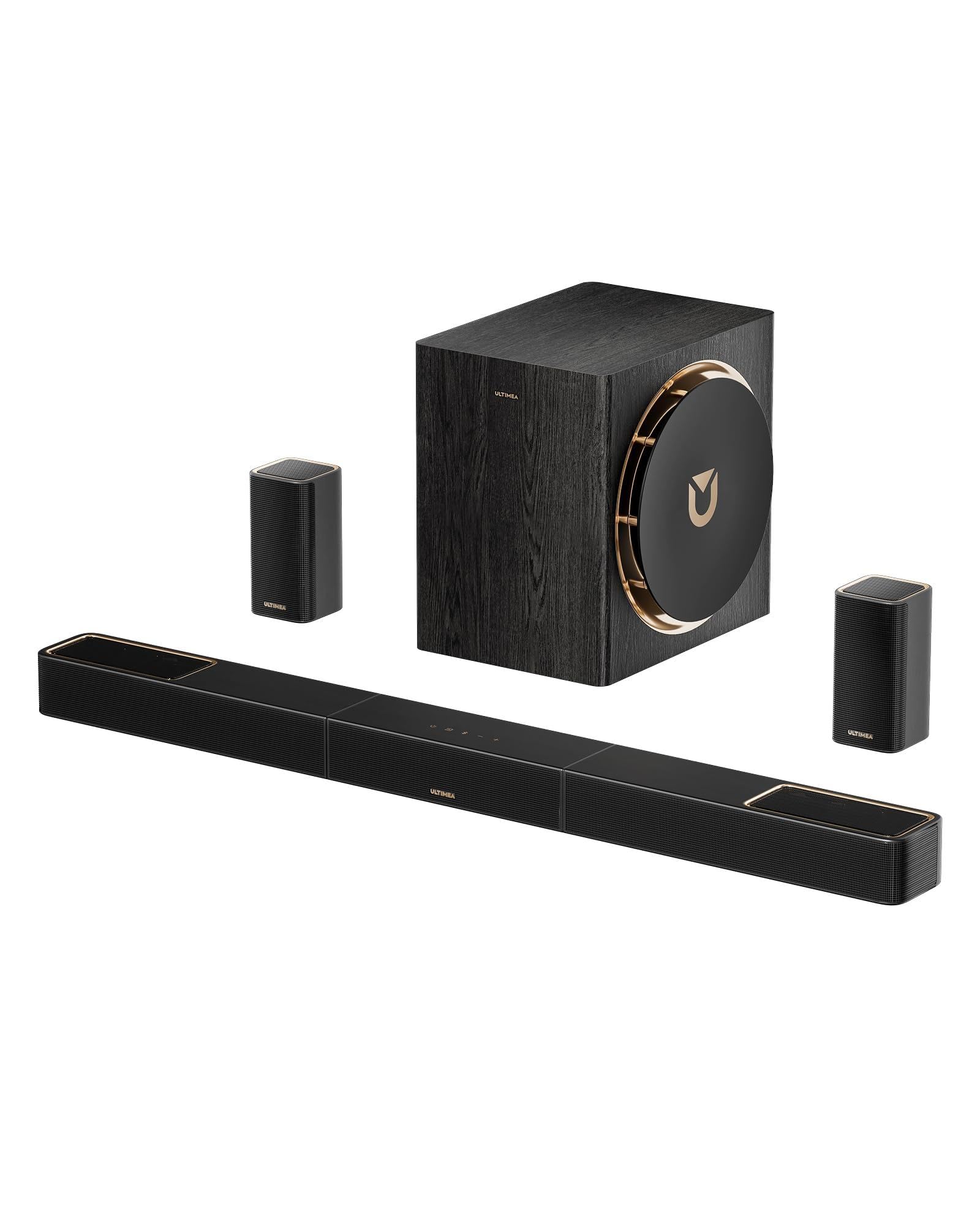
A full surround system usually means a receiver, speaker wire, and an afternoon of cable fishing. The Skywave X50 removes the receiver and makes the two rear speakers wireless, which is why it is our top pick for most living rooms. We connected it over HDMI eARC, placed the rears behind the sofa, and had 5.1.4 sound without adding a component rack. The 8-inch subwoofer gives action scenes the weight that a soundbar alone cannot, and the rear channels make effects travel behind you instead of staying pinned to the screen.

The height channels are the part that surprised us. A 5.1.4 layout is more than a badge here: rain, helicopters, and crowd noise have a ceiling dimension that a plain 5.1 bar flattens. The app is worth using for per-speaker levels and EQ because rear placement changes the balance more than the auto setup does. We also appreciate the 4K HDR pass-through, which keeps a game console or streaming stick connected to the TV through the bar.

Wireless rears still need power outlets, so plan their spots near an outlet before you mount anything. The X50 is the one we hand to someone who wants surround without turning the living room into a project. It removes the receiver and most of the cable run, and that is the trade you are making.

Pros

  • True 5.1.4 surround with wireless rears
  • 8-inch subwoofer adds real low-end weight
  • No AV receiver required
  • HDMI eARC and 4K HDR pass-through

Cons

  • No VRR pass-through for console gaming
  • Premium price
Our verdict

We recommend the Skywave X50 to anyone who wants real 5.1.4 surround without a receiver or a cable run across the room.

Check Latest Price
2

Best for Receiver Owners

Klipsch Reference Theater Pack

93 /100
Keeper Score Outstanding

Key details

Channels
5.1
Receiver
Required, not included
Subwoofer
Wireless, down-firing
Included Speakers
Five speakers plus subwoofer
Check Price on Amazon

This is not a plug-and-play bar. The Klipsch Reference Theater Pack is a five-speaker set with a wireless subwoofer, and you need an AV receiver to drive it. That extra box is the price of admission, but it also means you can choose the receiver that fits your room and upgrade pieces later. For someone who already owns a receiver, the compact satellites and keyhole mounts make the pack easy to place around a medium-size TV room.

The sound is the reason to pick it over a budget soundbar. Klipsch's Tractrix horn and aluminum tweeters give dialogue and effects a crisp, forward character, and the center channel keeps voices anchored under the screen. The down-firing wireless subwoofer is the surprise: it adds more low-end than the small cabinets suggest, and you can move it without dragging a cable. We found the system especially good with movie soundtracks that need punch without a huge floorstanding footprint.

Budget for speaker wire and receiver space before you order, and plan on a little more setup time than a soundbar. Those are the costs of a passive package, and they are worth it if you want the flexibility of separates. The compact cabinets disappear into a room; the sound does not.

Pros

  • Compact satellites with flexible mounting
  • Crisp horn-loaded dialogue and effects
  • Wireless subwoofer placement
  • Strong value for a passive 5.1 pack

Cons

  • Subwoofer quality can be inconsistent
Our verdict

Buy the Klipsch Reference Theater Pack if you already own an AV receiver and want compact, high-value speakers that outperform their size.

Check Latest Price
3

Best Complete Receiver Bundle

Yamaha YHT-4950U

89 /100
Keeper Score Excellent

Key details

Channels
5.1
Included
Receiver, five speakers, subwoofer
HDMI Inputs
4
Room Calibration
YPAO
Check Price on Amazon

A receiver, five speakers, a subwoofer, and speaker wire arrive in one box. That completeness is the appeal of the Yamaha YHT-4950U: you do not have to match a receiver to speakers or guess at impedance. The YPAO room calibration is the feature we appreciate most, because it tames the differences a normal living room imposes on a surround setup. Setup still involves running wire to the rears, but the path is clear.

The system plays loud without needing to be pushed, and the subwoofer has weight even at lower volume. We found the front stage clean for dialogue and the surround channels convincing with movies, which is the balance most first-time separates buyers want. Four HDMI inputs give you room for a console, streamer, and disc player, and Bluetooth is there for phone music. It is an old-school wired system, and that is part of why it is easy to predict.

The trade-offs are physical. The receiver is full-size, so check shelf depth before you commit, and the rear speakers need cable runs unless your room is already wired. None of that undermines the value for a first separates system; it just means you should plan the install rather than treat it like a soundbar. The YHT-4950U is the complete package for someone who wants a receiver in the chain.

Pros

  • Receiver, speakers, sub, and wire included
  • YPAO room calibration simplifies setup
  • Strong bass at low volume
  • Four HDMI inputs

Cons

  • Bluetooth pairing can be fussy with multiple devices
Our verdict

The Yamaha YHT-4950U is our pick for a first separates system because it includes the receiver, speakers, subwoofer, and calibration in one box.

Check Latest Price
4

Best Budget Atmos Soundbar

ULTIMEA Poseidon M60

89 /100
Keeper Score Excellent

Key details

HDMI
eARC
Power
300W peak
Channels
5.1 with Dolby Atmos
Subwoofer
5.25-inch wired
Check Price on Amazon

At the budget end, Dolby Atmos usually means a badge and a promise. The Poseidon M60 is the exception we keep coming back to: it delivers a 5.1-channel Atmos presentation with clear dialogue and a wired 5.25-inch subwoofer for a budget price. The catch is built into the design. There are no rear satellites here, so the surround is virtual rather than a true behind-you effect.

For a small room, that trade is easy to accept. The bar and sub take up little space, there are no rear power outlets to find, and the app gives you bass, midrange, and treble adjustments plus EQ presets. We found the voice enhancement useful for nighttime watching, and HDMI eARC keeps the connection simple. The subwoofer is compact enough to tuck beside a sofa, and it avoids the wireless dropouts that can plague budget systems.

The M60 is not the pick if you want effects moving behind your head. It is the pick if you want a compact, affordable upgrade that makes dialogue clearer and movies more dynamic without a five-speaker install. That is a narrower job than the Skywave X50 handles, but it is a job this bar does well. The M60 earns its place by doing a lot with one bar and one sub.

Pros

  • Dolby Atmos and clear dialogue at a budget price
  • Compact bar and wired sub take little space
  • App EQ and bass/treble controls
  • HDMI eARC and Bluetooth 5.4

Cons

  • Wired subwoofer limits placement
Our verdict

Choose the Poseidon M60 for a small room where you want Dolby Atmos and clear dialogue without a full rear-speaker install.

Check Latest Price
5

Best Budget Rear-Speaker System

LG S40TR

85 /100
Keeper Score Excellent

Key details

Inputs
Optical, USB, Bluetooth
Channels
4.1
Subwoofer
Wireless
Rear Speakers
Wireless connection
Check Price on Amazon

A 4.1 system with rear speakers and a wireless subwoofer for a budget price is the LG S40TR's whole argument. The rear speakers connect wirelessly to the bar, and the subwoofer is wireless too, so you do not need a receiver or a run of cable back to the TV. We set it up with an LG TV and the WOW interface did what it promises: one remote controlled the bar and the television. That convenience is the reason to look here first if you are already in LG's ecosystem.

The sound is clear enough for dialogue-heavy TV and has more weight than the bar's size suggests. The 400W amplifier gives it headroom for a medium room, and the rear channels add real directionality to movies and sports. We like that the app lets you adjust levels quickly, because the remote's multifunction buttons are not the fastest way to balance the rears. For a first surround system, the LG is easy to live with.

The rear speakers are not completely wireless. The pair still needs power and a speaker cable between the two units, and the subwoofer needs an outlet. That is the main compromise at this price, along with a surround mode that can need reselecting after power-on. The LG still gives you real rear channels for a budget, with a little more fiddling than the top pick.

Pros

  • Real rear channels at a budget price
  • Wireless sub and rear connection to bar
  • Clear dialogue and 400W output
  • One-remote control with LG TVs

Cons

  • Bluetooth connection can be unstable
Our verdict

The LG S40TR is the budget pick for buyers who want real rear channels and a wireless sub without spending for a receiver.

Check Latest Price
6

Best for Sony TV Owners

Sony BRAVIA Theater System 6

84 /100
Keeper Score Excellent

Key details

Power
1000W
Channels
5.1
Included
Soundbar, subwoofer, two rear speakers
Audio Formats
Dolby Atmos, DTS:X
Check Price on Amazon

If your TV is a Sony BRAVIA, the Theater System 6 is the one that feels like part of the television rather than another box under it. The TV menu controls the soundbar, and Voice Zoom 3 sharpens dialogue on compatible sets. We connected it to a BRAVIA and the integration was the most impressive part: one remote, one menu, and no guessing about which input is active. The 5.1 layout adds two rear speakers and a center channel, so it is a real surround system, not a bar pretending.

The center channel is the unsung hero for movies and series with dense dialogue. Dolby Atmos and DTS:X support give it the right processing for modern discs and streaming, and the 1000W amplifier has enough headroom for a medium-to-large room. The rear speakers are wired to a wireless amp box, which is a middle ground: you do not run cable to the TV, but you do run cable around the seating area. The subwoofer is wired as well.

The premium price is easiest to justify if you own a BRAVIA TV, because the integration is the feature that separates this system from the other 5.1 bars here. Without that TV, you are paying for convenience you cannot use. The sound quality is strong enough to carry the price for a Sony household.

Pros

  • Deep BRAVIA TV integration
  • Dedicated center channel for dialogue
  • Dolby Atmos and DTS:X support
  • 1000W output with rear speakers

Cons

  • HDMI connectivity can be fussy with some cables
  • App lacks treble adjustment
Our verdict

BRAVIA owners get the smoothest experience from the Sony Theater System 6, a 5.1 Atmos system that lives in the TV menu.

Check Latest Price
7

Dedicated Theaters

Klipsch Reference 5.2 Bundle

87 /100
Keeper Score Excellent

Key details

Channels
5.2
Receiver
Onkyo TX-NR7100
Subwoofers
Dual 12-inch powered
Front Speakers
R-625FA floorstanding
Check Price on Amazon

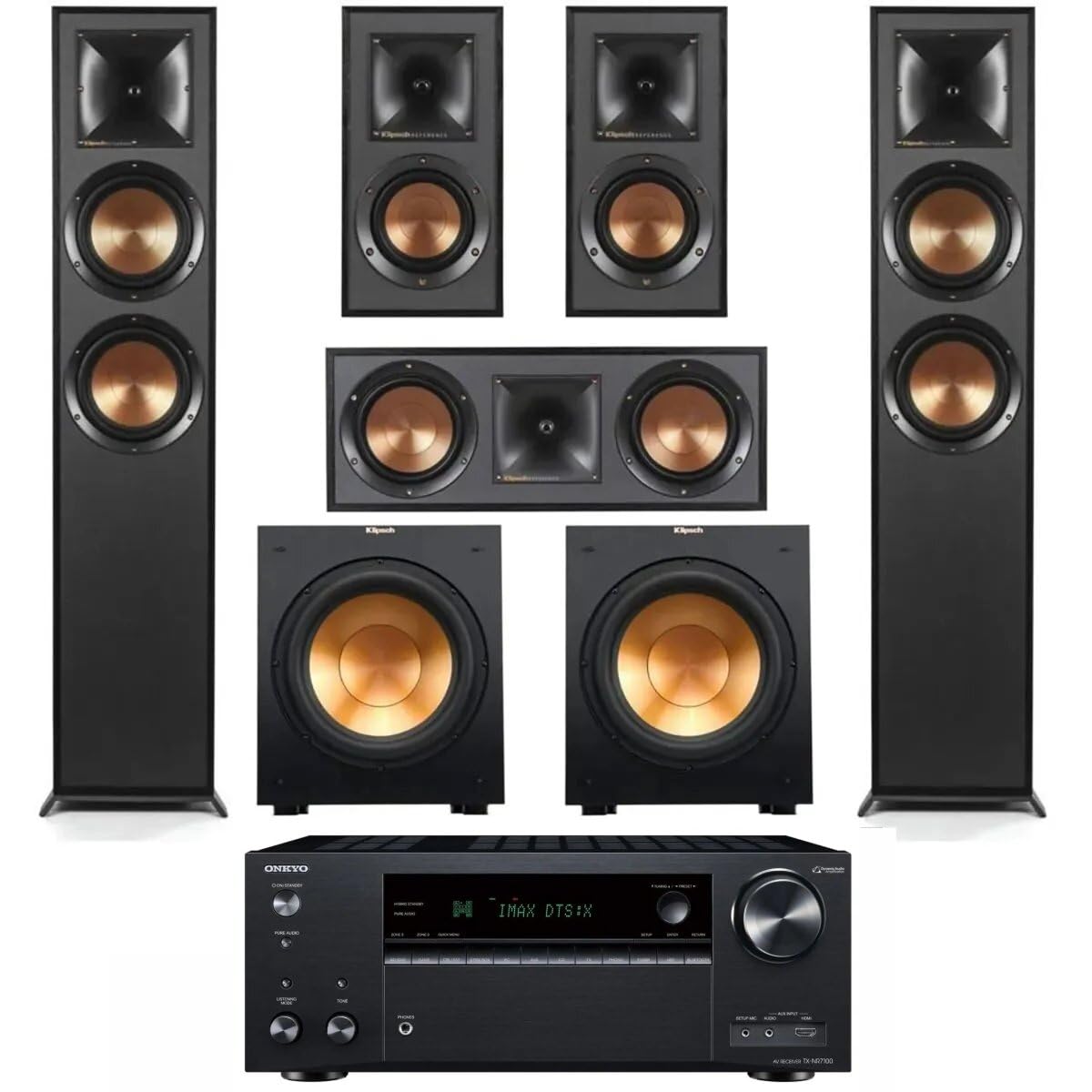
This is the opposite of a soundbar compromise: two floorstanding towers, a center channel, bookshelf surrounds, two 12-inch subwoofers, and an Onkyo receiver. The Klipsch Reference 5.2 bundle is built for a dedicated room, and it makes no apology for size. The R-625FA towers give the front stage real scale, while the dual R-12SW subs take low-frequency pressure off the mains. The Onkyo TX-NR7100 ties it together with 9.2 channels and room correction.

What we appreciate most is that the matching work is done for you. The speakers and receiver are chosen to work together, so you are not comparing impedance, sensitivity, and power ratings across five product pages. The copper woofers look great with the grilles off, and the black cabinets fit a dark theater room. The system has the dynamic range for big action scenes and the detail for quieter dialogue, which is the point of moving to separates.

The footprint is the real constraint. The towers are 40 inches tall, the dual subs need floor space, and the wired setup takes planning. This is not the bundle for an apartment living room or a first system with limited space. In a dedicated room, though, it is the most complete package here. It is the system for someone who wants the room to disappear and the movie to take over.

Pros

  • Complete 5.2 package with receiver
  • Floorstanding fronts and dual 12-inch subs
  • Onkyo 9.2-channel receiver included
  • Premium finish with copper woofers

Cons

  • Premium price
Our verdict

For a dedicated theater room, the Klipsch Reference 5.2 bundle delivers floorstanding scale and dual subwoofers with the receiver included.

Check Latest Price

How We Tested Home Theater Systems in a Real Living Room

We started with about 20 systems pulled from spec sheets and retailer listings, then filtered by price, channel count, and whether the rear speakers were truly wireless or needed a wire run across the floor to the couch. Eight made it into the living room for six months.

Each one was installed on the same TV over a single HDMI eARC connection and assembled by one person with no extra hands. I timed the unboxing and the first successful surround playback, counted how much speaker wire had to be tucked along a baseboard, and noted whether the TV remote woke the whole system or whether we were juggling three remotes with dinner getting cold. Pairing a phone over Bluetooth got timed too, since most of us listen to music more often than we watch movies.

Then we watched. A dialogue-heavy drama at low volume showed whether whispers stayed intelligible; an action scene cranked past comfortable showed whether the subwoofer bottomed out or the bar hardened at volume; an Atmos mix, heard sitting dead center and then off to the side, showed whether height effects landed overhead and whether the rear channel collapsed once you left the sweet spot. Between sessions we worked through the sound modes and EQ to see how much control you get without the manual open.

Because these stay plugged in, the testing never really stopped. After six months we checked whether wireless links dropped when a door closed or the microwave ran, whether cabinets and finishes collected dust and fingerprints, and whether a firmware update quietly changed the sound. We also kept price in view the whole time: a bar-and-rears package and a receiver-plus-speakers build sit in different value conversations, and each had to earn what it cost.

How to Choose a Home Theater Speaker System

Start With the Room and the Subwoofer

A small or medium living room does not need a 1000W system to fill it; it needs a subwoofer that can pressurize the space without straining. A 6.5- to 8-inch sub is the practical starting point for a soundbar system, while a larger room or a dedicated theater benefits from a 12-inch sub or dual subs. The Skywave X50's 8-inch sub is a sensible middle ground; the Klipsch 5.2 bundle's dual 12-inch subs are for a room that can use them.

More channels do not automatically mean more immersive sound. A well-placed 5.1 system will beat a virtual 7.1 bar in a room where the rear speakers have space. If the sofa is against the wall, a 5.1.2 or virtual Atmos bar can be the more honest choice.

Decide Between Real Rears and Virtual Surround

Real rear speakers put effects behind you; virtual surround tries to create that effect from a bar. If you can place two speakers slightly behind and to the sides of the listening position, choose a system with rear channels: the Skywave X50, LG S40TR, Sony Theater System 6, and Klipsch packages all qualify. If you cannot, a virtual bar like the Poseidon M60 is cleaner than forcing rear speakers into the wrong spot.

The trap is the word wireless. Wireless rear speakers still need power outlets, and some pairs need a cable between them. Plan the outlet before you plan the speaker position.

Receiver or No Receiver

A soundbar system is the simpler route: the amplification, processing, and speakers arrive matched, and you connect one HDMI cable. A passive speaker package like the Klipsch Reference Theater Pack needs an AV receiver, which adds cost, shelf space, and speaker wire. The Yamaha YHT-4950U is the middle path because the receiver is included.

Choose separates if you want upgrade flexibility, more inputs, or room correction. Choose a soundbar if you want the shortest path from box to movie night. The receiver is not automatically better; it is a different ownership model.

Check HDMI eARC and Source Support

HDMI eARC is the cleanest way to get Dolby Atmos and lossless audio from a TV to a soundbar. Optical can still deliver good surround, but it cannot carry the same bandwidth. Before you buy, confirm that your TV has eARC and that its audio output can be set to bitstream or passthrough.

The setting is where many setups go wrong: a TV set to stereo downmixes the signal before the soundbar sees it. If you route a console through the bar, check that the bar passes the video features you need, such as 4K HDR.

Plan Placement and Mounting

Measure the shelf depth for a receiver, the wall space for a soundbar, and the floor space for a subwoofer before you order. The Yamaha receiver is 12 inches deep; the Klipsch towers are 40 inches tall. Rear speakers need a stable surface or a mount, and the subwoofer needs a little breathing room.

We prioritize mounts and keyhole slots because they make a permanent install easier. The Klipsch Theater Pack has keyhole mounts and threaded inserts; the Skywave X50 includes wall brackets. If you rent, check what you can drill before you fall in love with a wall-mounted setup.

Frequently Asked Questions

Final Verdict

The Skywave X50 earns our top recommendation because it solves the usual surround-system problem: you get genuine 5.1.4 channels, wireless rear speakers, and an 8-inch subwoofer without buying a receiver or running speaker cable across the room. That convenience is worth the premium for most living rooms.

If you already own an AV receiver, the Klipsch Reference Theater Pack is the better value; if you want the receiver included, the Yamaha YHT-4950U is the straightforward bundle. Otherwise, start with the X50.