Best Fluid Tripod Heads of 2026

A fluid head is the difference between a pan that glides and one that lurches. It keeps a camera balanced as you follow the action, lets you start and stop a move without a jolt, and locks down so the shot stays put. I've shot enough wobbly birthday videos to know that a sticky pan or a creeping lock makes decent footage look amateur. A good head solves all three: smooth movement, secure locking, and a mounting system you can trust when you swap cameras.

Over the past six months, my team and I tested 12 fluid heads with compact mirrorless cameras, a DSLR and zoom lens, and a phone rig. We panned across a bird feeder, tilted from ground level to the treeline, locked shots at awkward angles, and carried each setup from the living room to the backyard. The differences that mattered were tactile: pan smoothness at slow speed, lock creep, plate engagement, metal parts and knob feel, packed weight, and whether the included extras earned their place.

Keeper Score summarizes customer ratings and review volume. Read it alongside the product details and trade-offs. How the score works.

1

Best Overall

SmallRig CH10 Fluid Head

88 /100
Keeper Score Excellent

Key details

Height
70 mm
Head Weight
9.84 oz
Load Capacity
6.6 lb / 3 kg
Quick Release
Arca Swiss
Check Price on Amazon

At 279 g and 70 mm tall, the CH10 barely changes how a travel tripod carries. That is the point of it: the compact legs you already own for stills become a video platform, and the 36 mm base sits on a small platform without overhanging. The Arca Swiss clamp takes the plate your camera already wears, and a 1/4-inch screw on top accepts a camera or a scope foot.

Steadiness is what earned it the top spot. Damping is fixed, set at a weight that suits a mirrorless body with a standard zoom, and the pan starts and stops without a lurch rather than snapping free. The 3 kg rating covers a DSLR with a kit lens, and the body feels like machined aluminum rather than painted plastic. We also appreciate a small thing: the Allen key that removes the handle is held by a magnet underneath the head, where it stays findable.

The one thing to plan around is leveling. There is no bowl here, so a flat horizon comes from your tripod's own leveling base or from careful leg work, a step the Neewer GM27 removes entirely. On legs that are already level, it is the only thing about this head you will ever think about.

Pros

  • 279 g adds almost nothing to a travel tripod
  • Pan is smooth and predictable at mirrorless weights
  • Arca Swiss clamp takes a plate you already own
  • Allen key stores magnetically under the head

Cons

  • Small clamp is marginal under a long lens
  • Fixed damping offers no drag adjustment
Our verdict

Our default recommendation: light enough to live on a travel tripod, steady enough for a mirrorless rig, and simple enough that you stop thinking about the head.

Check Latest Price
2

Best for Smooth Video

Sirui VA-5 Fluid Head

90 /100
Keeper Score Outstanding

Key details

Head Weight
1.17 lb
Drag Control
Continuously adjustable tilt
Plate System
Quick-release plate with safety lock
Load Capacity
6.6 lb / 3 kg
Check Price on Amazon

Where the CH10 gives you one damping setting and expects you to work with it, the Sirui VA-5 gives you a dial. Tilt friction adjusts continuously, which is the difference between a head that suits a bare mirrorless body and one that suits the same camera in a cage with a monitor and a microphone on top. Turn it up for a slow pan across a stage; back it off and the camera moves with a fingertip. That control is why we reach for this one when a shot needs a matched, repeatable move.

The rest of the design backs up the intent. A safety lock keeps the plate from sliding out when you loosen the clamp, the pan runs a full 360 degrees on a marked base, and two spirit levels let you check the horizon without crouching. At 0.53 kg with a 3 kg rating, it is the same working class as the CH10: a mirrorless or DSLR body with a sensibly sized lens, not a cinema build.

Two things to weigh. The clamp and the control levers sit close together, so finding the plate release by feel takes a moment with a camera mounted. And the base looks small on a full-size tripod platform, secure but worth checking against your tripod before you commit.

Pros

  • Tilt friction adjusts continuously, not in steps
  • Safety lock keeps the plate from slipping out
  • Two spirit levels for a quick horizon check
  • Full 360-degree pan on a marked base

Cons

  • Levers crowd the plate clamp
  • Premium price buys drag control, not capacity
Our verdict

Spend more here if you want to tune drag to the rig; the VA-5 gives the most controlled pans in this group and a safety lock to match.

Check Latest Price
3

Best for Heavy Rigs

SmallRig DH10 Fluid Head

84 /100
Keeper Score Excellent

Key details

Head Weight
2.65 lb
Plate Mount
SmallRig snap-on plate
Drag Control
Stepless adjustable damping
Load Capacity
22 lb / 10 kg
Check Price on Amazon

Twenty-two pounds is more capacity than most tripods need and exactly what a long lens asks for. The DH10 is built for the rig that makes a compact head wilt: a 200-600, a cinema camera with a cage and follow focus, or a gimbal plate that has to come off in a hurry. Stepless damping lets you dial resistance to that weight instead of accepting a factory setting.

The plate mount is the interesting part. It is a snap-on design built around SmallRig and DJI RS plates, so a camera can move between a stabilizer and the head without a rebuild, and there is a 1/4-inch-20 hole for a magic arm plus a wrench built into the body. Nothing here feels like parts-bin assembly.

For a heavy rig, this is the head we trust. The trade is commitment: 1.2 kg of head before you mount anything, and a plate system that leaves a bag of Manfrotto 501 plates useless. If your kit already runs SmallRig or DJI, neither slows you down.

Pros

  • 10 kg rating for long lenses and cinema builds
  • Stepless damping matched to the rig's weight
  • Snap-on plate suits SmallRig and DJI workflows
  • 1/4-inch accessory hole and built-in wrench

Cons

  • Tilt lock and tension share one knob
  • 1.2 kg adds real weight to a travel kit
Our verdict

For a rig that big, this is the head we trust: 22 pounds of capacity, stepless damping and a plate system built for gimbal workflows.

Check Latest Price
4

Best for Standard Plates

Avella V501 Fluid Head

90 /100
Keeper Score Outstanding

Key details

Tilt Range
+90° / -50°
Head Weight
1.9 lb
Plate System
Manfrotto 501HDV compatible
Load Capacity
11 lb / 5 kg
Check Price on Amazon

The specification that matters most on the V501 is not the 11 lb load, it is the plate. This head takes Manfrotto 501HDV-style plates, so the same plate can move between your head, a slider and a shoulder rig without a swap. For anyone whose kit already runs on 501 plates, it is the obvious buy here, and it happens to be the sturdiest-feeling head in this group as well.

At 1.9 lb with a 60 mm ball base, it sits on a full-size tripod like it was made for it. The 5 kg rating covers a DSLR with a 70-200, the pan bar is two sections and moves to either side for left-handed work, and the pan runs a marked 360 degrees. Metal everywhere you touch, including the knobs.

The tilt control bites early. A front-heavy rig wants tension set before you let go of the handle, which becomes a habit rather than a fault after the second time. The plate clamp is the weaker end: a heavy camera can creep if it is not tightened down properly, so check the plate is seated before you walk away from the tripod.

Pros

  • Takes standard Manfrotto 501HDV plates
  • 5 kg capacity in an all-metal body
  • Two-section pan bar mounts on either side
  • Marked 360-degree pan with +90 / -50 tilt

Cons

  • Plate clamp can let a heavy camera creep
  • Bulkiest body of the mid-size heads here
Our verdict

The one to buy if your kit already runs on Manfrotto 501 plates: metal, stable, and rated for a DSLR with a long zoom.

Check Latest Price
5

Best with a Leveling Base

Neewer GM27 Fluid Head

86 /100
Keeper Score Excellent

Key details

Height
93 mm
Leveling
±10° built-in bowl
Head Weight
13.1 oz
Load Capacity
8.8 lb / 4 kg
Check Price on Amazon

A leveling bowl on a head this small is unusual, and it is the whole reason the GM27 exists. The plus-or-minus 10 degree ball base sits inside a 37 mm body, so you loosen one knob and tilt the head until the horizon is straight instead of adjusting three legs. On a pan across a roofline that saves a couple of seconds on every take, and on a tripod without its own leveling base it is the difference between a straight horizon and a crooked one.

We choose it when a shot has to be level in a hurry. The 4 kg rating holds a mirrorless body with a zoom, the pan base is scaled, tilt runs from -55 to +90 degrees, and the two-section handle extends from roughly 5.7 to 9.5 inches, so it packs short but still gives leverage on a slow pan. At 370 g it is barely heavier than heads that hold less.

What you accept is height and a fixed feel. At 93 mm it is the tallest compact head here, which shows in how a small tripod folds, and the friction damping is set rather than adjustable, so the drag you feel is the drag you get with every lens. Buy it for the bowl; if folded length matters more, the CH10 is the alternative.

Pros

  • Plus-or-minus 10 degree leveling bowl in a 370 g head
  • 4 kg rating is generous for its size
  • Telescopic handle packs to about 5.7 inches

Cons

  • Tallest compact head here at 93 mm
  • Fixed friction damping with no drag dial
Our verdict

We choose it when a shot has to be level in a hurry; the built-in bowl saves the leg work that compact tripods make tedious.

Check Latest Price
6

Best Budget

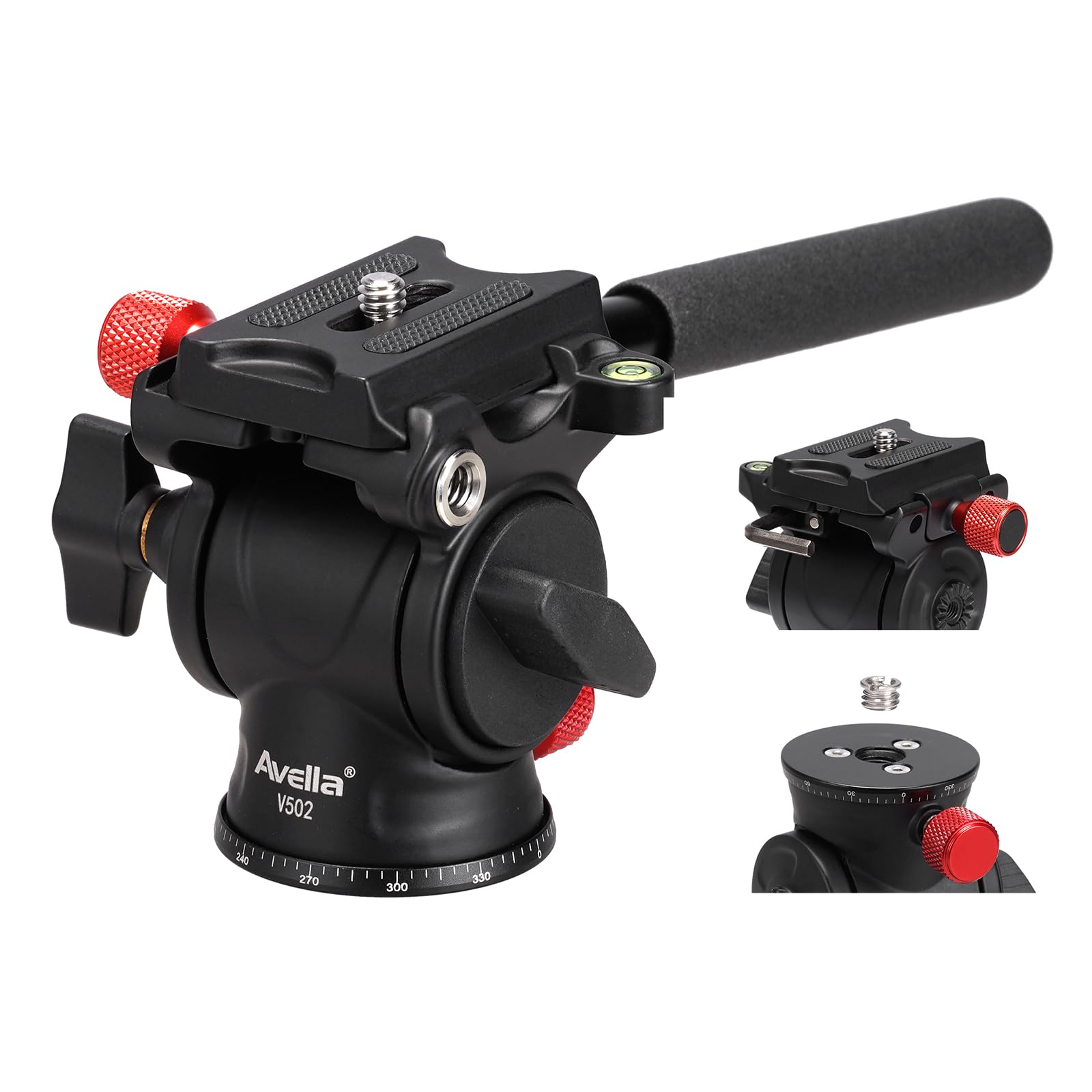
Avella V502 Fluid Head

84 /100
Keeper Score Excellent

Key details

Height
70 mm
Head Weight
8.82 oz
Base Diameter
45 mm
Load Capacity
6.6 lb / 3 kg
Check Price on Amazon

Every other head here asks you to give something up. The V502 asks for the least: it is the least expensive of the group and still arrives with a metal body, a 360-degree pan, an Arca Swiss plate and a handle that moves to either side.

It weighs 250 g and stands 70 mm tall, so it disappears onto a small tripod. The base is 45 mm, wider than the 36 mm and 37 mm bases on the SmallRig and Neewer heads here, which gives it more contact on a compact platform than its size suggests. Panning is steady rather than silky, and the fixed friction holds the camera where you leave it.

Two limits decide the buyer. The 3 kg rating covers a mirrorless body and a kit lens and runs out around a 70-200, and downward tilt stops at -45 degrees, short of the -55 and -90 degree heads here, so straight-down shots over an edge need something else. On a small tripod with a small camera neither comes up, which is why this is the one we suggest starting with.

Pros

  • Lowest-priced head in this group
  • 250 g with a wide 45 mm base
  • Arca Swiss plate and a handle that swaps sides

Cons

  • Downward tilt stops at -45 degrees
Our verdict

The easiest first fluid head to recommend: it does the basic job well, in aluminum, for less than anything else here.

Check Latest Price
7

Scopes and Phone Rigs

Innorel F10 Fluid Head

87 /100
Keeper Score Excellent

Key details

Height
77 mm
Head Weight
12 oz
Base Diameter
44 mm
Load Capacity
8.8 lb / 4 kg
Check Price on Amazon

Two Arca Swiss plates, a magic arm and a phone clip come in the box with the Innorel F10. That sounds like padding until you are moving one camera between a tripod and a handheld rig, or mounting a phone beside the camera for a second angle. A spare plate is the accessory most heads here make you buy separately.

The head itself weighs 341 g, stands 77 mm tall, has a 44 mm base and carries a 4 kg rating. Both the pan base and the tilt body are scaled, so a repeatable move, a 90 degree pan or a fixed tilt for a product shot, can be returned to the same mark next time. Pan and tilt are damped for control rather than speed.

Where it has proved most useful is on a scope. The 4 kg rating and the flat plate hold a 65 mm spotting scope or a smart telescope without the sag a ball head develops, and the phone clip means you can shoot through an eyepiece without building a mount. Check the thread on your scope's foot first, because not every foot arrives with the adapter you need.

As a plain video head it is good rather than exceptional; the cheaper SmallRig and Avella heads pan just as smoothly for a camera on its own. The F10 earns its place on the extras and the extra capacity, so buy it if those extras are things you will actually use.

Pros

  • Two Arca Swiss plates in the box
  • Scales on pan and tilt mark repeatable positions
  • 4 kg rating suits scopes and small telescopes
  • Magic arm and phone clip included

Cons

  • 4 kg rating falls short of the 5 kg heads here
Our verdict

Buy it for the extras as much as the head: two plates and a phone clip that turn it into a scope and phone-shooting kit.

Check Latest Price
8

Long Lens, Light Legs

K&F Concept FH-03 Fluid Head

84 /100
Keeper Score Excellent

Key details

Tilt Range
+90° / -90°
Head Weight
1.07 lb
Base Threads
3/8" and 1/4"
Load Capacity
11 lb / 5 kg
Check Price on Amazon

Five kilograms of rated load in a 484 g head is the best load-to-weight ratio in this group, and it is not close. The FH-03 folds to roughly 18 cm, takes Arca Swiss plates, tilts a full plus-or-minus 90 degrees and carries both 3/8-inch and 1/4-inch threads in its base, so it can move between a tripod, a monopod and a slider without an adapter.

The tilt is the strong half. Plus or minus 90 degrees gets you straight down onto a copy stand or straight up at a roofline, and the handle extends for reach and comes off for packing. Build quality does not read as budget: metal body, damped tilt, knobs that feel positive rather than mushy.

The pan is where it gets fussy. A full 360 degree turn is not a given, because the plate clamp can foul the rotation before you complete the circle, and the clamp itself rewards a firm hand, since a heavy camera can shift if you leave it loose. For a locked-off shot or a 90 degree follow, neither shows up.

Where this head makes sense is a long lens on light legs, when the tripod can take the weight but the head usually cannot. Nothing else here carries as much for as little mass. Go in knowing the pan arc you need and it is the most capable head of its weight in this group.

Pros

  • 5 kg capacity in a 484 g head
  • Plus-or-minus 90 degree tilt for straight-down and straight-up shots
  • 3/8-inch and 1/4-inch threads in the base
  • Folds to about 18 cm for packing

Cons

  • Clamp can cut a full 360-degree pan short
Our verdict

Choose it for load per gram, since nothing here carries more on lighter legs, as long as your shots do not need a full turn.

Check Latest Price

How We Chose and Tested Fluid Tripod Heads

We built the shortlist by reading specs and owner feedback, then filtering for clear load ratings, standard quick-release plates, metal locking parts, packed size, and a sensible price for the kit. We ordered 12 fluid heads and spent six months using them the way a small video kit actually gets used: on a tripod in the backyard, in the living room for tabletop shots, and packed into a shoulder bag for weekend outings. Each head got the same cameras—a compact mirrorless body, a DSLR with a zoom lens, and a phone rig—so we could compare balance and stability directly.

Smoothness was judged at slow speeds. We made repeated slow pans across a bird feeder and tilts from ground level to the treeline, noting whether motion started cleanly, whether it stuttered mid-move, and whether the camera drifted after we locked the tilt. We also tested the locking mechanism under load: set a camera off-center, lock the head, and watch for creep over a few minutes. Ease of use showed up in small things—whether the handle adjusted without tools, whether the plate engaged with a positive click, and whether we could level the head quickly.

Build quality and weight came down to handling. We checked for play in the pan and tilt axes, felt how the knobs and locks engaged, and weighed each head before packing it into the same bag. Mounting got its own check: we swapped plates between cameras, confirmed Arca-type compatibility where claimed, and noted whether the plate could be positioned to balance a front-heavy lens. For value, we looked at what came in the box—handles, plates, leveling bases—and whether those extras solved real problems or just added bulk.

How to Choose a Fluid Tripod Head

Read the load rating against your real rig

Add up the camera, lens, cage, microphone and plate before comparing ratings. A 6.6 lb head like the SmallRig CH10 is comfortable with a mirrorless body and a standard zoom; the jump to 11 lb and 22 lb is for long telephotos and cinema builds.

The trap is that a rating assumes a balanced load. A long lens hanging forward of the clamp eats usable capacity fast, and a head rated at 11 lb does not hold a 200-600 better just because the number is bigger. Weigh what you actually mount, not what the body alone weighs.

Fixed damping or adjustable drag

Most compact heads here use fixed friction: one resistance, set at the factory, that you learn to work with. That is fine for locked-off shots and the occasional pan. Adjustable drag, which the Sirui VA-5 offers on the tilt axis, lets you tune resistance to the weight on the plate and to the speed of the move you want.

The plate system decides how fast you work

Arca Swiss is the common standard, but clamp jaws vary between makers, so a plate from another brand can drop straight in, need a nudge, or refuse to slide at all. Check the plate you own against the head you are buying rather than assuming compatibility.

If your kit runs on Manfrotto 501 plates instead, the Avella V501 keeps you in that system. A clamp with a safety lock, like the Sirui's, costs a second to use and can save a camera.

Height, weight and base diameter

Compact heads are measured in millimeters for a reason. At 70 mm and 279 g the CH10 sits inside the folded length of a travel tripod; the Neewer GM27's 93 mm is still light but visibly taller in a pack. Base diameter matters more than it looks: a 36–37 mm base sits inside a small tripod's platform, while a 60 mm base like the V501's belongs on full-size legs.

Compact describes how a head packs, not what it can hold. Read the rating next to the dimensions.

Leveling and handles

Leveling is the feature people forget to check and then miss on every pan. A head with a built-in bowl, like the GM27's ±10°, levels without touching the legs; without one, leveling happens on the tripod or not at all.

Handles matter too. Two-section and removable bars pack shorter and let you switch sides for left-handed work, while a handle that needs a hex key to move is a job rather than an adjustment.

Frequently Asked Questions

Final Verdict

For most people, the SmallRig CH10 is the fluid head to buy. It adds almost no weight or length to a travel tripod, takes the Arca plate your camera already wears, and pans smoothly enough that the tripod stops being a stills-only tool.

Step up to the Sirui VA-5 if you want to dial drag to each lens rather than accept a single setting. Go to the SmallRig DH10 only when the rig genuinely needs 22 pounds of capacity. Everyone else can stop at the CH10 and put the difference toward a second plate.