Best Drone Backpacks of 2026

A drone backpack is really a case with shoulder straps, and most of what separates one from another comes down to a single question: hard shell or padded foam? A hardshell shrugs off a dropped tailgate; foam and dividers let you reshape the interior as your kit grows. The job either way is getting the drone, controller, batteries, and laptop to the trailhead in one trip, gimbal intact.

I've carried a folding drone in an ordinary camera bag for years, and once let the controller share a pocket with a water bottle. We've now spent six months with 12 drone backpacks, and the differences come down to small things: whether the drone stays put when you swing the bag over one shoulder, whether you can reach a fresh battery without unpacking everything, whether the rain cover is clipped inside or lost in a drawer. Liters get overrated; internal dimensions are what decide whether your kit actually fits.

The picks below cover all three approaches, from checkable hard shells to soft packs that pass as commuter bags.

Keeper Score summarizes customer ratings and review volume. Read it alongside the product details and trade-offs. How the score works.

1

Best Overall

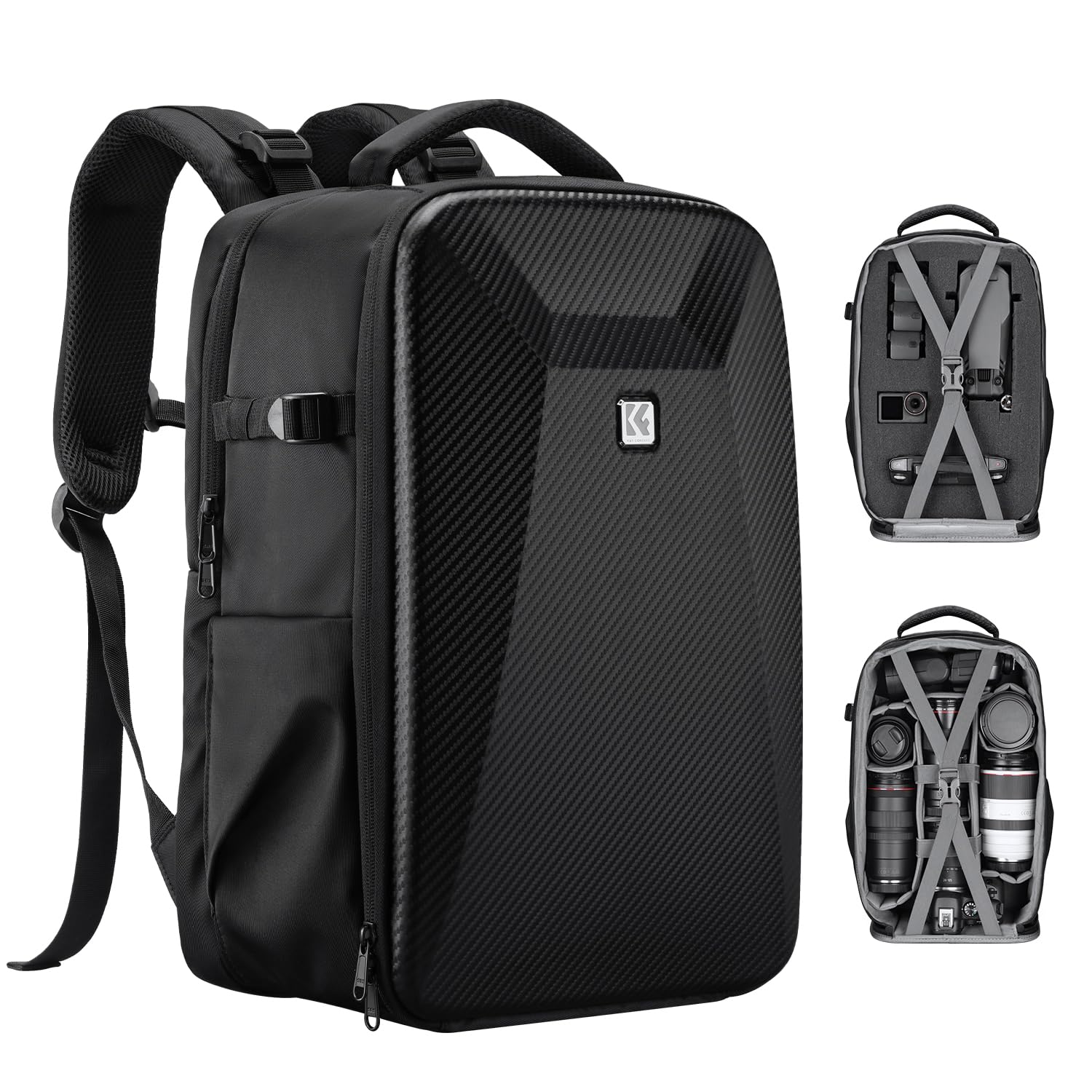
K&F Concept Drone Backpack

88 /100
Keeper Score Excellent

Key details

Capacity
22 liters
Interior
Pluck foam plus 8 dividers
Laptop Fit
15–15.6 inches
Protection
Hardshell front, rain cover
Check Price on Amazon

The K&F Concept's two interior systems—pre-scored pick-and-pluck foam and eight molded EVA dividers—solve the part of drone packing that usually goes wrong. You can carve a cavity around a folded drone and controller, then use dividers for batteries, props, and cables. We like that flexibility because a drone kit changes: one day it's a Mini and a couple of batteries, the next it's a larger airframe with goggles and a charger. The hardshell front panel gives the bag a protected side to set down, and the rain cover lives inside for weather that turns.

At 22 liters, it's a daypack, not an expedition pack. That's the right size for most drone flights: the drone, controller, batteries, a laptop, and a few tools fit without the bag becoming a suitcase. The laptop sleeve handles 15- to 15.6-inch machines, which covers most editing laptops, and the trolley belt lets you slide it onto rolling luggage. The external size is 17.3 by 11 by 7 inches, compact enough for a car trunk or an overhead bin, though you should check your airline's limit. The front hardshell is the main protection; the rest of the bag is padded fabric.

For a typical camera drone and a laptop, the 22L body is the right size—not so large that everything shifts around, not so small that you're strapping a charger to the outside. We recommend it as the default because it gives you both custom foam and movable dividers, a hardshell front, and a rain cover in a bag that still carries like a daypack. It's the one we point to first for a camera drone and a laptop.

Pros

  • Pluck foam shapes around a drone
  • Hardshell front and rain cover
  • Fits 15- to 15.6-inch laptops
  • Movable dividers adapt to different kits

Cons

  • 22L body is tight for full FPV kits
  • Hardshell protection is front-only
Our verdict

We recommend the K&F Concept as the default drone backpack: its pluck foam and eight dividers let you build a safe cavity around a drone and controller, with a hardshell front and laptop sleeve for travel.

Check Latest Price
2

Best Rugged Hard Shell

Hazard 4 Pillbox Backpack

90 /100
Keeper Score Outstanding

Key details

Shell
Rigid hardshell
Laptop Fit
Up to 16 inches
Empty Weight
5 lb
Storage Volume
29.5 liters
Check Price on Amazon

The Pillbox is built around a rigid shell and an external HardPoint mounting system, which is what makes it the pick for a drone pilot who treats a field kit like expedition luggage. The hardshell body and water-repellent PU-coated materials take knocks that would make a soft bag flinch. We like the idea of a bag that can ride in a truck bed and still keep a gimbal safe. The triple zippered compartments separate electronics from camera gear, and the padded laptop sleeve handles up to 16 inches. At 29.5 liters, it swallows a drone, controller, batteries, and a camera without feeling like a barrel.

The interior is where the Pillbox asks for patience. The divider set is sparse, so packing a drone, a camera, and several lenses takes extra dividers or a bit of improvising. That's a workable trade for a bag built around a hard shell, and the triple compartments give cables and tools a home. We also like the 16-inch laptop sleeve for editing on location. Just don't expect the interior to organize itself like a camera bag with a full divider kit.

Pros

  • Rigid shell resists impact
  • External HardPoint mounting
  • 29.5L with three main compartments
  • Fits up to 16-inch laptops

Cons

  • Five pounds empty
  • Front pockets are limited
Our verdict

We recommend the Hazard 4 Pillbox for rough travel and production days: its rigid shell and external mounting protect a drone kit, though you'll need to add dividers for a complex camera load.

Check Latest Price
3

Best for Fast Access

Lowepro ProTactic BP 450 AW III

83 /100
Keeper Score Excellent

Key details

Access
Four access points
Included
All-weather cover
Laptop Fit
Up to 16 inches
Storage Volume
28 liters
Check Price on Amazon

The ProTactic's four access points are the reason to consider it: dual side doors, a top opening for a long lens, and a full back panel that lays the bag open. You can reach a controller or a battery without unpacking the whole bag. The 28L body has room for a drone, a camera, a couple of lenses, and a 16-inch laptop. The ActivZone harness and hip belt help when the bag is loaded, and the included all-weather cover is a practical addition for field work.

The divider system is the fussy part. Lowepro's MaxFit dividers can be connected in multiple ways, which is flexible, but it takes trial and error to get a drone and camera to sit without wasted space. The side doors also have a learning curve: you need to pack around them, not just fill the bag from the back. We recommend it for a photographer who moves between a camera and a drone and wants quick side access, not for someone who wants a simple foam cavity. We like the access enough to keep it in the mix for hybrid kits, but the setup is not plug-and-play.

Pros

  • Four access points
  • 28L with 16-inch laptop sleeve
  • All-weather cover included
  • Modular belt and pouches

Cons

  • Soft shell lacks hardshell protection
  • Gets heavy when fully loaded
Our verdict

We recommend the Lowepro ProTactic for hybrid camera-and-drone work: four access points and a 28L body make it a mobile base, provided you'll take the time to dial in the dividers.

Check Latest Price
4

Best Budget FPV Pack

SoloGood FPV Drone Backpack

79 /100
Keeper Score Very Good

Key details

Size
45cm x 32cm x 20cm
Laptop
Dedicated laptop room
Rain Cover
Included
Compartments
4
Check Price on Amazon

The SoloGood is the budget FPV pack: a soft 45 by 32 by 20 centimeter backpack with four compartments, movable padded dividers, and a dedicated laptop room. We like it for the pilot who carries a quad, goggles, a radio, batteries, and a charger, because the dividers let you build a bay around the airframe instead of dumping everything into one sack. The rain cover and water-resistant shell are useful for damp fields, and the laptop sleeve means you can review footage without a second bag.

The trade-off is protection. This is a soft bag with isolated foam and padded dividers, not a hard shell, so it cushions knocks but won't match a rigid case if something heavy lands on it. That's the right compromise for a budget daypack, and the external dimensions keep it easy to sling into a car. We recommend it as a first FPV bag or a budget travel bag, not as a replacement for a hard case in a packed van.

Pros

  • Dedicated laptop room
  • Movable padded dividers
  • Rain cover included
  • Lowest-priced full-size pack here

Cons

  • Interior fills fast with goggles and radio
  • Retention strap won't suit every airframe
Our verdict

We recommend the SoloGood for FPV pilots on a budget: it gives goggles, radio, batteries, and a laptop a dedicated home, with dividers that adapt to the airframe.

Check Latest Price
5

Compact DJI Carry

JSVER DJI Drone Case

86 /100
Keeper Score Excellent

Key details

Shell
Hard EVA
Dimensions
9 x 4.7 x 12.6 inches
Carry Options
Back, shoulder, or front
Compatibility
DJI Mini, Air, Mavic 1, Avata
Check Price on Amazon

The JSVER's compatibility list is narrow on purpose: DJI Mini, Air, Mavic 1, and Avata series, in a hard EVA case that measures 9 by 4.7 by 12.6 inches and weighs 1.1 pounds. It's the smallest bag here, and that's the point. If you want a case that disappears into a larger travel bag, this is the one we recommend.

The hard shell protects against knocks and dust, and the bag opens 180 degrees so you can lay it flat and pack around two removable dividers. We like the carry options: over the shoulder, on the back, or in front of the body in a crowd. The three top pockets take props and cables, and the splash-proof zippers handle light rain. It is not a submersible case, so treat the waterproof claim as splash protection and add a dry bag for a wet boat trip.

The limits are real: there's no laptop sleeve, and the compact body won't hold a full FPV kit with goggles and a radio. Avata 2 pilots should check the interior depth before buying because the case is shallow for some kits. We recommend it as a second bag for a single drone and controller, not as your only travel pack.

Pros

  • Hard EVA shell protects against knocks
  • Wear on back, shoulder, or front
  • Opens flat for easy packing
  • Very light and compact

Cons

  • Not compatible with Mavic 2 or Mavic 3
  • Accessory pockets are narrow and deep
Our verdict

We recommend the JSVER for DJI Mini, Air, Mavic 1, or Avata pilots who want a tiny hard-shell carry case, not a full gear hauler.

Check Latest Price

How We Tested a Dozen Drone Backpacks

We built the shortlist from spec sheets first, filtering on interior dimensions rather than exterior liters: a bag that couldn't swallow a folding drone, a controller, and three charged batteries without pressing on the gimbal was out, however good it looked. From there we split the field by approach — hard shell, pick-and-pluck foam, padded dividers — because that choice drives weight, protection, and how much you can reconfigure later. Twelve bags made the cut, and we used them for six months.

Every bag carried the same load: a folding drone, controller, three batteries, spare props, a filter case, a 15-inch laptop, and a rain shell. We commuted with them, sent them through airport security and into overhead bins, hiked them to a few ridgelines, and let one ride loose in a truck bed. At the gate we timed a full repack with people waiting behind us, which is where organization — or the lack of it — gets exposed fast.

Because the drone is the expensive part, we tipped each loaded bag off a car seat and a hip-height wall, then checked the airframe for play. Foam and dividers were judged by whether the drone stayed put when the bag was carried sideways. Each rain cover went under a faucet for five minutes with paper towels packed inside, and zippers got worked with grit on them. At six months we looked at scuffs, stretched stitching, and whether the bag still read as a camera pack on a city street. We also noted what came in the box at each price tier — an included rain cover versus one sold separately is real money.

How to Choose a Drone Backpack

Fit the drone before you count liters

We start with the drone and controller, not the liter rating. A 22-liter bag and a 29-liter bag can hold the same drone because liters measure volume, not useful shape. The controller, goggles, and charger are the awkward pieces: they take up odd spaces that a rectangular cavity wastes. Measure your drone with props folded and your controller with sticks attached, then look for an interior that can be divided or shaped around those two items. The K&F Concept is the clearest example here: pre-scored foam lets you carve a cavity, and eight EVA dividers handle the rest. If you carry a full FPV kit, add goggles and a radio to that measurement before you choose a capacity.

Hardshell versus padded soft shell

A hard shell is the better choice if the bag will ride in a truck bed, on a motorcycle, or under a pile of luggage. It resists crushing and keeps its shape when empty, but it adds weight and usually costs more. A padded soft shell is easier to compress into a car trunk and often gives you more access points, but it relies on foam and dividers to protect the drone. The Hazard 4 Pillbox is the rigid option here; the Lowepro ProTactic is the soft-shell alternative with four access points. For airline travel, a hard front panel or a full hard shell is worth the bulk.

Access is part of protection

If you have to unzip the whole bag and unpack it to reach a battery, you'll leave gear loose on the ground. Side doors, a top opening, or a full back panel let you get to the drone or controller without emptying the bag. We pay close attention to the harness too: a hip belt and a padded back panel matter once the bag holds a drone, a laptop, and a few batteries. The Lowepro's four access points are the most flexible layout here, while the smaller JSVER opens flat for packing at a table. Choose the access pattern that matches how you work, not the one with the most pockets.

Leave room for batteries, laptop, and weather

Batteries and cables are the small items that turn a neat bag into a mess. Look for dedicated pockets or dividers that keep spare packs from sliding against the drone, and check the laptop sleeve size if you edit in the field. A rain cover is worth having even on a water-resistant bag, because zippers and seams are the first places water gets in. The K&F Concept includes a rain cover and a 15- to 15.6-inch laptop sleeve; the SoloGood has a dedicated laptop room and a cover at a budget level. If you carry a laptop and a full FPV kit, size up rather than cram.

Frequently Asked Questions

Final Verdict

We recommend the K&F Concept as the default drone backpack because it gives you the two things most kits need: a protected front panel and an interior you can shape around the drone, controller, and batteries. The 22L body also carries a laptop and a rain cover without turning into a suitcase. If your travel is rougher, the Hazard 4 Pillbox adds a full rigid shell and external mounting; if you need fast side access and more room for camera gear, the Lowepro ProTactic is the better fit.