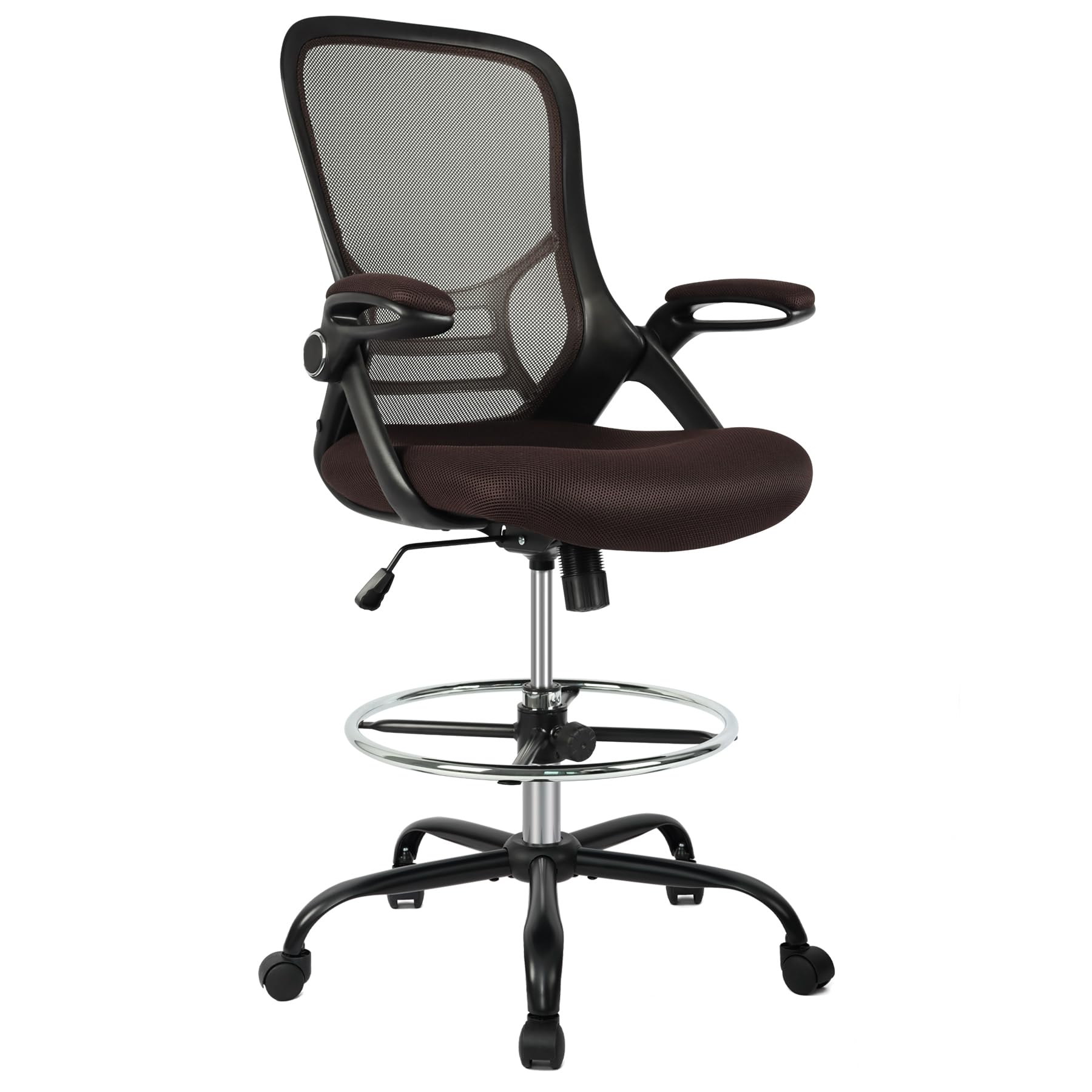
Best Drafting Chairs of 2026

A drafting chair is a bar stool that decided to get serious about posture. The extra height lifts you to a counter, a drafting table, or a standing desk; the foot ring keeps your legs from dangling; the backrest is there for hour four, when the novelty of standing has worn off. The catch is that height amplifies every flaw — the ring has to land where your feet actually want it, and the base has to stay planted when you lean back.

We've spent the past six months with 11 of these chairs, in a home office, at a kitchen counter doubling as a standing desk, and in a converted-garage studio, and the gaps between them showed up within a week of assembly. Mesh backs run cooler through a long afternoon, upholstered seats feel plusher but can get sticky, and flip-up arms sound gimmicky until you need to push the chair under a counter. Our picks earned their place on adjustability, sturdiness, and the kind of comfort you stop noticing.

Keeper Score summarizes customer ratings and review volume. Read it alongside the product details and trade-offs. How the score works.

1

Best Overall

Office Star DC Series Drafting Chair

90 /100
Keeper Score Outstanding

Key details

Foot Ring
Height adjustable
Back Height
11.75 inches
Weight Capacity
275 lb
Seat Height Range
24" - 34"
Check Price on Amazon

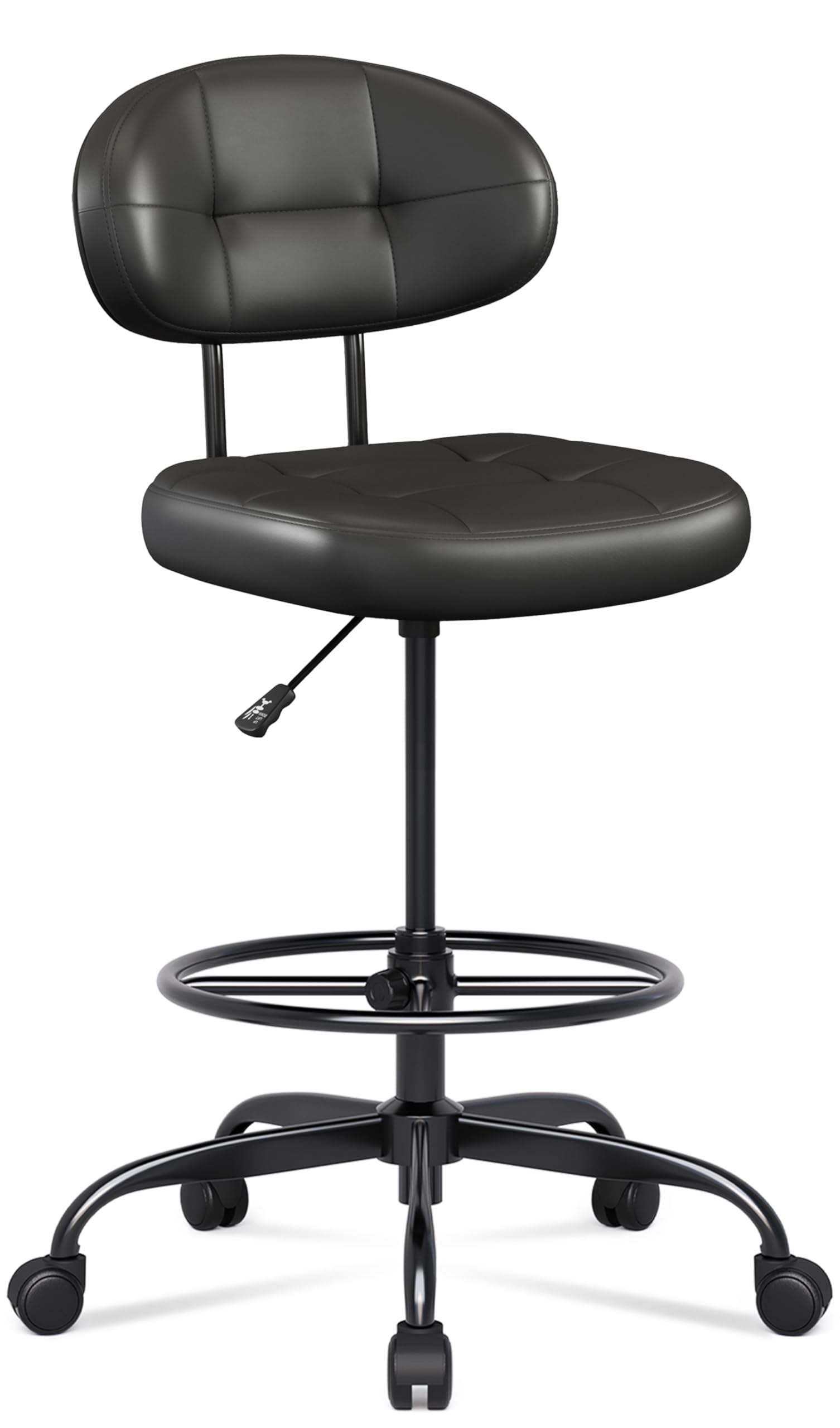
Ten inches of seat travel is what decides this one. The DC Series runs from 24 to 34 inches at the seat, which covers a 36-inch drafting table, a standing desk near the top of its rise, and the stool-height bench in between. That spread, more than any single feature, is why we send most people here first.

The cushion is sculptured foam, 2.5 inches thick, and the back is a low 11.75-inch panel that meets the base of your spine rather than wrapping your shoulders. We like that for drafting, where you lean over the board and want your shoulder blades free; if you plan to recline between tasks, it's the wrong shape. The vinyl wipes clean with a damp rag, which matters in a studio shared with ink, clay, and coffee.

The money goes into the frame. Office Star rates this chair for commercial use and warrants the non-moving metal parts for 15 years, the longest coverage in this group, and the chair carries GREENGUARD certification for low emissions — worth knowing if the studio is a small room you work in all day. The base is nylon with dual-wheel carpet casters; on bare concrete or tile, plan on soft-floor wheels or a mat so it doesn't skate when you sit.

At 28 pounds it's easy to drag out of the way at the end of a session, and the armless frame slides under the table. What you give up is upper-back support and any change in the backrest angle: this chair sets one posture and does it well.

Pros

  • Seat height spans 24 to 34 inches
  • Commercial-rated with 15-year metal warranty
  • Wipe-clean vinyl handles studio mess
  • Armless frame slides under a drafting table

Cons

  • Low backrest supports the lumbar region only
Our verdict

Our default recommendation: the widest seat-height range in this group, commercial-rated construction, and a wipe-clean vinyl seat that shrugs off studio mess.

Check Latest Price
2

Best Breathable Mesh

Primy PR777-Z Drafting Chair

90 /100
Keeper Score Outstanding

Key details

Back Style
C-shaped mesh
Seat Height
30 inches
Chair Weight
17.6 lb
Weight Capacity
250 lb
Check Price on Amazon

At 17.6 pounds, this is the lightest chair in the group and the one that moves between rooms without a second trip. The back is a C-shaped mesh panel rather than a padded slab, the seat is woven mesh as well, and there are no arms to catch on the edge of a table.

We reach for it in a warm room. Mesh lets air through where vinyl holds it, and after an hour leaning over a light table that difference is the whole story. The armless build also lets you pull the seat right up to the board instead of sitting a foot back from it. Two things to check before you order: the listing gives a single 30-inch seat height rather than a range, so measure your bench, and the 250-pound capacity is the lowest here.

Assembly is a 15-minute job by the listing's count, and the foot ring slides on the column so you can set it after you've found your height. The one-year warranty is the shortest coverage in this set — reasonable at the price, and a long way from the Office Star's 15-year metal coverage.

Pros

  • Mesh back and seat stay cool
  • Armless frame pulls right up to the board
  • 17.6 pounds, easy to move between rooms

Cons

  • 250-pound capacity is the lowest here
  • Backrest is a low C-shape, lumbar only
Our verdict

Buy this one for a warm studio or a standing desk: the mesh back keeps air moving, the armless frame pulls up to the board, and it weighs almost nothing.

Check Latest Price
3

Best for Small Studios

Misolant Armless Drafting Chair

89 /100
Keeper Score Excellent

Key details

Foot Ring
Height adjustable
Chair Weight
21.6 lb
Backrest Width
16.5 inches
Seat Height Range
23.5 to 31.9 inches
Check Price on Amazon

The seat drops to 23.5 inches, lower than anything else here, and that one figure changes what the chair can do. At the bottom of its range it works at an ordinary 30-inch desk; run it up to 31.9 and it meets a drafting table or a counter. If one chair has to cover a shared studio with two surface heights, this is the one that will.

Misolant pads it in faux leather over sponge, with a 16.5-inch-wide back that curves around the ribs and a seat 16.3 inches deep. The upholstery is soft and wipes clean with a damp cloth, and the back has enough curve to sit against your lumbar rather than float behind it. The gas lift is SGS-certified and the chair is BIFMA-tested, so the hardware under you is documented rather than assumed.

Assembly takes minutes and the parts arrive labeled, and at 21.6 pounds it's easy to shift out of the way. Misolant doesn't publish a weight rating, so if you're a heavier sitter, start with the BOLISS instead. For everyone else in a small room, this is the one we keep pointing to.

Pros

  • Seat range covers both desk and drafting height
  • Curved backrest supports the lower back
  • Assembles in minutes with labeled parts

Cons

  • Faux leather holds heat in a warm room
Our verdict

Our pick for a small studio: it drops to desk height, rises to a drafting table, and the padded back lands where a lumbar curve wants it.

Check Latest Price
4

Best Budget

Brick Attic T12 Drafting Chair

89 /100
Keeper Score Excellent

Key details

Backrest
Detachable
Seat Width
15.8 inches
Seat Height
29.15 inches
Weight Capacity
300 lb
Check Price on Amazon

The backrest unbolts. That's the trick here: pull the bolts and the chair becomes a rolling stool for a bench you stand over, then the back goes on when you want to lean. It's the least expensive chair in this group and still rated to 300 pounds, with an adjustable foot ring and a five-star base that doesn't flex. For a garage or a basement shop, that's the combination we take.

The seat is PU leather over high-density memory foam, and the foam is soft enough that it can hold a shallow impression from the packaging for a day or two before it settles. The foot ring moves on the column, and the height figure the listing quotes — 33.86 to 41.75 inches — is overall chair height, not seat height. The seat itself is listed at 29.15 inches, so measure your bench before you commit.

The foam is also where the price shows. On the Office Star and the BOLISS the padding is molded and holds its shape, where this one is softer and takes a set under a heavier sitter. At a hobby bench where you're up and down all evening, that's a fair trade for the money. It goes together in about 15 minutes and rolls over a short-pile rug without digging in.

Pros

  • Removable backrest converts it to a stool
  • 300-pound capacity at the lowest price here
  • Adjustable foot ring sets your feet at height

Cons

  • Backrest is short and fixed at one angle
  • Narrow 15.8-inch seat for larger sitters
Our verdict

The value pick: a 300-pound rating, an adjustable foot ring, and a backrest that comes off when you want a stool instead of a chair.

Check Latest Price
5

Best for Big and Tall

BOLISS 2818HD Drafting Chair

88 /100
Keeper Score Excellent

Key details

Seat Depth
20.1 inches
Chair Weight
46.2 lb
Weight Capacity
400 lb
Seat Height Range
24.8" - 32.1"
Check Price on Amazon

Four hundred pounds is the headline, and the chair is built for it: a 20.1-inch-deep molded foam seat, a high mesh back with a headrest, and a base wide enough that the whole thing weighs 46.2 pounds. Nothing else in this group is in that class.

The lift runs 7.3 inches, from 24.8 to 32.1 at the seat, and the flip-up arms fold out of the way so you can push in close to a table or drop the chair under it. The molded foam is firm, which is what we want at a bench where you shift your weight forward all day, and the mesh back lets air through on a long afternoon. The upright angle doesn't change, so if you want to lean back between tasks, the HYLONE is the one to look at. BOLISS backs it with a two-year warranty.

Size cuts both ways, and it's worth being honest about which way it cuts for you. The seat runs tall enough that shorter sitters can find their feet dangling even at the lowest setting, so this chair rewards height rather than accommodating it. For a tall or heavy sitter who wants a headrest at a raised bench, that's exactly the trade they want to make.

Pros

  • 400-pound rating is the highest here
  • High mesh back with headrest
  • Flip-up arms clear a drafting table

Cons

  • Seat can creep down under a heavy load
  • 46 pounds with a wide footprint
Our verdict

For heavy or tall sitters: a 400-pound rating, a wide molded-foam seat, and a headrest that makes long shifts at a raised bench easier.

Check Latest Price
6

Counter-Height Work

Amazon Basics Drafting Stool

88 /100
Keeper Score Excellent

Key details

Foot Ring
Fixed
Back Cushion
16.5 by 9.5 inches
Weight Capacity
275 lb
Seat Height Range
28.3 to 33.9 inches
Check Price on Amazon

It won't go low. The seat bottoms out at 28.3 inches and tops out at 33.9, which puts this chair squarely in counter and workbench territory — not a standard desk, and not a drafting table you sit low at. Buy it knowing which surface it's for.

What it does, it does simply. The chrome arched base is heavy and planted, the faux leather wipes clean, and a back cushion gives you something to lean against without arms in the way. It's a workbench stool with a back rather than a task chair, and at 23.2 pounds it's easy to shove aside when the bench needs clearing.

The seat is a smooth, slightly domed pad on free-rolling casters, so on a hard floor the chair can travel out from under you as you sit down; set it against a bench or a wall and that stops happening. The arched base and the vinyl are the parts we trust most here — this is a stool built to be knocked around, not a chair you adjust twice a day.

Pros

  • Chrome arched base feels solid
  • Back cushion without arms in the way
  • Assembly is quick and well organized

Cons

  • Foot ring is fixed at one height
  • Back cushion is only 9.5 inches tall
Our verdict

A sturdy, simple counter-height stool with back support; skip it if you need a foot ring that adjusts to your leg length.

Check Latest Price
7

Reclining at Height

HYLONE HL-0016 Drafting Chair

88 /100
Keeper Score Excellent

Key details

Arm Style
Flip-up
Foot Ring
Height adjustable
Chair Weight
32 lb
Weight Capacity
380 lb
Check Price on Amazon

Flip-up arms and a tilt mechanism are rare at drafting height, and they're why this chair made the guide. Fold the arms up and you pull right in to a standing desk; drop them and you have a high-back chair to lean back in between tasks.

The back is mesh over a built-in lumbar curve, the seat has a waterfall front edge to take pressure off the backs of your thighs, and the seat board is FSC-certified wood. It's rated to 380 pounds — second only to the BOLISS here — and we like that HYLONE covers it with a two-year warranty. At 32 pounds it's steady enough to push in and out all day without feeling nailed down.

The catch is the seat angle. The pan slopes forward, and in a long session you can find yourself sliding toward the front edge; with the back reclined and your weight against it, that mostly disappears. If you want a flat, locked seat for detailed work, the Office Star is the better chair.

Where it earns its place is the combination: a reclining high back, arms that disappear, and enough capacity for a big sitter, all at standing-desk height. If your day alternates between leaning over the desk and leaning back from it, that's worth more than a marginally better cushion.

Pros

  • Flip-up arms clear the desk in seconds
  • Reclines with adjustable tilt tension
  • 380-pound rating on a high-back mesh chair

Cons

  • Foot ring can slip down the column
  • Lowest seat setting is still high for a desk
Our verdict

For sit-to-stand days when you want to lean back: flip-up arms, a reclining high back, and a 380-pound rating.

Check Latest Price

How We Tested the Drafting Chairs

We started with the non-negotiables: a seat that reaches at least 30 inches so it can meet a standard 36-inch counter, a foot ring rather than a bare post, and a five-star base on casters. That narrowed the field to 11 chairs, from slim armless stools to high-back models with flip-up arms, and each one stayed in rotation for six months.

Assembly came first, because it colors everything that follows. I put every chair together alone with a stopwatch running and noted where the instructions stalled — the foot ring was the usual culprit, since most have to be slid onto the gas cylinder and locked at a fixed height before the seat goes on. Once built, I measured seat height at both extremes, sat at a 36-inch counter and a 24-inch desk, and checked whether the ring could be repositioned without taking the whole chair apart.

Then came the part that actually matters. Chairs went into full workdays in a home office, at a kitchen counter, in a garage studio, and at an art table, with testers from 5 feet 2 to 6 feet 4 taking turns. We leaned back hard, rolled across carpet and hardwood, and flipped the arms up and down until we stopped thinking about them. We noted where the lumbar landed on a shorter back, whether the foam bottomed out after two hours, and whether the upholstery ran hot. Anything that wobbled, pinched, or needed a second person to adjust got cut, and value came last: each chair had to justify itself next to the least expensive one that fit the same desk.

How to Choose a Drafting Chair

Work From Your Table Down

Measure the top of your table or bench, then look for a seat that puts your forearms level with it. As a rule of thumb, that means a seat roughly 10 to 12 inches below the worktop: a 36-inch drafting table wants a seat around 24 to 26 inches, and a 42-inch standing bench wants 30 to 32. Check the bottom of the range as carefully as the top, because a chair that won't go low enough leaves you reaching for the board all day.

The Office Star spans 24 to 34 inches and covers both ends, which is what makes it our default. The Amazon Basics floors out at 28.3 inches, so it's a counter stool by design rather than a drafting chair you can also use at a desk.

The Foot Ring Does More Than You Think

The ring is what stops your legs dangling, and dangling legs are what make a tall chair feel like a perch. An adjustable ring slides up and down the column, so it can follow the seat wherever you set it; a fixed ring is welded in place and is only ever correct at one seat height. If you plan to move the seat between a stool height and a leaning height, that difference is the whole purchase.

The Amazon Basics is the one chair here with a welded ring, and it's why we treat it as a fixed-station stool. Rings that clamp to the column can also slip when you push against them, so give the clamp a twist every few weeks.

Back Height, and How Long You Sit

Low backs — the Office Star's 11.75-inch panel, the Amazon Basics' 9.5-inch cushion — sit against your lumbar curve and leave your shoulder blades free, which is exactly right when you're leaning over a board. High backs with headrests, like the BOLISS, give you somewhere to put your head between tasks but push you forward at a table.

Match the back to the session rather than the price. Two-hour drawing stints and eight-hour shifts want different chairs, and a chair that's wrong for your day is wrong however well it's built.

Mesh or Padded, and What It Costs You in July

Mesh breathes; vinyl and faux leather wipe clean. In a warm room the difference shows up by early afternoon, and in a clay or painting studio the wipe-clean surface wins most arguments. We treat this as a climate decision rather than a quality one: the Primy's mesh and the Misolant's faux leather are both well made and simply suit different rooms.

If the studio is unheated in summer, mesh is the kinder choice. If it's a garage with dust and oil, buy the vinyl and keep a rag nearby.

Capacity, Seat Size, and Getting On

Rated capacity across these chairs runs from 250 to 400 pounds, and the heavy-duty models also give you a deeper seat — the BOLISS is 20.1 inches front to back against 16.3 to 17.5 inches on the lighter chairs. A taller seat is climbed onto rather than sat down into, so set the base against a bench or a wall and check the fasteners at the seat-to-lift joint and where the back meets the seat after the first month.

Finally, arms. Armless and flip-up frames slide under a drafting table; fixed arms don't. If the chair lives in a small room, that's the difference between fitting and not.

Frequently Asked Questions

Final Verdict

For most people the Office Star DC Series is the chair to buy: ten inches of height travel, commercial-rated construction, and a vinyl seat that takes a rag. If your studio runs warm or the chair moves between rooms, the mesh Primy is the lighter, cooler choice.

On a tight budget, the Brick Attic covers a home shop for the least money, and heavy or tall sitters should go straight to the 400-pound BOLISS. Pick the chair that matches your surface height first; the rest follows.