Best Art Easels of 2026

A wobbly easel ruins a drawing in a way that's hard to explain afterwards: you press down to darken a line and the whole board skates half an inch sideways. An easel's only real job is to hold still, keep your surface at the angle you chose, and otherwise disappear. Folding flat, carrying a bag, doubling as a chalkboard — those are bonuses.

Over the past six months, my team and I have assembled, adjusted, painted on, folded up, and hauled around 14 easels, from tabletop tripods to full-height aluminum stands to wooden kids' models that live in the playroom. What I'd tell a first-time buyer is that the frame gets all the attention, but the tray and the tilt mechanism decide whether you'll actually enjoy using the thing.

Adjustability matters more than the height printed on the box, too — a mast that slides smoothly and locks down hard beats one that technically reaches higher but sags the moment you lean on it. Below are the ones that held their ground, grouped by who they suit.

Keeper Score summarizes customer ratings and review volume. Read it alongside the product details and trade-offs. How the score works.

1

Best Overall

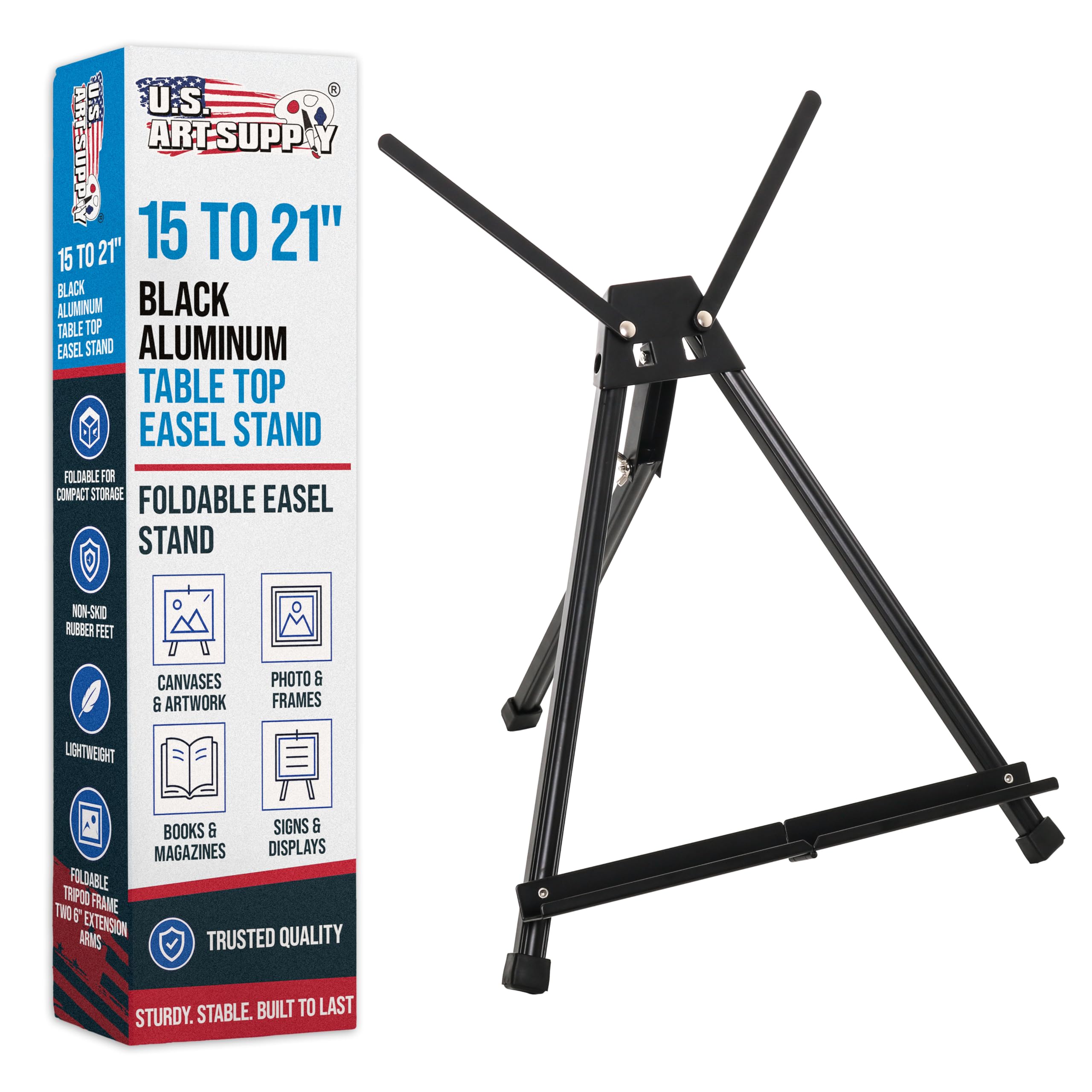
U.S. Art Supply Cabrillo Easel

94 /100
Keeper Score Outstanding

Key details

Max Load
10 lb
Max Canvas
24" x 30"
Folded Size
3.75"W x 2.5"D x 16"H
Height Range
15" to 21"
Check Price on Amazon

Sixteen inches long and about a pound, the Cabrillo folds into something you can drop in a tote beside a sketchbook. Open the tripod, set the rear leg, and the mast adjusts from 15 to 21 inches — that's the entire setup.

What makes it our overall pick is how much it does inside that small frame. Two six-inch arms at the top and a shelf below hold a 16x20 canvas, a framed print, or a dry-erase board steadily enough for a paint-night class, and the rubber feet keep it from skating across a table while you work. There's nothing to assemble either; it arrives ready and folds flat again in seconds.

Small pieces are fussier than large ones: a postcard-sized panel can slip between the two top arms instead of seating against them, so keep a clipboard nearby for thumbnail work. It's also a stand rather than a drafting board — the face tilts back, never down toward your lap.

Take it to a class, set it on a kitchen counter, or leave it on a studio shelf. Nothing about it needs negotiating, and that — light, quick, steady enough for real work — is why the rest of this list has to argue against it.

Pros

  • Folds to 16 inches and weighs about a pound
  • Holds a 16x20 canvas or framed print steadily
  • Arrives assembled and opens in seconds
  • Rubber feet protect tabletops and stop sliding

Cons

  • Caps out at 24 x 30 inches and 10 pounds
Our verdict

Our overall pick: a pound of aluminum that sets up in seconds and holds a 16x20 steady for painting, sketching, or display. Buy it if you work at a table.

Check Latest Price
2

Best Floor Easel

abitcha 66-Inch Easel Stand

90 /100
Keeper Score Outstanding

Key details

Max Load
25 lb
Height Range
17" to 66"
Folded Length
17"
Max Canvas Height
38"
Check Price on Amazon

Seventeen inches to sixty-six is the whole case for this one. Drop the mast and it sits on a desk for sketching; raise it and you're standing at a canvas at eye level. That range is the reason it's our floor pick for anyone who hasn't settled on how they like to work.

The rest is sensible tripod design: a spring-loaded top clamp, a shelf that takes canvases up to 38 inches tall, legs that adjust independently for uneven ground, and a shoulder bag for the yard or the park. It folds to 17 inches, so it lives in a closet rather than a studio.

Where it gives is the joints. Set the mast near full height, lean into a stroke, and the legs can shift under the pressure — this easel wants a light hand and a lower setting rather than the tallest one it will reach. We found that an acceptable trade for the range it covers; if you paint wet with a loaded brush, keep the mast down and the legs spread wide.

Pros

  • Adjusts from 17-inch tabletop to 66-inch floor height
  • Holds canvases up to 38 inches tall
  • Carry bag with shoulder strap for outdoor sessions
  • Independent legs cope with uneven ground

Cons

  • Holds canvases only up to 38 inches tall
Our verdict

For standing at a big canvas or sitting at a small one, this is the floor easel we choose: the 17-to-66-inch range does both, as long as your brush hand stays light.

Check Latest Price
3

Best for Kids

Joyooss Kids Wooden Easel

95 /100
Keeper Score Outstanding

Key details

Boards
Magnetic whiteboard and chalkboard
Frame Material
Pine wood
Height Settings
39.57", 46.61", 50.12"
Paper Roll Width
15 inches
Check Price on Amazon

Fifty inches is tall for a kids' easel, and that top setting is what separates this one from the rest of the wooden crowd. Most children's easels here stop somewhere around 43 to 46 inches; the Joyooss has three positions — 39.57, 46.61 and 50.12 inches — and reaches the highest of them with room to spare.

The rest of the package is complete: a magnetic dry-erase board on one side, a chalkboard on the other, a 15-inch paper roll across the top, and chalk, markers, and a storage bag in the box. The pine frame goes together without drama and the instructions are clear enough to follow at a glance.

One detail that isn't in those instructions: both boards arrive under a protective film that fights you on the way off. Peel it before a child sees the easel, or you'll be picking at a corner while someone asks whether it's ready yet.

Durability is the honest caveat. A pine easel with adjustable joints takes a beating from a four-year-old, and the frame is where the wear will show first rather than the boards. For a child who'll use it most days through the preschool years, that's a fair trade — and the height range is what makes it the pick.

Pros

  • Three heights up to 50.12 inches
  • Magnetic whiteboard and chalkboard with paper roll
  • Chalk, markers, and a storage bag included
  • Goes together quickly with clear instructions

Cons

  • Paper roll takes only 15-inch widths
Our verdict

For a growing artist, this is the kids' easel we steer parents toward: it reaches 50 inches, so it keeps working after preschool, and the boards and roll are ready on day one.

Check Latest Price
4

Best for Sketching

Falling in Art Drafting Easel

92 /100
Keeper Score Outstanding

Key details

Weight
1.9 lb
Material
European beech
Board Size
16 1/2" x 12 1/8"
Angle Settings
5, flat to 68°
Check Price on Amazon

Five settings, from flat to 68 degrees, on a beech board measuring 16 1/2 by 12 1/8 inches. That makes it a drafting tool rather than a stand, and we think it's the most useful thing on a desk for anyone whose work happens on paper — lettering, diamond painting, pastel, watercolor studies.

The board is solid European beech with rubber feet, and at 1.9 pounds it moves between the kitchen table and the studio without complaint. It arrives assembled, which is more than several easels here can say, and the surface is smooth enough that tracing paper lies flat on it.

The underside isn't a solid panel, so treat it as a tabletop board and not a lap desk: braced against a table edge it's steady, balanced across your knees it isn't. On a polished table it can also walk a little as you work, and a strip of non-slip matting under the feet does more than the feet manage alone.

Pros

  • Five angles from flat to 68 degrees
  • Solid beech board with a smooth drawing surface
  • Under two pounds and arrives assembled
  • Rubber feet protect the table

Cons

  • Small board for anything beyond paper and panels
Our verdict

For drawing, lettering, and diamond painting, this is the desk board we reach for: five angles, real beech, and a working area you can leave set up.

Check Latest Price
5

Best Portable Sketchbox

Miratuso Tabletop Sketchbox Easel

90 /100
Keeper Score Outstanding

Key details

Storage
Removable compartment dividers
Material
Beech wood
Folded Size
14.5" x 10.5" x 3.5"
Max Canvas Height
21"
Check Price on Amazon

A sketchbox that opens into an easel solves two problems at once: where the brushes live between sessions, and what the canvas leans on. Folded, the Miratuso is 14.5 by 10.5 by 3.5 inches — briefcase-sized — and the lid props a small canvas at a workable angle. We think it's the pick for anyone who paints away from home.

The box is hand-sanded beech with plated hardware and rubber feet, and the interior dividers lift out, so you can configure it around tubes instead of around compartments. It swallows around 20 paint tubes along with brushes and a small sketchpad, and the feet keep it from marking a borrowed table.

The lid takes a beat to seat properly when you close the box up — fine for an adult, fiddly for a small child — and that's the only fuss in the thing. For a class, a workshop, or a corner of somebody else's kitchen, it's the least ceremony we've found for carrying a working setup.

Pros

  • Converts from supply box to easel in one motion
  • Removable dividers keep brushes and tubes organized
  • Folds to a briefcase-sized 14.5 by 10.5 by 3.5 inches
  • Hand-sanded beech with smooth edges

Cons

  • Max canvas height is 21 inches
  • Interior fits tubes and brushes, not bottles
Our verdict

For classes and painting away from home, this is the sketchbox we take: it carries its own supplies and sets up wherever you can sit.

Check Latest Price
6

Display and Posters

RRFTOK Adjustable Easel Stand

89 /100
Keeper Score Excellent

Key details

Material
Aluminum
Max Load
10 lb
Max Canvas
36" h x 1.2" d
Height Range
17" to 66"
Check Price on Amazon

The legs don't lock. That one fact decides what this easel is for: it will hold a poster, a finished canvas, or a presentation board at whatever height you set, but it isn't the stand to lean into while you paint.

What it does well is height and travel. Seventeen to 66 inches covers a tabletop demo and a floor display, the telescoping legs cope with uneven ground, and it folds into a pouch you can carry in one hand. Canvases up to 36 inches tall and 1.2 inches deep sit in the clamp without complaint.

Our call: buy it for display — market stalls, classroom demos, a poster at the back of a booth — where light and adjustable are virtues rather than compromises. Buy it for painting and you'll spend the session chasing it around the room. Two easels in one closet is often the honest answer, and this is the display half.

Pros

  • 17 to 66 inches covers tabletop and floor use
  • Folds into a pouch for carrying and storage
  • Telescoping legs handle uneven ground
  • Holds canvases up to 36 inches tall

Cons

  • Light enough to tip with a bump
  • Tray is flimsy under a load of supplies
Our verdict

We recommend it for posters, stalls, and demo tables, where its height range and light weight earn their keep — not for painting with a real brush.

Check Latest Price
7

Preschoolers

Hape All-in-1 Kids Easel

95 /100
Keeper Score Outstanding

Key details

Included
3 paint pots and holders
Surfaces
Chalkboard, magnetic whiteboard, paper roll
Age Range
3+ years
Height Range
37.5 to 43.5 inches
Check Price on Amazon

Three paint pots and their holders come in the box, and they're the detail that makes this easel work for a three-year-old: paint sits where a small arm can reach it, and the tray underneath catches what misses.

We like it best for the preschool years, when a child is painting more than drawing. A magnetic whiteboard on one face and a chalkboard on the other means two children can work at once, and the height adjusts from 37.5 to 43.5 inches — low enough at the bottom setting for a three-year-old standing on the floor.

Assembly is a short job with a screwdriver, and the boards go on square. Tighten the screws to snug and no further: past that point they spin in the wood, and a stripped screw is the one thing likely to send you looking for a drill.

Pros

  • Three paint pots sit within a child's reach
  • Double-sided chalkboard and magnetic whiteboard
  • Height adjusts from 37.5 to 43.5 inches
  • Two children can paint at once

Cons

  • Tops out at 43.5 inches
  • Wood frame can crack after months of use
Our verdict

For a first easel, this is the one we point to: paint in reach, two work surfaces, and a low setting a three-year-old can actually use.

Check Latest Price
8

Two Children

Melissa & Doug Deluxe Standing Easel

91 /100
Keeper Score Outstanding

Key details

Size
47" H x 27" W x 26" L
Weight
15 lb
Included
2 trays, 4 clip grips, paper cutter, roll holder
Surfaces
Dry-erase board and chalkboard
Check Price on Amazon

Forty-seven inches tall and 15 pounds, this is the biggest kids' easel in the group, and the width is the point. Two children can stand at opposite sides with their own trays and never touch elbows, which is rarer than the double-sided label suggests.

The kit is unusually complete: two large plastic trays, four clip grips, a locking paper roll holder, and a child-safe paper cutter on the roll. The cutter sounds like a gimmick until you've watched a four-year-old try to tear paper straight.

Assembly is the friction point. The instructions are inconsistent about which piece is which, and the first hour is slower than it should be for a piece of furniture this simple. Sort the hardware into a muffin tin and build it on a soft floor, and the job goes better.

If you have a corner for it and two children who'll use it daily, the size and the trays justify the premium over the smaller wooden easels here. If only one child will use it, a narrower easel does the same job and takes less of the room.

Pros

  • Two large trays hold real supplies
  • Locking paper roll with a child-safe cutter
  • Wide enough for two children at once
  • Height adjusts as children grow

Cons

  • Board screw holes don't always line up with the frame
Our verdict

If two children will share it, this is the kids' easel we point to: wide enough to stand side by side, with trays that hold real supplies.

Check Latest Price

How We Tested Art Easels

We started with roughly 60 easels on the market and read the one- and two-star reviews first, looking for complaints that repeated: knobs that stripped, trays that wouldn't sit level, hinges that loosened within a month. Filtering by material, size, adjustable range, and price left us with 14 to order and test.

Every easel arrived flat-packed. We timed the first assembly with the instructions face-down, then took it apart and built it again the right way, noting which hardware needed two hands and which joints had room to shift. We raised and lowered every adjustable mast, leg, and tray a dozen times, marking whether the lock bit down or slipped, and set a square against the board to see if it sat true or canted to one side.

Then we worked on them for real. Tabletop models went on a kitchen table during a weekly drawing session; the aluminum tripods came to a park and a craft fair, once as a painting stand and once holding a sign; the kids' easels went into a playroom with a four-year-old and a nine-year-old. We watched whether canvas crept under pressure, whether a bumped elbow set the whole frame rocking, and whether a heavy board made the tray bow.

Six months in, we checked every knob, hinge, and leg joint again, folded each one back into its bag or against a wall, and asked whether the extras — paper rolls, paint pots, storage compartments — were things anyone would actually use. Value came down to that, plus a simpler measure: the easel we reached for on a rainy Saturday without thinking about it was rarely the most expensive one.

How to Choose an Art Easel

Sit or stand: the height range decides it

A tabletop easel's height is measured from the table, not the floor. A 21-inch mast on a 30-inch counter puts the middle of a canvas near eye level for a seated adult, which is why tabletop models suit sketching, watercolor, and small canvases; a mast that reaches 66 inches is a floor easel you stand at. The trap is the top of any range: an easel set at its maximum extension is at its least stable, so buy for the height you'll actually work at rather than the tallest number on the box.

Match the easel to your canvas, not your ambition

Capacity gets stated two ways — the largest canvas and the load it carries — and both matter. A tripod rated for 10 pounds will hold a mounted 16x20 comfortably; if you work on stretched 24x36, look for something rated at 25. Depth counts too: a clamp with about an inch of jaw won't take a deep gallery-wrap canvas.

Solid tabletop boards are a different calculation, because the working area is the board itself. Anything much bigger than 16 by 12 hangs over the edge and has nothing to lean on, so a drafting board is for paper and panels, not for paintings at scale.

Stability is the specification nobody prints

Every easel claims stability; the difference shows up in the joints and the feet. Friction-locked or locking legs, rubber feet, and a wide tripod spread are what keep a canvas still while you press on it. Light aluminum tripods are excellent for display and frustrating for painting with a loaded brush — that is the single most useful split in this category.

If you paint standing and work wet, the heavier stand is worth the extra outlay. If you're holding a poster at a market stall, the light one wins and the wobble never matters.

Folded length, storage, and the space it takes

Measure folded length before you order, not open height. The most portable tabletop models fold to around 16 inches and weigh about a pound, which makes them tote-bag objects; a wooden children's easel is furniture and wants a corner it can stay in.

On-board storage is the other half of the decision. A sketchbox keeps tubes and brushes inside the same object you carry, while a children's easel's trays put paint where a small hand can reach it without a trip to the cupboard.

Choosing an easel for a child

Three things decide it: the lowest height setting, the surfaces, and what's in the box. A three-year-old needs a board low enough to reach while standing on the floor — around 37 to 40 inches is the working range — and you want the top of the adjustment past 46 inches if the easel is going to last beyond kindergarten.

Paper rolls are not universal, so check the refill width before you commit to a model. Frames and adjustable joints do wear under daily use; assume a few good years rather than a decade, and you'll be pleased rather than disappointed.

Frequently Asked Questions

Final Verdict

If you're setting up at a table, the U.S. Art Supply Cabrillo is the one we recommend. It weighs about a pound, arrives assembled, and holds a 16x20 canvas or a framed print steadily enough for a class or a display — for less than most of the other picks on this list.

You need to stand at a canvas, the abitcha's 17-to-66-inch range is the reason to choose it; just keep the mast below its limit when you're painting wet. And if the easel is for a child, the Joyooss's 50-inch top setting is what keeps it useful after preschool ends.