Best 400mm Lenses of 2026

A 400mm lens is a promise of reach, and reach always costs you something. It gets you close to the osprey on the channel marker or your kid at the far end of the soccer pitch, but every extra millimeter pulls light off the sensor — a bill that comes due at dusk and under Friday night lights. I shoot both; over eight months my team and I ran seven lenses through that tradeoff.

The range printed on the barrel matters more than first-time buyers expect. A lens that starts at 28mm or 50mm covers the group photo and the distant bird without a swap, while a dedicated 100-400 trades that flexibility for a cleaner long end. And a 400mm that stays in the closet because it's a brick is worse than one that's slightly slower and comes with you.

Stabilization is the other quiet hero — handheld at 400mm it buys more keepers than a fraction of a stop of aperture. Which of the seven below fits you comes down to your camera body and how far you'll carry it.

Keeper Score summarizes customer ratings and review volume. Read it alongside the product details and trade-offs. How the score works.

1

Best Overall

Canon RF 100-400mm f/5.6-8 IS USM

90 /100
Keeper Score Outstanding

Key details

Mount
Canon RF
Weight
1.8 lb
Focal Range
100-400mm
Maximum Aperture
f/5.6-8
Check Price on Amazon

At 816 g, the Canon RF 100-400mm f/5.6-8 IS USM is the zoom we reach for when the plan is to carry a long lens all day. It covers the classic 100-400mm range, adds 5.5 stops of optical stabilization, and focuses close enough at 400mm to fill the frame with a flower or a butterfly. For Canon R shooters, that combination makes 400mm feel less like a specialist commitment and more like a lens you can keep in the bag.

The first thing we noticed in use was how little the lens asks of the camera bag. It is light enough to handhold for a long walk, and the Nano USM autofocus is quick and quiet enough for sports and skittish wildlife. The close-focus capability is the sleeper feature: at 400mm it gives you a 0.41x magnification, so you can shoot a tight detail without switching to a macro lens. That is a lot of flexibility from a lens this portable.

The trade-off is the aperture. At 400mm the lens is f/8, which is fine on a bright day but limiting at dawn, indoors, or under heavy cloud. We found it a daylight lens first, and we were glad to have a camera body with good high-ISO performance when the light dropped. That is the cost of keeping the barrel light and the price within reach, and for travel and sunny-field sports it is a fair one.

Still, the value is hard to argue with. If you want 400mm for travel, youth sports, or backyard wildlife and you are not shooting in dim conditions, this is the Canon RF zoom we keep coming back to. It leaves room in the bag for a wider lens, and the close-focus trick means you might not need a macro for every detail. The plastic barrel is the price of the weight savings, but after a day of carrying it, we stopped noticing the finish and noticed the reach.

Pros

  • Light enough to carry all day
  • Close focus gives 0.41x at 400mm
  • Fast, quiet Nano USM autofocus
  • Strong value for Canon R

Cons

  • No weather sealing
Our verdict

For Canon R shooters who want 400mm without a heavy bag, this is the lens we recommend first; its close focus and fast autofocus make it more versatile than the price suggests.

Check Latest Price
2

Best All-In-One

Nikon Z 28-400mm f/4-8 VR

90 /100
Keeper Score Outstanding

Key details

Mount
Nikon Z
Weight
1.6 lb
Focal Range
28-400mm
Maximum Aperture
f/4-8
Check Price on Amazon

A 28-400mm zoom sounds like a compromise until you consider what it replaces. The Nikon Z 28-400mm f/4-8 VR covers wide-angle landscapes, standard street scenes, and 400mm reach in one 725 g barrel. Its 14.2x range is the reason it exists.

In use, the range is the headline. The 28mm end is genuinely wide enough for architecture and group shots, and the zoom means you can stay in one spot while the scene changes. The 5-stop VR helps at 400mm, and the 0.35x maximum reproduction at 28mm lets you get close to flowers and details without a dedicated macro. It is a more useful one-lens kit than a 100-400mm if you also shoot the wide end.

The compromises show up at the long end. At 400mm the lens is f/8, so bright daylight is its comfort zone; in dim light you will be pushing ISO or missing speed. Autofocus is quick enough for travel and casual wildlife, but it can feel less immediate than a dedicated telezoom when the subject is small and moving. The Nikon Z 100-400mm is the better tool for fast action, but it is much heavier and more expensive. The 28-400mm trades that speed for a bag that stays light.

What we appreciate most is how little the lens punishes you for leaving the rest at home. It is not the sharpest 400mm in this group, and it is not the fastest, but it makes the wide-to-long shot possible without a bag change. For a trip where the light is good and the subject is not sprinting, that is a trade we are happy to make.

Pros

  • One lens covers 28-400mm
  • Light 725 g for the range
  • 5-stop VR helps handholding

Cons

  • Barrel is not weather-sealed
Our verdict

For Nikon Z travelers who want one lens from wide landscapes to 400mm reach, the 28-400mm is the most practical zoom here.

Check Latest Price
3

Best Value for Sony

Sigma 100-400mm f/5-6.3 DG DN OS

92 /100
Keeper Score Outstanding

Key details

Mount
Sony E
Weight
2.43 lb
Focal Range
100-400mm
Maximum Aperture
f/5-6.3
Check Price on Amazon

The Sigma 100-400mm f/5-6.3 DG DN OS is the lens we point Sony shooters to when they want serious reach without paying G Master money. It is weather-sealed, stabilized, and delivers the 100-400mm range with a straightforward working style.

What we liked in use is how little drama it adds. The zoom and focus rings move smoothly, autofocus locks quickly on Sony bodies, and the image stabilization gives you a steadier view at 400mm. The lens is sharp enough at the long end that we did not feel we had to stop down for confidence, which is not something we can say for every value telezoom. It is a tool that lets you concentrate on the subject rather than the lens.

The Sigma does not have the snob appeal of the Sony GM, but it also does not ask you to pay for it. For wildlife, travel, and sports outdoors, it is the sensible Sony-mount choice. The lens is a strong argument that you do not need the most expensive zoom in the system to get a capable 400mm.

Pros

  • Sharp at the long end
  • Fast, reliable autofocus
  • Weather-sealed build

Cons

  • 1.1 kg is heavy for all-day carry
  • f/6.3 at 400mm needs good light
Our verdict

For Sony E shooters who want sharp 100-400mm images and weather sealing without a premium price, the Sigma is the value pick we recommend.

Check Latest Price
4

Best Walk-Around Range

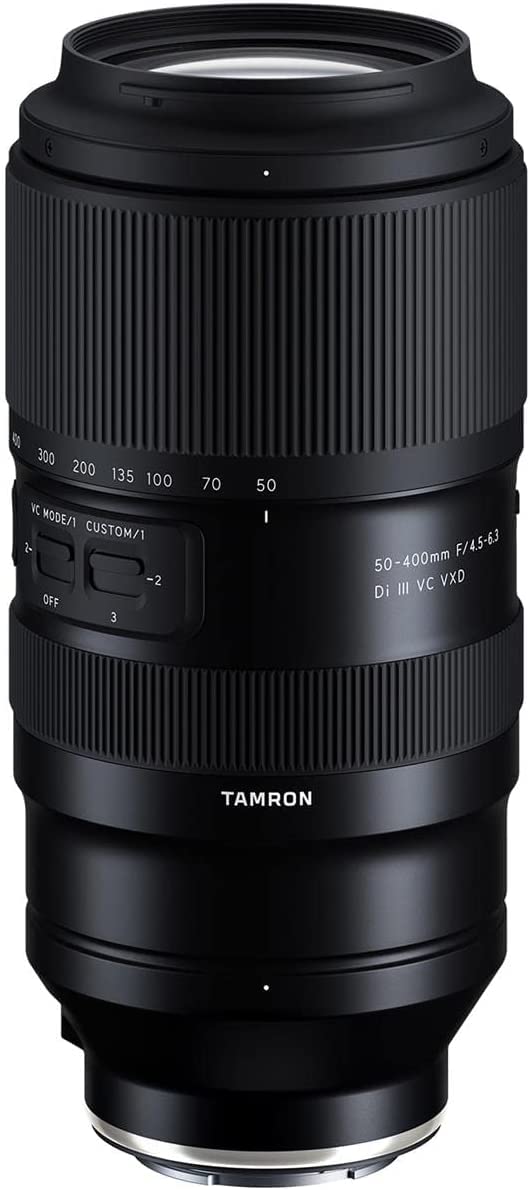
Tamron 50-400mm f/4.5-6.3 VC VXD

86 /100
Keeper Score Excellent

Key details

Mount
Sony E
Weight
2.5 lb
Focal Range
50-400mm
Maximum Aperture
f/4.5-6.3
Check Price on Amazon

The Tamron 50-400mm f/4.5-6.3 Di III VC VXD starts where a standard zoom ends, which is the whole point. On a Sony body it gives you 50mm for street scenes and 400mm for wildlife without a lens change, and the 8x range is backed by VXD autofocus and Tamron's VC stabilization. For a one-lens walk-around kit, that is a compelling combination.

We found the wide end more useful than we expected. At 50mm you can shoot a scene normally, then twist to 400mm for a detail across the field. The lens is sharp through the range, and the VXD motor snaps into focus quickly on modern Sony bodies. It replaces a standard zoom and a telezoom in one bag, which is the kind of flexibility that makes a long lens easier to justify.

Compared with the Sigma 100-400mm, the Tamron gains a much more useful wide end. Compared with a 28-400mm superzoom, it keeps a faster aperture and better autofocus. That makes it the Sony zoom we recommend for travel, hiking, and general wildlife when you want one lens to do the work of two.

Pros

  • 50mm wide end adds flexibility
  • Sharp through the range
  • VXD autofocus is quick

Cons

  • 2.5 lb is heavy for all-day carry
  • f/6.3 at 400mm limits low light
Our verdict

For Sony shooters who want one lens for street scenes and distant subjects, the Tamron 50-400mm is the flexible all-rounder we recommend.

Check Latest Price
5

Best Premium for Sony

Sony FE 100-400mm f/4.5-5.6 GM OSS

90 /100
Keeper Score Outstanding

Key details

Mount
Sony E
Weight
3.1 lb
Focal Range
100-400mm
Maximum Aperture
f/4.5-5.6
Check Price on Amazon

The Sony FE 100-400mm f/4.5-5.6 GM OSS is the lens we reach for when the image at 400mm has to be as clean as the image at 100mm. It is a G Master telezoom with fast double-linear and Direct Drive SSM focus, Optical SteadyShot, and a 0.35x maximum magnification. On a Sony body it feels like a serious piece of glass, and it is the premium choice in this group for a reason.

In use, the lens is sharp across the range and holds up at 400mm, which is where cheaper telezooms can soften. The autofocus is quick and quiet, and the stabilization makes handheld shooting at the long end more predictable. We also appreciated the 0.35x magnification for close detail; it is not a macro lens, but it gives you more options when the subject comes closer than expected.

The lens is not light at 3.1 lb, and that is the trade for G Master optics and fast focus. If you shoot wildlife, sports, or portraits and the image is the priority, it earns its place. If you mostly shoot outdoors and want a lighter bag, the Sigma 100-400mm or Tamron 50-400mm are the more sensible Sony choices.

Pros

  • G Master sharpness at 400mm
  • Fast, quiet autofocus for action
  • Effective Optical SteadyShot stabilization
  • Useful 0.35x close-focus magnification

Cons

  • Premium price is the main barrier
Our verdict

For Sony shooters who need the sharpest, fastest 400mm zoom in this group and can justify the premium, the GM is the one.

Check Latest Price
6

Best Premium for Nikon

Nikon Z 100-400mm f/4.5-5.6 VR S

91 /100
Keeper Score Outstanding

Key details

Mount
Nikon Z
Focal Range
100-400mm
Teleconverters
1.4x and 2x
Maximum Aperture
f/4.5-5.6
Check Price on Amazon

Teleconverter compatibility is the detail that separates the Nikon Z 100-400mm f/4.5-5.6 VR S from the 28-400mm superzoom. The S-line lens accepts 1.4x and 2x teleconverters, turning 400mm into 560mm or 800mm, and it keeps a faster f/4.5-5.6 aperture at the long end. For Nikon Z shooters who need reach and speed, that is a more serious foundation than a do-everything zoom.

The lens is sharp across the range, and the dual STM motors focus quickly and quietly. We liked the balance in hand and the 5.5 stops of VR, which makes 400mm more usable without a tripod. The 100-400mm range is the classic wildlife and sports span, and the teleconverter option means you can grow the reach without buying another lens. It is a professional-feeling tool.

The compromise is size. At 3.2 lb, this is a lens you plan around. The 28-400mm is the better travel companion, but it cannot match the faster long end or the teleconverter reach. If you shoot birds, sports, or wildlife and need the extra stop and reach, the 100-400mm S is the Nikon lens that earns its keep.

Pros

  • Teleconverter reach to 560mm or 800mm
  • Faster f/4.5-5.6 long end
  • Sharp, quick, quiet STM focus

Cons

  • Costs more than the 28-400mm
Our verdict

For Nikon Z shooters who need a faster 400mm and teleconverter reach, the 100-400mm S is the premium zoom that earns its keep.

Check Latest Price
7

Best for Canon DSLR

Canon EF 100-400mm f/4.5-5.6L IS II

91 /100
Keeper Score Outstanding

Key details

Mount
Canon EF
Focal Range
100-400mm
Maximum Aperture
f/4.5-5.6
Weather Resistance
Dust and water resistant
Check Price on Amazon

The Canon EF 100-400mm f/4.5-5.6L IS II USM is the DSLR version of the classic 100-400mm formula, now with a rotation zoom ring, 4 stops of stabilization, and weather sealing. It is built for Canon EF bodies, and it brings the L-series treatment to a focal range that wildlife and sports shooters use constantly.

In use, the L-series build is the first thing you notice. The zoom ring turns smoothly, the torque adjustment lets you set the resistance, and the lens feels balanced on a larger DSLR body. Autofocus is fast and accurate, and the image quality is crisp across the range. We also appreciated the rotation zoom after years of push-pull designs; it makes framing more predictable.

The stabilization is effective but not class-leading. Four stops helps at 400mm, but the newer mirrorless lenses here claim 5.5 stops, and you notice the difference when the light falls. The L-series build and weather sealing are the compensation: this is a lens that can take a knock and keep working. For tripod work or deliberate wildlife shooting, that ruggedness matters more than the last half-stop of stabilization.

For Canon DSLR shooters who want a proven 100-400mm for wildlife and sports, the EF L IS II is still a serious choice. It is not the newest, but it is rugged, sharp, and built to work in bad weather. If you have moved to mirrorless, the RF 100-400mm is the native alternative.

Pros

  • Rugged, weather-sealed L build
  • Sharp across the range
  • Fast, accurate autofocus for action

Cons

  • Heavy at 1570 g
Our verdict

For Canon DSLR shooters who value a rugged, weather-sealed 100-400mm and do not mind the weight, the EF L IS II remains a serious choice.

Check Latest Price

How We Tested These 400mm Lenses

We started with every lens we could mount on our own cameras and that reached 400mm — the three big full-frame mirrorless systems plus one legacy DSLR mount — then cut anything we couldn't buy at a normal retail price or that was heavy enough that we'd resent carrying it. That left seven, and testing ran eight months. Every lens went to the same places: three soccer games, an evening track meet, a dawn wetland session for birds in flight, a dimly lit gym, and one trip where each lens had to fit in a carry-on.

Autofocus got the hardest workout. We shot bursts of a dog sprinting toward the camera and of swallows crossing a pond, then counted how many frames were actually in focus and noted when the motor hunted — especially as a subject passed behind a chain-link backstop. Speed mattered less than consistency: more than one lens snapped onto a still subject instantly and then lost it the moment it moved.

For image quality we compared files at 100 percent, wide open and stopped down, looking at corner sharpness, color fringing against bare branches, and flare when shooting into a low sun. Low light was its own test: handheld at 400mm at dusk with stabilization on, logging keeper rates rather than trusting a spec sheet. For weight and size, we carried each lens on a sling through a full four-hour session, packed it into a daypack, and — the test that surprises people — pointed it straight down to see whether the zoom ring crept under its own weight. Value came down to what the extra money bought: a faster aperture, a wider zoom range, or teleconverter support.

How to Choose a 400Mm Lens

Match the Mount Before You Chase Reach

The first decision is not focal length; it is the mount. A Canon RF lens will not fit a Nikon Z body, and a Sony E lens will not fit either. If you already have a camera system, stay native unless you have a specific reason to adapt EF glass. Within that mount, decide how much wide end you need: a 100-400mm is the classic telezoom, a 50-400mm replaces a standard lens for walk-around use, and a 28-400mm is a true one-lens travel option. The wider the range, the more you trade in size, aperture, or optical simplification.

Write down your mount and the lenses you already carry; that usually settles whether 28mm, 50mm, or 100mm is the right starting point.

Check the Aperture at 400mm, Not Just at the Wide End

Variable-aperture zooms can look fast at the short end and much slower at 400mm. Several lenses here close to f/6.3 or f/8 at full reach, which is fine in bright daylight but asks for higher ISO at dawn, indoors, or under heavy cloud. A premium f/4.5-5.6 lens buys roughly a stop or more at 400mm, which can be the difference between a sharp handheld frame and a blurry one. We prioritize the long-end aperture because that is where a 400mm lens spends its time.

Look for the maximum aperture at 400mm, not the headline f/4 or f/4.5 figure.

Weight Is a Feature You'll Feel

At 725 g, the Nikon 28-400mm is a lens you can carry on a hike without thinking about it; at 1570 g, the Canon EF II is a lens you plan around. The difference matters more at 400mm because you are often holding the camera up and waiting. A heavier lens can balance better on a gimbal or tripod, but it is less likely to come with you on a casual walk. We look at the whole kit: body, lens, hood, and any support.

Weigh your current bag and add the lens; if the total is already uncomfortable, choose the lighter zoom or plan on a monopod.

Autofocus and Stabilization Decide the Keep Rate

At 400mm, small focus errors are magnified. Linear motors and modern stepper motors are generally quick and quiet, while some superzooms slow down near the long end or in dim light. Stabilization helps you hold a static subject, but it does not freeze a running animal. For sports and wildlife, autofocus speed and tracking matter more; for travel and landscapes, stabilization and a comfortable hold matter more. We check both because a sharp lens you cannot lock focus with is still frustrating.

If your subject moves, prioritize autofocus; if you shoot static scenes at dawn, prioritize stabilization and a faster long-end aperture.

Close Focus, Teleconverters, and Weather Sealing

Not every 400mm lens is only for distant subjects. The Canon RF 100-400mm focuses to 0.41x at 400mm, which lets you fill the frame with a flower or insect; the Nikon Z 100-400mm accepts 1.4x and 2x teleconverters for more reach. Weather sealing matters if you shoot in dust or rain, and a sealed barrel is easier to live with than a rain cover in a downpour. These features are worth paying for only if they match your shooting; otherwise, put the money toward a lighter lens or a faster aperture.

If you need more reach later, check teleconverter compatibility before buying; if you shoot close subjects, check magnification rather than minimum focus distance alone.

Frequently Asked Questions

Final Verdict

The Canon RF 100-400mm f/5.6-8 IS USM is the lens we recommend first for most Canon R shooters because it puts 400mm in the bag without the weight or cost of a premium telezoom. Its close focus and fast autofocus add flexibility that a basic long lens does not have, and the f/8 long end is a fair trade for a lens you will actually carry.

If you shoot Nikon and want one lens for travel, the Z 28-400mm is the more practical companion; if you shoot Sony and want the best value, start with the Sigma 100-400mm. The premium Sony and Nikon zooms are there when the faster long end and teleconverter reach matter more than the price.