Best 35mm Lenses of 2026

For years my bag held a 24mm and an 85mm, and I spent half of every shoot swapping between them while the light moved. The 35mm ended that. It's wide enough for a small room and long enough that faces don't stretch at the corners, which is why so many photographers leave one on the body and call it done. What it fixes is simple: one lens that covers most of a day without you backing into traffic.

Choosing between them is harder. A fast aperture buys low-light headroom and creamy background blur, but it also buys weight, money, and a thinner margin for focus error — and on a crop-sensor body a 35mm frames like a 50mm, so the same glass behaves differently depending on what you mount it to. We spent eight months shooting with eight 35mm primes across full-frame, APS-C, and a couple of older DSLRs, and the spec sheets flatten differences you notice the second you pick one up.

Some of those eight are built for video, some for carrying all day, some purely for image quality. The keepers are below.

Keeper Score summarizes customer ratings and review volume. Read it alongside the product details and trade-offs. How the score works.

1

Best Overall

Sony FE 35mm f/1.8

89 /100
Keeper Score Excellent

Key details

Mount
Sony E
Weight
9.9 oz
Aperture
f/1.8
Close Focus
8.66 in
Check Price on Amazon

The Sony FE 35mm f/1.8 is a 9.9-ounce full-frame prime with an f/1.8 aperture, a 9-blade diaphragm, and an 8.66-inch minimum focus distance. On paper it sits between the budget E-mount lenses and the much larger f/1.4 GM, and that is exactly where most Sony shooters want to be.

We found that balance is the point. It is light enough to carry all day, fast enough for indoor available light, and the linear motor snaps into focus without the hesitation that makes a budget prime feel cheap. The 0.24x magnification is not a true macro, but it is close enough for food, flowers, and detail shots that otherwise need a second lens.

Sharpness holds up wide open in our use, and the 9-blade aperture gives out-of-focus backgrounds a smooth, rounded look rather than a busy one. The caveat is chromatic aberration: high-contrast edges can show color fringing at f/1.8, especially toward the corners. Stop down a little and it cleans up.

The lens does not chase the GM's f/1.4 look, and it is not the cheapest E-mount option, but it is the least compromised everyday lens in this set. Color fringing is the one thing we notice; the rest of the time it disappears into the kit.

Pros

  • Balanced size, speed, and sharpness
  • Fast, quiet linear autofocus
  • Close focus for everyday details

Cons

  • Costs more than budget E-mount picks
Our verdict

This is the 35mm we recommend first for full-frame Sony: compact, quiet-focusing, and sharp, with close focus that covers everyday detail.

Check Latest Price
2

Best for Canon RF

Canon RF 35mm f/1.8 Macro

93 /100
Keeper Score Outstanding

Key details

Mount
Canon RF
Aperture
f/1.8
Magnification
0.5x
Stabilization
Up to 5 stops
Check Price on Amazon

The Canon RF 35mm f/1.8 Macro IS STM is the one lens here that can pull double duty as a walkaround prime and a close-up lens. Its 0.5x magnification and 0.56-foot minimum focus distance let you fill the frame with flowers, food, or product details without switching lenses. We think that makes it the most useful single lens for a Canon EOS R body.

The 5-stop optical stabilization is the other feature we appreciate. It helps in dim interiors and at slow shutter speeds when the subject is still. The lens is 10.88 ounces, compact enough for a small bag, and the control ring can be set to aperture, ISO, or exposure compensation.

Autofocus is the trade-off. It can hunt in low contrast, and the STM motor is audible enough that we notice it in quiet rooms. For still subjects, the close focus and stabilization are worth the patience. For fast-moving kids or street scenes, the Sony 1.8 is more decisive.

For Canon RF shooters who want one lens for everyday and close-up work, it is a strong value. The 52mm filter thread also keeps a polarizer or close-up filter from adding much bulk.

Pros

  • 0.5x macro close-up ability
  • Up to 5 stops of optical stabilization
  • Compact 10.88-ounce body
  • Customizable control ring

Cons

  • Not weather-sealed
Our verdict

For Canon RF shooters, we recommend this as the most versatile 35mm here: a compact walkaround lens that also focuses to 0.5x and stabilizes low-light shots.

Check Latest Price
3

Best Nikon DSLR Value

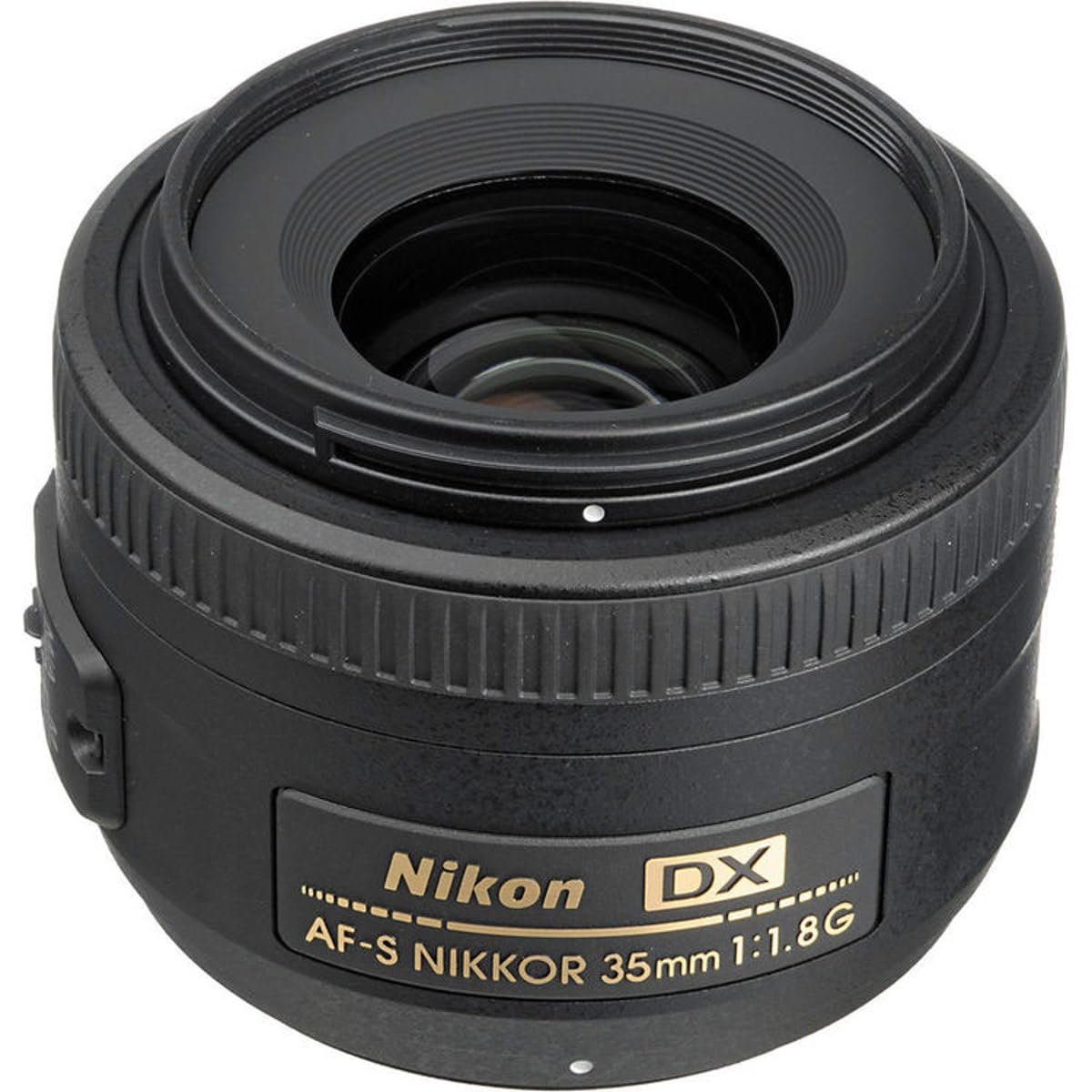
Nikon AF-S DX 35mm f/1.8G

96 /100
Keeper Score Outstanding

Key details

Mount
Nikon F (DX)
Weight
7.04 oz
Aperture
f/1.8
Angle Of View
44°
Check Price on Amazon

Nikon's AF-S DX 35mm f/1.8G is the affordable prime that turns a DX DSLR into a much more capable low-light camera. It is a 52.5mm-equivalent lens, so it behaves more like a normal prime than a wide 35mm, and that is exactly why it works so well for portraits, family photos, and everyday carry.

At 7.04 ounces, it adds almost nothing to the body. The f/1.8 aperture is the real draw: it lets in enough light for indoor shots without flash and gives a shallow depth of field that kit zooms cannot match. The silent wave motor is quiet in normal use, and manual focus override is available.

We think the value case is hard to argue with. Sharpness is the strongest part of the package, and it holds up in our use. The lens is simple and light, with a 7-blade diaphragm and a 44-degree angle of view on DX. On a DSLR, it is worth checking focus calibration if wide-open shots consistently land behind your subject.

The DX-only coverage is the main catch: on a full-frame Nikon it works only in crop mode, so you lose the wide 35mm field of view. For a DX shooter, the plastic barrel is a fair trade for the low weight and low cost.

Pros

  • Sharp wide-open images
  • Strong low-light performance
  • Light 7.04-ounce build
  • Quiet silent-wave autofocus

Cons

  • Autofocus speed can lag in low light
Our verdict

We recommend this as the default upgrade for Nikon DX shooters: a light, sharp f/1.8 prime that makes indoor and portrait photos look far more expensive than the lens.

Check Latest Price
4

Best Premium E-Mount

Sony FE 35mm f/1.4 GM

93 /100
Keeper Score Outstanding

Key details

Mount
Sony E
Weight
1.2 lb
Aperture
f/1.4
Diaphragm
11 blades
Check Price on Amazon

The Sony FE 35mm f/1.4 GM is the premium option in this group: an f/1.4 full-frame prime with an 11-blade diaphragm, two extreme aspherical elements, an ED element, Nano AR II coating, and a dust- and moisture-resistant barrel. At 1.2 pounds, it is not a featherweight, but it is compact for an f/1.4 lens.

The aperture is the reason to pay attention. It gives you a stop more light than the f/1.8 picks, which matters indoors and at dusk, and it makes background separation easier without moving closer. The 11-blade diaphragm keeps out-of-focus highlights round rather than polygonal.

Autofocus is fast and accurate in our use, and the lens stays sharp across the frame. The GM rendering has a smooth, corrected look that we like for portraits and environmental shots. It is also sealed against dust and moisture, which matters if you shoot outdoors.

We think this is the lens for a Sony shooter who knows 35mm is their main focal length and wants the extra aperture without a huge barrel. It is the one we reach for when the light is low and the background needs to fall away; the rest of the time, the smaller Sony 1.8 is easier to carry.

Pros

  • Bright f/1.4 aperture
  • Fast, accurate autofocus
  • Sealed, fluorine-coated build
  • 11-blade diaphragm

Cons

  • Highest price in this set
Our verdict

We recommend this premium 35mm for Sony shooters who live at f/1.4: fast focus, beautiful separation, and a sealed build in a surprisingly compact barrel.

Check Latest Price
5

Best Compact Macro for Sony

Tamron 35mm f/2.8 Di III OSD

89 /100
Keeper Score Excellent

Key details

Mount
Sony E
Weight
7.4 oz
Aperture
f/2.8
Magnification
1:2
Check Price on Amazon

The Tamron 35mm f/2.8 Di III OSD is the compact macro option for Sony E, and it makes a different trade than the fast primes. At 7.4 ounces and with 1:2 magnification, it is the lens you can leave on the camera for a walk and then use for a close-up of a leaf or a plate. We like that versatility more than the f/2.8 aperture suggests.

Sharpness is excellent, especially in the center, and the lens renders color cleanly. The 1:2 close focus is the standout, getting you much closer than the Sony 1.8. The moisture-resistant construction is a useful bonus for a lens this small.

Autofocus is the compromise. It is accurate for static subjects, but it is slow and the motor makes an audible click that you will notice in quiet rooms. For landscapes, products, and slow portraits, that is a fair trade. For kids or street scenes, the Sony 1.8 is the better tool.

If you want a small Sony 35mm for travel and close-up work, this is the one we recommend. The 67mm filter thread is a common size, so a polarizer or close-up filter is easy to find.

Pros

  • 1:2 macro close focus
  • Very light 7.4-ounce body
  • Sharp center and clean color
  • Moisture-resistant construction

Cons

  • Audible focus motor
  • f/2.8 aperture limits low light
Our verdict

For Sony shooters who want a tiny 35mm that also does close-ups, we reach for this one; its slow focus suits still subjects, not action.

Check Latest Price
6

Best for Nikon Z

Nikon NIKKOR Z 35mm f/1.4

85 /100
Keeper Score Excellent

Key details

Mount
Nikon Z
Weight
14.6 oz
Aperture
f/1.4
Close Focus
10.6 in
Check Price on Amazon

The Nikon NIKKOR Z 35mm f/1.4 is the faster, more atmospheric alternative to Nikon's f/1.8 prime. It is a full-frame Z lens with a 9-blade diaphragm, a silent STM motor, and a close focus distance of 10.6 inches. At 14.56 ounces, it is heavier than the f/1.8 lenses here but still compact enough for a walkaround kit.

The f/1.4 aperture is the point. It gives you more light for indoor and evening shots and a softer, more gradual falloff into the background. Nikon describes the bokeh as painterly, and our use supports the idea: the out-of-focus areas are smooth and the transition is natural rather than abrupt.

Sharpness is where we hesitate. Wide open, the lens can look softer than the best 35mm primes here, and high-contrast edges can show chromatic aberration. Stopped down, it sharpens up and the rendering becomes more controlled. We think that is a fair trade for the extra aperture, but it is a real one.

The silent STM motor is quick enough for everyday photos and quiet enough for video. The 62mm filter thread is a common size, which keeps a polarizer or ND filter easy to share.

Pros

  • Bright f/1.4 aperture
  • Silent STM autofocus
  • Close focus to 10.6 inches
  • Compact for an f/1.4 lens

Cons

  • Not weather-sealed
Our verdict

For Nikon Z shooters who want f/1.4 character and low-light speed, we recommend this one; stop it down for crisp edges.

Check Latest Price
7

Best Fujifilm Value

VILTROX 35mm f/1.7 X

89 /100
Keeper Score Excellent

Key details

Mount
Fujifilm X
Weight
6 oz
Aperture
f/1.7
Close Focus
0.33 m
Check Price on Amazon

The VILTROX 35mm f/1.7 X is a compact Fujifilm prime that costs less than most first-party options while still offering a bright f/1.7 aperture. It uses 11 elements in 9 groups, including two high-refractive, one ED, and one aspherical element, and it weighs 170 grams. On Fuji's APS-C sensor, it gives a 53mm-equivalent field of view.

We think that focal length is the first thing to understand. This is not a wide 35mm; it is a normal prime, close to the classic 50mm look. For portraits, street scenes, and everyday carry on a Fuji body, that is a useful place to be. The f/1.7 aperture gives you low-light headroom and soft background blur without a huge barrel.

Sharpness wide open is the strongest part of the performance. The STM motor focuses quickly and quietly for most subjects, and the 0.33-meter minimum focus distance lets you get reasonably close.

For Fuji shooters building a small prime kit, this is an easy lens to justify, as long as the 53mm-equivalent view suits their work. The included hood and pouch are a nice touch at this end of the market, and the 52mm filter thread keeps accessories small.

Pros

  • Bright f/1.7 aperture
  • Sharp wide open
  • Fast, quiet STM focus
  • Light 170-gram body

Cons

  • No weather sealing
Our verdict

We think this is the best value Fujifilm prime here: sharp wide open, quick to focus, and small enough to carry, as long as you want a 53mm-equivalent view.

Check Latest Price
8

Light Sony Budget

Rokinon AF 35mm f/1.8

89 /100
Keeper Score Excellent

Key details

Mount
Sony E
Weight
7.4 oz
Aperture
f/1.8
Filter Size
58 mm
Check Price on Amazon

The Rokinon AF 35mm f/1.8 is the featherweight of the Sony E-mount options. It weighs 7.4 ounces and measures 2.5 inches long, yet it covers full frame and opens to f/1.8. The barrel includes a custom switch that lets the focus ring control aperture or manual focus, and it is sealed against dust and moisture.

The linear stepping motor focuses quickly and accurately in our use, and the lens is sharp at f/1.8. The 9-blade diaphragm gives background blur a pleasant shape. For travel and street photography, the combination of low weight and fast focus is hard to beat.

The 9-blade diaphragm and f/1.8 aperture give background blur a pleasant shape, and the lens is sharp at f/1.8 in our use. It is not as clean as the Sony wide open: chromatic aberration can show on high-contrast edges, and the barrel feels more plastic.

We think this is the budget E-mount lens to beat if you want the lightest possible kit. It is not as refined as the Sony 1.8, but it costs less and weighs less. For a second body or a travel kit, that trade makes sense.

Pros

  • Very light 7.4-ounce build
  • Fast linear autofocus
  • Weather-sealed body
  • Useful custom switch

Cons

  • Chromatic aberration wide open
  • Noticeable focus motor noise
Our verdict

We recommend this as the budget Sony E-mount pick for travelers: full-frame, weather-sealed, and just 7.4 ounces, with sharp results and a few optical trade-offs.

Check Latest Price
9

Leica M Character

Voigtlander Nokton 35mm f/1.4 II

80 /100
Keeper Score Excellent

Key details

Focus
Manual
Mount
Leica M
Aperture
f/1.4
Filter Size
43 mm
Check Price on Amazon

The Voigtlander Nokton 35mm f/1.4 II is a manual-focus Leica M lens with a classic rendering and a very small barrel. It uses high-index glass and multi-coating, has a 10-blade diaphragm, and takes 43mm filters. It is the odd one out here: no autofocus and no weather sealing.

That list of omissions is also the appeal. On a Leica M body, the lens is small enough to disappear in a jacket pocket, and the manual focus throw is long enough for precise placement. The f/1.4 aperture gives a soft, glowing look wide open that is more characterful than clinical.

Stopped down, it sharpens up and the multi-coating keeps contrast high in backlight. The rendering is not as corrected as the modern Sony or Nikon primes, and that is the point. We like it for documentary, travel, and portraits where a little imperfection adds atmosphere.

Manual focus is the only option, so it is not the tool for fast-moving subjects or video autofocus. For a Leica M shooter, that is a familiar trade, and the long focus throw rewards a deliberate approach.

We think this is the character lens of the group: compact, solid, and capable of images that look different from the autofocus crowd. If you want a technically perfect 35mm, look elsewhere; if you want a small f/1.4 with personality, this is it. The optional LH-6 hood is worth adding if you shoot into the sun.

Pros

  • Compact, solid Leica M build
  • Classic f/1.4 rendering
  • Multi-coated glass for contrast
  • Smooth long-throw manual focus

Cons

  • No manufacturer's warranty
Our verdict

For Leica M shooters who want a compact f/1.4 with classic rendering, we recommend this character pick; it demands manual focus and a careful eye.

Check Latest Price

How We Picked and Tested These Lenses

The shortlist started with mounts. Every lens had to be native to a current mirrorless or DSLR system, and we mixed first-party glass with the third-party options that undercut it on price, since value came up again and again in owner reviews. That filter left eight lenses, full-frame and crop-sensor both, which we shot with for eight months.

They came with us: dim living-room birthday parties, dusk street walks, a rented studio, a two-day wedding, and a genuinely wet Saturday in the park. Each spent at least a week mounted on one body so we judged it as a walkaround rather than a novelty.

Sharpness got settled on a brick wall and a hedge of bare branches, shot wide open and again at f/2.8 and f/5.6, with corners compared at 100 percent on a calibrated monitor. For bokeh we photographed string lights at dusk and looked at whether highlights stayed round, whether they carried onion rings, and whether the background turned harsh behind a subject. Those same backlit branches against an overcast sky showed which lenses fringed purple at the edges.

Autofocus we timed by racking from a coffee cup a foot away to a fence post across the yard, in daylight and under one dim lamp, counting the hunts before it locked. To judge motor noise we recorded clips in a silent room with the on-camera mic and listened back on headphones. Versatility was the last check: a single lens had to handle a morning of landscapes, a lunch of food photos, and an afternoon of portraits without us wishing we'd brought something else.

How to Choose a 35Mm Prime Lens

Start With Your Mount and Sensor Format

A 35mm lens is only a wide-normal 35mm on a full-frame body. On Nikon DX, Canon APS-C, or Fujifilm X, the same focal length behaves like a 50mm-class normal lens, which is why the Nikon AF-S DX 35mm and Viltrox 35mm f/1.7 are portrait-and-everyday primes rather than street-wide lenses. If you want the classic 35mm field of view on APS-C, look for a 23mm lens instead. We put mount compatibility first for that reason; a great lens for the wrong system is simply the wrong lens.

Aperture: Speed, Blur, and Weight

The aperture decides how much light the lens gathers and how much background blur it can produce. An f/1.4 lens is roughly a stop faster than f/1.8, which helps indoors and at dusk, but it usually means more glass, more weight, and a higher price. The f/1.8 primes here are the sensible middle; the Tamron f/2.8 trades speed for a tiny, macro-friendly body. We prioritize f/1.8 for most people, and f/1.4 only when low light or shallow depth is the main reason for buying.

Autofocus and Handling

Autofocus is where a cheap prime can feel cheap. A lens that hunts in low contrast or clicks on video can cost you the shot, and the difference between a linear motor and a slower geared motor is obvious in use. Look for a quiet motor if you shoot people, events, or video; a focus hold button or AF/MF switch if you change settings often; and a smooth focus ring if you use manual override. The Sony 1.8 and GM are the quickest here, while the Tamron is accurate but deliberate.

Close Focus, Sealing, and Support

Close focus is the most underrated feature in a 35mm. A 0.5x macro like the Canon RF lets you fill the frame with a flower or a product detail without swapping lenses; the Sony 1.8's 0.24x is enough for food and flowers but not a true macro. Weather sealing matters if you shoot outdoors, and a manufacturer's warranty matters more with niche manual glass. We look at all three before recommending a lens for travel or daily carry.

Sharpness, Contrast, and Character

Every lens here is sharp enough for social media and most prints; the differences show up at wide apertures and toward the edges. A lens with strong correction, like the Sony GM, gives clean edges and controlled color fringing. A character lens like the Voigtlander trades some correction for glow and atmosphere wide open. We look for clean center sharpness at the aperture we use most, then decide whether edge perfection or rendering matters more. Stop down one stop before judging a lens's edge performance.

Frequently Asked Questions

Final Verdict

For most full-frame Sony shooters, the Sony FE 35mm f/1.8 is the one we recommend first. It is compact, focuses quickly and quietly, and stays sharp wide open, with enough close focus for everyday detail. Canon RF owners should choose the RF 35mm f/1.8 Macro for its stabilization and 0.5x close-up ability; Nikon DX shooters get the best value from the AF-S DX 35mm f/1.8G. The premium Sony GM is the step up only if f/1.4 is central to your work.